A Black Agenda Radio commentary by executive editor Glen Ford Americans imprison big, but they pardon very small. President Obama set a record by giving clemency to 1/2000th of the 2.3million U.S. prison inmates. The Brennan Center recommends release of 40 percent of inmates. But the Black Is Back Coalition calculates that even release of twice that many – 80 percent – would still maintain mass incarceration at 1973 levels. The whole damn system has to go, for Black folks to even get close to justice.
Obama’s Pardons Distract from the Horror of Mass Black Incarceration A Black Agenda Radio commentary by executive editor Glen Ford “The system is deliberately racist, brutal, arbitrary and malevolent.”
President Obama, a master of public relations, now has bragging rights for having granted clemency to a record number of federal prisoners – 1,176 of them , at last count, more than those set free by the past 11 presidents, combined. Looking at the number from a different angle, Obama released only one out of every two thousand of the nation’s 2.3 million prison inmates , the largest incarcerated population in the world, both in raw numbers and in the proportion of U.S. society living behind bars. In other words, Obama’s clemencies, like all other presidents’, are statistically meaningless and morally and politically distractive. But, of course, that’s what Obama’s good at – distracting people.
The incompetent, lazy and white supremacist corporate media forget, or never reported, that for several years the Obama administration delayed the release from prison of five times as many inmates as he pardoned: about 6,000 federal prisoners convicted under the old crack cocaine laws. A federal appeals court wanted to let them out, ruling that they were covered by a prison reform bill, but President Obama successfully argued to keep these men and women in prison. Several years later, Obama staged a huge public relations extravaganza, releasing many of these same inmates, supposedly out of the goodness of his heart. It was two years too late. Some never got out.
The Brennan Center for Justice released a study last month that concluded the U.S. could set free 39 percent of its prison population with no threat to public safety. The Brennan researchers argue that you can’t make a dent in the mass incarceration system unless whole categories of prisoners are made eligible for immediate release. They say 25 percent of the prison population should, instead, have been sentenced to drug treatment, community service, probation or a fine. Another 14 percent of inmates have already served enough time in prison, and are no longer a risk. Together, that comes to almost 40 percent of the prison population -- one and a half million people, about half of them Black.
“Not Even a Half-Way Measure”
Prison reformers seem to think the system can be made more rational and fair. They don’t seem to understand that the system is deliberately racist, brutal, arbitrary and malevolent -- it is not meant to be fair, and it cannot be reformed. Former Black Panther Sundiata Acoli turns 80 this month. He has been in a New Jersey prison since 1973 and first became eligible for parole in 1992, but was turned down by the parole board, which set his next parole hearing for 15 years from now , when Sundiata Acoli will be 95 years old.
This system is pure meanness and race-hate. The Brennan Center’s proposal to release almost 40 percent of prison inmates is, itself, not even a half-way measure. As the Black Is Back Coalition for Social Justice, Peace and Reparations points out in number five of its 19 point platform on Black self-determination, the United States would have to release 80 percent of its prison population -- four out of every five inmates -- just to bring the incarceration rate down to 1973 levels. And, remember: the U.S. was already the worst mass incarceration state in the world back in 1973. Even the release of four out every five inmates does not change the essential nature of American mass Black incarceration. There can be no compromise with such an evil.
For Black Agenda Radio, I’m Glen Ford. On the web, go to BlackAgendaReport.com.

 Tensions increase in the Red Sea and the Gulf of Aden.
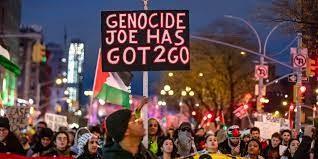 "Genocidal Joseph’s coat of many logos or Boss Tweet’s swastika sensibilities?" is the latest from BAR's Poet-in-Residence.
 In the U.S., a nation built on the enslavement and exploitation of humans, the system of slavery cannot be destroyed. It has merely changed from one form to another.
 Cedric Robinson's Black Marxism can be used as a tool to further expand our understanding of Israel's settler colonial domination over Palestine.
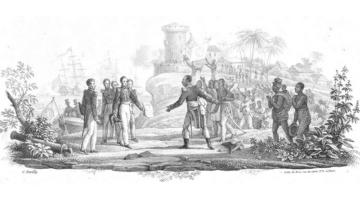 Black scholars have worked to challenge the accepted white supremacist imperialist historical narrative of colonialism and enslavement. The legacy of the Haitian Revolution sits at the center of this…


