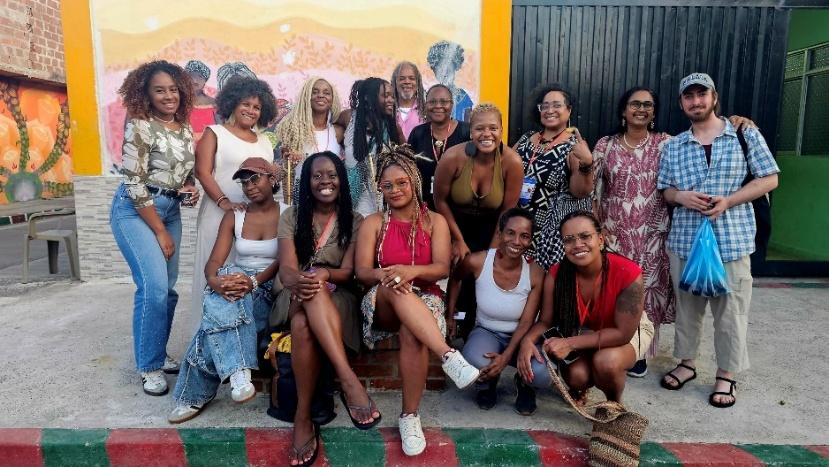
Afro-Colombian activists from Choco and Cartagena. December 2025
Colombia's constitution recognizes Black communities as collective rights-holders, but extractivism and dispossession have undermined those guarantees, so they built their own institutions to do what the state won't.
Across the Americas Afro-descendant women have played a fundamental role in the care economy, production, and community economics, and their contributions are impacted by racism and gender inequality (Economic Commission for Latin America and the Caribbean [ECLAC] & United Nations Population Fund [UNFPA], 2020). Approximately 200 million people of African descent live across the Americas (United Nations, n.d.). Latin America and the Caribbean is home to an estimated 153.3 million Afro-descendants, representing 23.7 percent of the region’s population (UNFPA, 2025, p. 3).
To counter business exclusion, Black diaspora women have been engaging in a plurality of economic systems through member-owned institutions (MOIs). These MOIs are the antidote to combat persistent forms of colonialism, racism, sexism, and structural violence. The 1991 Constitution and Law 70 of 1993 of Colombia does recognize Black communities as collective rights-holders, including rights to territorial ownership, cultural identity, and participation. These advances on paper have been undermined by a counter-reform and it limits Black people’s rights due to inadequate regulation, weak state protection, extractivism, dispossession, and targeted violence (Palacios Valencia, 2022). As a result, Afro-Colombians have had to rely on their ancestral knowledges of alternative and cooperative economic systems because mainstream capitalistic business are just elitist and exclusionary.
It was development scholar Arturo Escobar (2020, p. 25) who defined the pluriverse, as one that many economic systems have to exist and he reasoned that the Zapatista formulation, is how “a world in which many worlds might fit” is how people who refuse to be dominated can thrive. Pluriversal politics and economics recognizes multiple ways of knowing, being, organizing economic life, and defining collective well-being. Black economic exclusion in Colombia is rooted in racialized land concentration and plantation economies. Escobar (2020) shows how oil, palm, and sugarcane plantations displaced Black communities and replaced diverse community economies with monocultures organized around capital accumulation. This process has undermined Afro-Colombian territorial and economic autonomy while pushing many people into precarious, low-paying labour.
African women and their descendants have been compelled to develop a politics of place: “a praxis of appropriating, defending, and reconstructing a place that requires building practical knowledge of nature” (Lozano Lerma 2019, p. 108). Place is therefore not merely a physical setting, but a collective creation sustained through relationships among people, territory, and other living beings. Through these practices, Afro-Colombian women produce knowledge, organize care and economic life, build community, and defend the conditions necessary for collective survival. In Colombia, the Black Social Economy encompasses agriculture, fishing, artisanal mining, ancestral foodways, and local markets where Black people live and work. Daniel Tubb’s (2018) research further examines how Black communities in Chocó organize community-based economic and social structures rooted in territorio colectivo. The concept of territorio colectivo is how people counteract deep forms of racial capitalism and exclusion through intentionally building group businesses.
The Black Social Economy IS Cooperative Economics
Self-managed organizations based on collective labour like territorio colectivo have helped communities settle, build, and defend their livelihoods through diverse forms of work. In Liberating Economics: Feminist Perspectives on Families, Work, and Globalization, Barker, Bergeron, and Feiner (2021) argue that feminist economics is grounded in social provisioning where these goods improve women’s well-being and work lives, which can be challenging in a corporate economy. Economist Nina Banks (2020) has also found that African American women, a targeted minority, have had to organize themselves collectively not only in the care economy where they are not compensated but in terms of the activist labour they take on that remains unseen, everywhere.
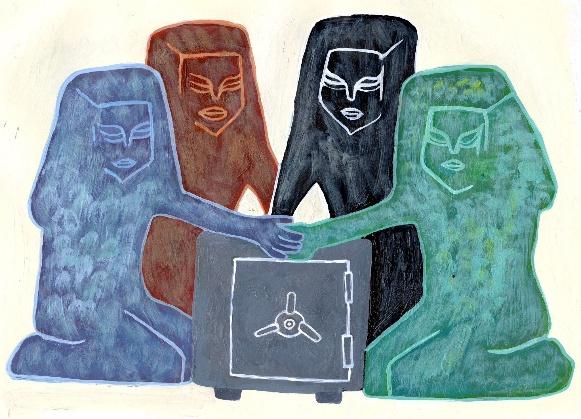
In Colombia, Black, Indigenous, and peasant movements demand attention to systemic and deeply rooted inequalities, as well as new economic alternatives, including access to land and transitions away from illegal economies (Truth Commission, 2022). In a compilation of stories in The Black Social Economy (2018), feminist political economist Caroline Shenaz Hossein finds that many economic initiatives undertaken by Black women in particular emerge in response to crises and racial capitalism. The Black Social Economy is membership-focused and often informalized on purpose—instead of waiting on hand-outs, these women create socially-minded businesses grounded in cooperation and collectivity.
Comadreo Builds up Local Community Life
Afro-Colombian women have a long history of doing this work. In the case of viche (a local alcoholic brew), women connect sugarcane cultivation and distillation with healing knowledge, reciprocal labour, intergenerational transmission, and household income (Meza, 2013; Murillo Rodríguez & Cano Pérez, 2020). Similarly, through the community processing of papachina by the Asociación de Mujeres Campesinas Negras e Indígenas de Buenaventura (AMUCIB; Association of Black and Indigenous Peasant Women of Buenaventura) women combine food autonomy, comadreo, collective work, and territorial knowledge with selective participation in markets (Escobar Arango et al., 2025). Comadreo is a community methodology created by the Black women in Buenaventura in 2008 in response to gender-based violence. It provides a space for listening, dialogue, mutual support, trust, and the sharing of ancestral knowledge. Becoming comadres (friends) entails relationships grounded in respect, familiarity, care, and solidarity (AMUCIB, n.d., p. 2). Ideas of comadreo for women under attack are about counting on family and kinship, and other trusted networks, and these cooperative groups are engaged in repairing the harms that women have suffered and still ensuring that the livelihoods and the social provisioning projects put people first.
The fact is that Afro-Colombian women in particular have a hard time accessing stable employment and financial services for self-employment. The intentional community that Black women lead draw on cultural values of collectivity and these self-managed group, are structured on their own terms. The Colombian activist Betty Ruth Lozano Lerma (2019) has documented these collective labour exchange practices as a way to counter business exclusion because systems of comadreo build up the community, and friends and neighbours join in to get the work done whether it be farming or selling cooked foods. The concept of community giving is everywhere.
Ma-Kuagro is a Form of Reciprocity Ingrained in Everyday Life
In Palenque culture there is a special word for community giving known as ma-kuagro. Ma-Kuagro is ingrained in daily life in that people just reach out and support one another. For example, if a person needs someone to help run their business to care of a sick relative, neighbours and family members pitch in and do this work without requesting or expecting anything in return.
Ma-Kuagro is rooted in self-help and reciprocity, where people do things for one another without the need to commercialize said efforts. This theme emerges in “Ma-Kuagro,” the hit song by hip-hop group Kombilesa Mí, which documents how strong the solidarity economy is within Black cultures and relates this strength to listeners.
Traditional Business at Work
Money collective traditions such as Minga, Cardenas, Convite, and Mano Cambiada are ways for Black women in Colombia to build houses and community infrastructures. Minga, Convite, and Mano Cambiada are local names for what are known as Rotating Savings and Credit Associations or localized cooperative banks. At a December 2025 focus group meeting held at the La Enredadera Kultural in Bogotá, a participant from Palenque explained the value of a mutual aid system locally called ma-kuagro. Ma-Kuagro is a traditional way for Afro-Colombians to collectively organize around social issues and to work together.
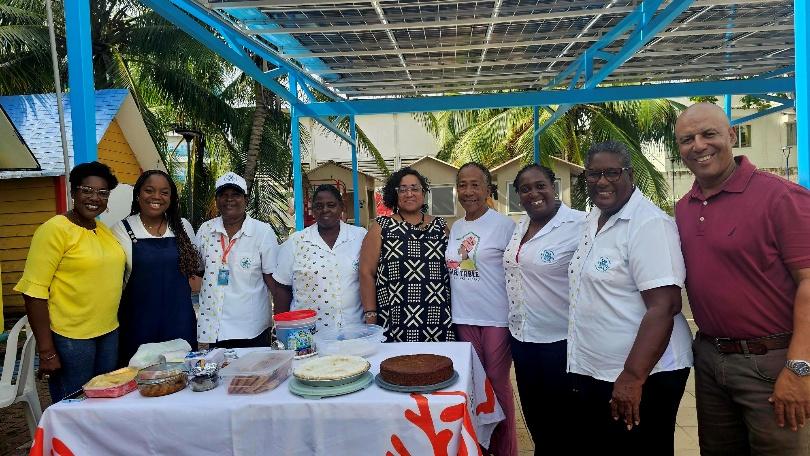
Much of life in Afro-Colombian communities is rooted in cooperation and a historical sensibility grounded in reciprocity, self-management, and collective care. Because of inequalities in business, people find a logic in making business cooperatively organized. Nobel Prize winner Elinor Ostrom (1990), author of Governing the Commons, found in her empirical work that oppressed people will strategically pool resources in the interest of the community. On San Andres island, Raizal women have figured out how to counteract foreign-owned tourist businesses by creating a demand for local cuisine and homestays. Raizal businesswomen have set up Fier Tiebls (Creole for Fair Tables) where they sell ancestral foods like bammy, fish, and coconut rice on roadsides across the island and run a network of Native Lodges inviting tourists to stay with them as opposed to corporate hotels, and live like locals.
Money systems of Minga, Cardenas, Convite, and Mano cambiada are ways for Afro-Colombian women to draw on ancestral group-based systems of collectivity rooted in communalism and the logics of cooperative economies. Mano cambiada is very much part of the Black Social Economy that has enabled reciprocity-based economies to flourish in many territories such as in the departments of Chocó, Valle del Cauca, Cauca, and Nariño. Mano Cambiada is an agreement to exchange labour through which relatives and community members reciprocally collaborate in agricultural activities and related tasks without money changing hands.
In the words of Gloria Amparo Arboleda, Mano cambiada (within the AMUCIB) is a collaborative work system that helps people in the following way: “AMUCIB emerged from the need to strengthen mutual strategies and support the entire community in productive activities amid the armed conflict. We began with what we call Mano Cambiada: If someone needs help on her farm—such as, harvesting or planting—the whole community commits to coming and helping them. That is how we moved forward together, taking turns working on each other's crops of every community member in turn” (Interview for documentary Pueblos Vicheros, 2020).
The Logic of Cooperative Economics
Strengthening Black social economies from the ground up is politicized action. And in Colombia, Black citizens are engaging in cooperative systems as a way to expand territorial autonomy and reinforce peace agreements from below (Tubb, 2018). The Casa Cultural El Chontaduro in Cali, Colombia puts these principles into practice by sustaining community-managed educational initiatives, including its popular library and Pre-ICFES program; organizing Black women around collective care, food sovereignty, and mutual support; and training Afro-Colombian youth in political participation, conflict mediation, and community-based peacebuilding.
Feminist solidarity economies thus have immense potential to stymie racial capitalist tactics against Afro-Colombian women.
Combining politicized action with collective care, the Black Social Economy advances economic alternatives to counter the violent economic systems in which Black women live. Solidarity practices by Afro-Colombian communities such as Mano Cambiada, Fair Tables, ma-kuagro, and comadreo are expressions of a solidarity economy that, is doing business collectively and together. In the Black Colombian context, this work is grounded in social provisioning, reciprocity, care, memory, territorial autonomy, and collectivity, thereby broadening our understanding of what a people-centered economy can be.
Cited Works
Ararat Orozco, M. C., Sinisterra Garcés, C. L., & Hernández Rivera, C. (2014). Valoraciones agronómicas y de rendimiento en la cosecha de “papa china” (Colocasia esculenta L.) en el trópico húmedo colombiano. Revista de Investigación Agraria y Ambiental, 5(2), 169–180. https://doi.org/10.22490/21456453.1335
Asociación de Mujeres Campesinas Negras e Indígenas de Buenaventura [AMUCIB]. (n.d.). El comadreo: Implementación de esta herramienta comunitaria en el proyecto Cultura Pazcífico Sobreviviente [Community booklet]. Fundación Sociedad Portuaria de Buenaventura.
Banks, N. (2020). Black women in the United States and unpaid collective work: Theorizing the community as a site of production. The Review of Black Political Economy, 47(4), 343–362. https://doi.org/10.1177/0034644620962811
Barker, D. K., Bergeron, S., & Feiner, S. F. (2021). Liberating economics: Feminist perspectives on families, work, and globalization (2nd ed.). University of Michigan Press. https://doi.org/10.3998/mpub.10048520
Commission for the Clarification of Truth, Coexistence, and Non-Repetition [Truth Commission]. (2022). Resistir no es aguantar: Violencias y daños contra los pueblos étnicos de Colombia [Resistance is not endurance: Violence and harms against Colombia’s ethnic peoples]. In Hay futuro si hay verdad: Informe final [There is a future if there is truth: Final report]. https://www.comisiondelaverdad.co/resistir-no-es-aguantar
Congress of the Republic of Colombia. (1993, August 27). Ley 70 de 1993, por la cual se desarrolla el artículo transitorio 55 de la Constitución Política [Law 70 of 1993, implementing Transitory Article 55 of the Political Constitution]. Official Gazette No. 41,013. https://www.funcionpublica.gov.co/eva/gestornormativo/norma.php?i=7388
Economic Commission for Latin America and the Caribbean [ECLAC] & United Nations Population Fund [UNFPA]. (2020). Afrodescendientes y la matriz de la desigualdad social en América Latina: Retos para la inclusión [People of African descent and the social inequality matrix in Latin America: Challenges for inclusion]. United Nations. https://www.cepal.org/es/publicaciones/46191
Escobar Arango, L., Gómez Sánchez, A., & Torres Carabalí, W. (2025). Buscando la buena ventura: Economías propias en comunidades negras de Buenaventura (Valle del Cauca, Colombia). El caso de la Planta de Transformación Comunitaria de AMUCIB (1980–2024). Revista Pueblos y Fronteras Digital, 20, 1–34. https://doi.org/10.22201/cimsur.18704115e.2025.v20.780
Escobar, A. (2020). Pluriversal politics: The real and the possible. Duke University Press. https://doi.org/10.1215/9781478012108
Hossein, C. S. (Ed.). (2018). The Black social economy in the Americas: Exploring diverse community-based markets. Palgrave Macmillan. https://doi.org/10.1057/978-1-137-60047-9
Lozano Lerma, B. R. (2019). Aportes a un feminismo negro decolonial: Insurgencias epistémicas de mujeres negras-afrocolombianas tejidas con retazos de memorias [Contributions to a decolonial Black feminism: Epistemic insurgencies of Black Afro-Colombian women woven from fragments of memory]. Universidad Andina Simón Bolívar & Ediciones Abya-Yala.
Meza, C. A. (2013). La ruta del viche: Producción, circulación y consumo de una bebida destilada en el litoral Pacífico colombiano. Revista de Estudios del Pacífico Colombiano, 1(2), 137–157. https://biblioteca-repositorio.clacso.edu.ar/handle/CLACSO/260750
Murillo Rodríguez, Y., & Cano Pérez, W. A. (2020). El viche, un baluarte de las bebidas tradicionales y ancestrales del Pacífico colombiano (Caso Bojayá-Chocó). Revista Bioetnia, 17(1), 48–61. https://doi.org/10.51641/bioetnia.v17i1.225
Ostrom, E. (1990). Governing the commons: The evolution of institutions for collective action. Cambridge University Press. https://doi.org/10.1017/CBO9780511807763
Palacios Valencia, Y. (2022). Los derechos étnicos en la Constitución Política colombiana de 1991: Avances y desafíos en el contexto del conflicto armado. Revista de la Facultad de Derecho y Ciencias Políticas, 52(137), 489–516. https://doi.org/10.18566/rfdcp.v52n137.a06
Political Constitution of Colombia [Const.]. (1991). Link accessed August 31, 2026: https://www.secretariasenado.gov.co/constitucion-politica
Tubb, D. G. L. (2018). The everyday Black social economy of Afro-descendants in the Chocó, Colombia. In C. S. Hossein (Ed.), The Black social economy in the Americas: Exploring diverse community-based markets (pp. 97–117). Palgrave Macmillan. https://doi.org/10.1057/978-1-137-60047-9_6
United Nations. (n.d.). People of African descent. https://www.un.org/en/fight-racism/vulnerable-groups/people-of-african-descent
United Nations Population Fund [UNFPA]. (2025). Latin America and the Caribbean: Independent evaluation of UNFPA support to the integration of the principles of “leaving no one behind” and “reaching the furthest behind,” 2018–2024: Case study. Link accessed Sept 22, 2026: https://www.unfpa.org/sites/default/files/2025-12/LNOB%20LAC%20case%20study%20EN.pdf







 BAR Executive Editor Margaret Kimberley joined Sabby Sabs to analyze recent developments in West Asia.
 Reaching a 20th anniversary for Black Agenda Report is indeed a milestone. But longevity alone is not what makes this publication special to thousands of readers. BAR’s principled journalistic…
 “The President of the United States is more/ the President of my country/ than the President of my country.”
 Marco Rubio's speeches invoking a shared Western civilization are part of the ideological consolidation of fascism, mobilizing racial solidarity to defend a declining capitalist order.
 Nayib Bukele, El Salvador’s president, joins Erik Prince, the US, and the UN to kill more Haitians.



