Cuba has been experiencing a increasing energy crisis due to the fuel blockade.
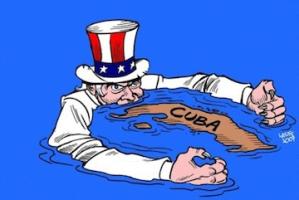
Washington is using economic warfare to manufacture unrest in Cuba, then using that unrest to justify more aggression.
Originally published by Isaac Saney on Facebook.
The events surrounding the peaceful protests of March 13 in the Cuban city of Marón are being deliberately distorted by reactionary political forces and segments of the monopoly media. What began as a demonstration by citizens—during which a small group engaged in acts of vandalism and violence—is now being cynically manipulated to discredit the Cuban Revolution and manufacture a climate of disinformation and confusion. The objective is clear: to legitimize further aggression against the island nation and reinforce a narrative that obscures the broader context in which these events have unfolded.
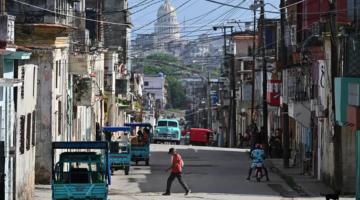
These incidents are occurring amid an intensified campaign of economic warfare against Cuba. At the centre of this escalation is the fuel blockade imposed by Washington: for more than three months, no oil deliveries have reached the island. This deprivation is part of the wider system of U.S. sanctions that seeks to cripple Cuba’s economy and deepen the hardships faced by its population. The sanctions regime—illegal, immoral, and widely condemned internationally—aims to strangle the Cuban economy by creating shortages of essential goods, prolonged electricity blackouts, and the paralysis of transportation and productive activity.
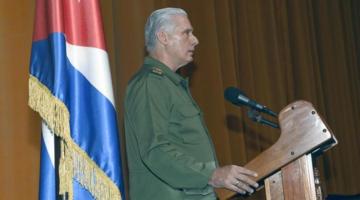
As Cuba’s President Miguel Díaz-Canel stated: “The frustration felt by our people due to the prolonged power cuts—a consequence of the U.S. energy blockade, which has intensified cruelly in recent months—is understandable. And complaints and protests are legitimate, provided they are conducted in a civilised manner and with respect for public order. What will never be understandable, justified or tolerated is the violence and vandalism that threatens public peace and the security of our institutions.”
Washington's strategy is neither accidental nor new. Its objective is to generate precisely the type of social distress that can be exploited politically. By fostering economic hardship and frustration, Washington hopes to provoke unrest that can then be invoked as justification for intervention or regime change. This logic lies at the heart of the more than sixty-five–year U.S. economic and subversive war against Cuba—the longest-running sanctions regime in modern history.
The intent of this policy was stated with striking clarity by Lester D. Mallory, then Deputy Assistant Secretary of State, in a now-declassified Lester D. Mallory Memorandum on Cuba dated April 6, 1960:
“The only foreseeable means of alienating internal support is through disenchantment and disaffection based on economic dissatisfaction and hardship… every possible means should be undertaken promptly to weaken the economic life of Cuba… denying money and supplies to Cuba, to decrease monetary and real wages, to bring about hunger, desperation, and overthrow of the government.”
More than six decades later, the same logic continues to shape U.S. policy. In the context of this ever-escalating economic war, every misstep by Cuban authorities—errors that occur in all countries, including those that present themselves as “highly developed”—is deliberately amplified and weaponized. Governance in Cuba is forced to operate under extraordinary constraints: chronic scarcity, restricted access to international finance, and the systematic obstruction of trade and investment.
When shortcomings emerge under such conditions, they are portrayed not as the predictable consequences of a siege economy but as evidence of systemic failure. This narrative is then magnified through U.S.-funded media networks and digital platforms designed to influence public perception inside and outside Cuba. Their function is to sow confusion, deepen cynicism, and erode public confidence in Cuban institutions, while concealing the external pressures that shape the country’s economic reality.
For more than six decades, however, the Cuban people have demonstrated remarkable resilience in the face of this relentless campaign to restore U.S. domination and hegemony over the island. Despite immense pressures, they have consistently rejected schemes intended to undermine their sovereignty and dismantle the social project that emerged from the Cuban Revolution. In doing so, they continue to defend a national commitment to independence, social justice, and human dignity—principles that remain at the core of Cuba’s enduring struggle for self-determination.
Isaac Saney is a Black Studies and Cuba specialist and coordinator of the Black and African Diaspora Studies (BAFD) program at Dalhousie University in Halifax, Nova Scotia.




 Maurice Carney is the Executive Director of Friends of the Congo. He joins us from Washington to discuss the ongoing crisis in eastern Democratic Republic of Congo, Rwanda’s continued intervention…
 “What did the Arab lady say to the Israeli tank?”
 African Stream's Pan-African, anti-imperialist journalistic perspectives made it the target of a state that colludes with corporate media to spread war propaganda.
 The U.S. and Israel’s unchecked aggression has plunged the world into a lawless state of imperial violence—yet their latest attacks on Iran have only exposed the limits of colonial power. As Western…
 Kizito Mihigo and Victoire Ingabire both challenged Rwanda's foundational genocide narrative. He died in jail, and she is now in custody.


