United States Treasury Secretary Scott Bessent testifies before the US Senate Banking, Housing and Urban Affairs Committee on Capitol Hill, on February 5, 2026, in Washington. (AP)
The US Treasury Secretary admits Washington engineered a dollar shortage in Iran, triggering currency collapse, economic unrest, and foreign-backed riots against that state.
Originally published in Al Mayadeen English.
The United States Secretary of the Treasury, Scott Bessent, has acknowledged that Washington deliberately engineered a shortage of US dollars inside Iran, a policy that contributed to the collapse of a major Iranian bank, a sharp devaluation of the national currency, and the economic pressures that preceded the December unrest.
Speaking during a Senate hearing on Friday, Bessent confirmed that the Trump administration intensified its so-called “maximum pressure” campaign by directly targeting Iran’s financial system.
“What we have done is create a dollar shortage in the country,” Bessent said in response to questioning by Senator Katie Britt. He added that the policy reached “a swift and, I would say, grand culmination in December, when one of the largest banks in Iran went under.”
Currency collapse and inflation driven by sanctions
Bessent stated that the Iranian central bank was forced to print money in response to the engineered shortage, triggering a rapid collapse of the rial and a surge in inflation.
“The central bank had to print money, the Iranian currency went into free fall, inflation exploded,” he said, openly linking US actions to Iran’s economic turmoil.
He further acknowledged that Washington simultaneously pushed Iran’s oil exports “down to zero,” compounding economic pressure on the country and deepening the impact on ordinary Iranians.
In a January 20 interview, Bessent reiterated that US sanctions were explicitly designed to weaken Iran’s currency, describing the economic warfare as “economic statecraft.”
“This is economic statecraft, no shots fired,” he said, underscoring the deliberate use of financial warfare as a tool of US foreign policy.
Foreign-backed riots and debunked casualty claims
The economic pressures triggered protests in December following the sharp currency devaluation. Legitimate economic demonstrations were subsequently hijacked and turned into violent riots.
Iranian Chief of Police Ahmad Reza Radan stated that the gatherings initially “were legitimate economic protests by market traders,” but “later turned into riots,” as organized groups attacked demonstrators, security forces, government buildings, and mosques.
Iranian police detained rioters and their organizers, including individuals found carrying weapons and explosives, as well as others who admitted to receiving funding from abroad. Iranian officials said several detainees confessed to receiving payments in US dollars, pointing to the involvement of foreign NGOs and intelligence-linked networks. Israeli media later confirmed the presence of Mossad-linked elements during the unrest, as well as coordination in anti-government attacks.
Militants affiliated with Kurdish separatist groups based in northern Iraq also crossed into Iran to participate in the violence, according to Iranian authorities. These groups include the Kurdistan Democratic Party of Iran (KDPI) and similar factions, which Tehran says have long operated with foreign backing.

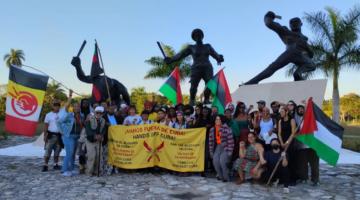
 Black political organizations condemne