Nicaragua has built a resilient economy against the odds. Now, that success is being met with escalating economic attacks from the U.S.
Originally published in Resumen Latinoamericano – English.
The International Monetary Fund’s new assessment of Nicaragua’s economy labels it as “strong” no fewer than 56 times. But it also shows how key factors in the country’s growing prosperity – export earnings, trade relations and remittances (money sent by Nicaraguans living abroad) are vulnerable to US attacks. The IMF points out that US sanctions – more appropriately known as unilateral coercive measures – have severely restricted the help the country gets from multilateral bodies like the World Bank.
Nicaragua’s relationship with the IMF is an odd one. On the one hand, the institution’s annual “Article IV” reports are consistently positive, praising the way that the country’s economy “weathered well the multiple shocks” of the 2018 coup attempt and the 2020 pandemic. Since 2008, the IMF hasn’t had to save Nicaragua from economic collapse and hasn’t tried to impose the “structural adjustment” programs that have been justly criticized when used elsewhere.
On the other hand, when Nicaragua’s government did ask for temporary assistance during those two crises (2018 and 2020), it only received help during the second one. Two years ago, I asked the government’s then-finance minister, Ivan Acosta, why the IMF had said “no” when 2018’s attempted coup had dealt such a blow to the country’s economy. He explained that while officials confirmed that Nicaragua qualified for emergency assistance, they also advised that any request would be turned down by the IMF’s US-dominated board. At the time, legislation was passing through the US Congress imposing sanctions on Nicaragua. These required US officials to block any funding by international bodies (such as the IMF) whenever they had the power to do so. Acosta was therefore quietly asked by IMF staffers not to make any loan requests, so they wouldn’t be turned down.
Other institutions like the World Bank bowed quickly to US pressure and halted their projects, even those aimed at Nicaragua’s poorest communities. Both the IMF and (belatedly) the World Bank later helped the country with loans during the pandemic and in the aftermath of two devastating hurricanes in 2020, but only with modest amounts. While IMF loans are no longer needed, World Bank funding would significantly strengthen the country’s poverty-reduction programs, but it has again been halted. Acosta estimated that this costs Nicaragua up to $600 million annually in lost development finance. As he put it, a country whose income per head is (currently) about $2,900 annually is being penalized by countries (the US and its allies) whose per capita income is as much as $80,000.
Despite these obstacles, on January 20 the IMF’s annual report on Nicaragua again praised the government’s macroeconomic management and highlighted GDP growth of close to 4% in 2025, higher than the Latin American average, reflecting a strong recent recovery. “The Nicaraguan economy has weathered multiple shocks since 2018 thanks to appropriate macroeconomic and financial policies,” it said. The government shows “prudence” in its fiscal, monetary, and financial policies which will “contribute to maintaining macroeconomic and financial stability, preserving fiscal sustainability, and strengthening policy protection mechanisms.” The IMF also remarked on the country’s significant liquidity reserves, low inflation, declining public debt-to-GDP ratio, good performance in collecting taxes, growing financial surpluses and well-capitalized banks.
Government anti-corruption measures were also acknowledged, including a new legal framework that allows immediate removal of public officials for mismanagement of government funds. In recognition of these measures, four years ago, Nicaragua was removed from the “grey list” of countries being monitored by the Financial Action Task Force (the anti-corruption body set up by G7 countries).
Nicaragua’s relative strength can be seen from the table comparing it with its neighbors: despite being the region’s lowest-income country, it fares better than Honduras in productivity, has low debt and the lowest cost of living (using an established international index). Indeed, a prosperous Nicaragua is key to regional stability: it receives 28% of its imports from Central America and contributes 16% of its exports. It is also a recognized bulwark against regional organized crime and drug trafficking.
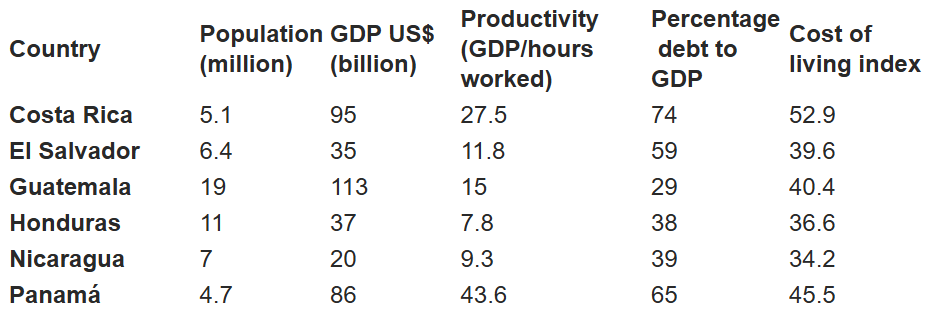
Yet the picture painted here would be unrecognizable to anyone relying on Nicaragua’s right-wing opposition media. One of the best known, Confidencial, has the country’s debt costs so high as to squeeze public budgets, criticizes costly borrowing terms on recent loans and warns of “uncertainty” about Nicaragua’s economy in 2026. In October 2025, right-wing outlet La Prensa warned that Nicaragua’s economy is at risk and has “few options to maneuver.” In fact, as the IMF points out, Nicaragua has recently been repaying debt more quickly that it is taking on new liabilities.
Even so, Nicaragua’s economy could be vulnerable to US attacks or policy changes in three main ways.
First, its exports, which continued to grow in 2025, are heavily dependent on trade with the US despite Trump’s recent tariffs and Nicaragua’s attempts to diversify its markets. When they reach the US border, Nicaraguan products not protected by the regional trade agreement (CAFTA) are subject to an 18% tariff (exemptions include gold, beef and coffee). The IMF notes that many producers have been able to absorb these additional costs and remain competitive, but Washington plans to impose even higher tariffs on some goods in 2027 and higher still in 2028. These hikes in tariffs will apply to Nicaragua but not to its neighbors.
Legislation in the US Congress would, if approved, even threaten Nicaragua with exclusion from the CAFTA treaty, although this would require the agreement of the other member countries. The IMF urges Nicaragua to diversify its export markets more rapidly, to mitigate these threats. Of course, this is exactly what the government is aiming to do.
Second, remittances from Nicaraguans living abroad are a very significant contributor – around a quarter – to Nicaragua’s annual income (the same applies in Honduras and El Salvador). This could change rapidly if migrants now in the US are deported or return to Nicaragua voluntarily in significant numbers. The IMF speculates that the recent growth in remittances was fueled by US-based Nicaraguans, encouraged to migrate by Biden, anticipating they would soon be obliged to “go home” by Trump. This year they also face a 1% tax on the money they send. Even so, after dipping in 2026, the IMF expects remittances to continue to grow.
Third, while the IMF notes that Nicaragua is still eligible for loans from multilateral bodies such as the World Bank, in practice these continue to be blocked by US sanctions. A vital exception is CABEI, the Central America Bank for Economic Integration, which continues to fund projects in Nicaragua despite vigorous attempts by the US to stop it. The IMF indicates that CABEI, together with bilateral loans from China and other countries, will be Nicaragua’s main sources of external funding for future development projects.
The US legislation referred to earlier also calls for Washington to attempt to block further CABEI loans. It is not clear how this could be done, because the US is not a member of CABEI, but if it were successful it would completely cut off Nicaragua’s access to multilateral funding sources, an extraordinary position for one of the hemisphere’s lowest-income countries.
As well as weathering “multiple shocks” since 2018, the IMF analysis suggests that “strong fundamentals should help Nicaragua withstand headwinds from ongoing shifts in the global policy landscape.” Though expressed diplomatically, this is a clear reference to the Trump administration’s recent threats. It is testimony to the resilience of the Sandinista government and its management of the economy that Nicaragua is well-placed to face them.
John Perry is a writer based in Nicaragua and writes on Central America for the Nation, the London Review of Books, openDemocracy, the Council on Hemispheric Affairs, and other outlets.


 The climate movement will never be effective as long as it refuses to confront white supremacy within its own organizations and as a belief system which is unconcerned about Black and brown death.
 "They Wear The Masks" is the latest from BAR's Poet-in-Residence.
 Fisk University, an HBCU, is presenting a $400 million A.I. data center as progress for the North Nashville community. In truth, it means more pollution, more surveillance, and another chapter in a…
 The mass incarceration system demands thousands of Black bodies behind bars. That system is maintained by prosecutorial misconduct which goes unpunished. That impunity is integral to keeping the…
 Arday was killed by the contradiction at the heart of white elite institutions: they want the appearance of racial progress without structural change, and they readily discard Black people, even…


