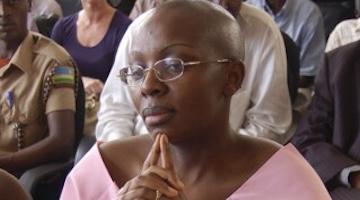
CODEPINK is collaborating with the International Women’s Network for Democracy and Peace, which works for peace and democracy in Africa, on a webinar on Rwanda, Congo, and the case of Rwandan political prisoner Victoire Ingabire.
On Sunday, December 14, at 2 pm EST, CODEPINK–Women for Peace will hold a webinar to expose the lies about Rwanda, Congo, the so-called peace deal, and the case of Rwandan political prisoner Victoire Ingabire. This is a collaboration with the International Women’s Network for Democracy and Peace (IWDP), Réseau international des femmes pour la démocratie et la paix (RifDP) in French.
The RifDP/IWDP is an organization founded in 2011, with desks in Canada, France, The Netherlands, and Belgium. Every year on International Women’s Day it awards the Victoire Ingabire Umuhoza for Democracy and Peace Prize, and on October 14, it celebrates Ingabire Day in cooperation with other human rights organizations. I spoke with Marceline Nduwamungu, one of RifDP/IWDP’s founders.
ANN GARRISON: Tell us about the International Women’s Network for Democracy and Peace. What were your goals when you created it?
MARCELINE NDUWAMUNGU: Our three desks in Canada, The Netherlands, and Belgium were created almost at the same time. The organization acquired its legal identity in Belgium in January 2010. The branch in France was the last to open in 2018.
Our broad goals are to inform and raise public awareness about what stands in the way of peace and democracy in Africa, especially in the African Great Lakes region.
We also want to support any initiatives to establish peace and democracy and encourage the widespread participation of women in all democratic processes.
Like Victoire Ingabire, we want to promote human rights and encourage dialogue between peoples to resolve conflict.
AG: Why did you choose to found a women’s organization?
MN: Because our society does not properly value the contributions of women in different aspects of life, especially in peacebuilding efforts.
AG: How has the organization evolved over time?
MN: In 2011, the organization decided to create the “Victoire Ingabire Umuhoza for Democracy and Peace Prize.” That was on March 8, 2011, the 100th anniversary of International Women's Day.
The prize was created to honor Victoire Ingabire Umuhoza, who has been a political prisoner in Rwanda since 2010 for daring to run for president against Paul Kagame and exposing the false narratives that his regime has used to justify repressive extremes in Rwanda and war in Congo.
Those we present the award to have shown courage, leadership, and scholarship in pursuit of peace and democracy, particularly in the African Great Lakes region.
AG: Tell us about a few of the people you have presented with the Victoire Ingabire Umuhoza Democracy and Peace Prize. They’re all worthy of attention but we don’t have space to talk about all of them, so I’d like to just highlight a few starting with Colonel Luc Marchal, senior officer in the Belgian peacekeeping contingent in Rwanda during the 1994 Rwandan Genocide. Why did you present the prize to Colonel Marchal in 2013?
MN: The search for peace, justice, and democracy in the Great Lakes Region of Africa begins with the search for truth. Colonel Luc Marchal fought to tell the true story surrounding the events in Rwanda between 1990 and 1994. He commanded the Belgian contingent of the United Nations Assistance Mission for Rwanda (UNAMIR) and was second-in-command after Roméo Dallaire. He witnessed firsthand what happened in Rwanda and offers an unflinching account even in the face of harsh criticism. He is author of the book Rwanda, la descente aux enfers (Rwanda, the descent into hell).
AG: Now tell us about journalist and author Judi Rever, who won the prize two years later, in 2015.
MN: Ms. Judi Rever is a Canadian journalist deeply committed to human rights issues and the plight of refugees, most specifically those in and from Africa.
Since 1997, she has been documenting the daily realities faced by Rwandan refugees in the Goma region of the Democratic Republic of Congo. Later, she traveled to Kisangani, in the hellish conditions of the equatorial forest, to stay in Mbandaka. She also experienced extremely difficult working conditions in transit camps in Rwanda.
Her experience with refugees extends beyond this sub-region of Africa, as she has also documented their living conditions in Sierra Leone, Guinea, Liberia, and Palestine.
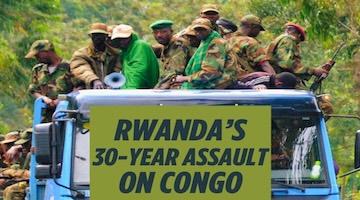
She has written two powerful books: In Praise of Blood: The Crimes of the Rwandan Patriotic Front, published by Random House in 2020, and the forthcoming Rwanda's 30-Year Assault on Congo: The Crimes, the Criminals, and the Cover-Up, just published by Baraka Books.
AG: I ordered my copy of the new one at that link today. Can’t wait.
Can you tell us about Congolese Canadian author Patrick Mbeko, who was one of several winners in 2016.
MN: Patrick is a Congolese political scientist and author who now lives in Canada. He specializes in the geopolitical issues of the African Great Lakes region and is the Quebec representative of the Friends of the Congo collective based in Washington, D.C.
In 2012, he published his first book with Le Nègre Éditeur, entitled: Le Canada dans les guerres en Afrique centrale: Génocides et pillages des ressources minières du Congo par le Rwanda interposé (Canada in the wars in Central Africa: Genocide and plundering of Congo's mineral resources through Rwanda as an intermediary).
In 2014, he published his second book, Le Canada et le pouvoir tutsi du Rwanda: deux décennies de complicité criminelle en Afrique centrale (Canada and the Tutsi regime of Rwanda: Two decades of criminal complicity in Central Africa).
That same year, he published Stratégie du chaos et du mensonge: Poker menteur en Afrique des Grands Lacs (Strategy of chaos and lies: A game of bluff in the Great Lakes region of Africa), co-authored with Honoré Ngbanda, former special security advisor to President Mobutu.
His fourth book, Guerre secrète en Afrique Centrale (Secret War in Central Africa) was published by Kontre-Kulture in Paris in 2015. He also published Objectif Kadhafi: 42 ans de guerres secrètes contre le Guide de la Jamahiriya arabe libyenn (Target Gaddafi: 42 years of secret wars against the Leader of the Libyan Arab Jamahiriya), a groundbreaking investigation into the life of Muammar Gaddafi and NATO's war against Libya, and most recently, Rwanda: Malheur aux vaincus 1994-2024 (Rwanda: Woe to the vanquished 1994-2024).
When asked why he wrote all these books, Patrick Mbeko replied: "Because Africans must access the truth through their own intellectual investigation, and it is up to us Africans to write our own history. For our dignity and our very existence as a people depend on it."
AG: Tell us about Cameroonian French author Charles Onana, who won the prize in 2018. I reported on his conviction in France for speech crime, and I see that he himself filed a complaint against Rwandan President Paul Kagame for threatening him. Tell us about him and whether you know of any updates on his legal actions.
MN: Charles Onana is a Franco-Cameroonian investigative journalist and an internationally recognized expert on the Rwandan tragedy and its repercussions in the Democratic Republic of the Congo.
For many years, he has tirelessly denounced the monolithic ideology that those who plunged the Great Lakes region into deadly chaos are attempting to impose on it far and wide.
His first book was Les Secrets du génocide rwandais : Enquête sur les mystères d'un président (The secrets of the Rwandan Genocide: An investigation into the mysteries of a president). He co-authored that book with Rwandan political prisoner Deo Mushayidi.
His other books include Holocauste au Congo (Holocaust in Congo) which has been translated, and Ces tueurs tutsi au cœur de la tragédie congolaise (These Tutsi killers at the heart of the Congolese tragedy).
He has been convicted of denying the Rwandan Genocide in his book Rwanda, la vérité sur l'opération Turquoise: Quand les archives parlent enfin (Rwanda, the truth of Operation Turquoise: When the archives speak), but his case is on appeal.
He denounces the failings of an international justice system entirely subservient to partisan interests, with little regard for the Rwandan and Congolese people's need for justice and fairness.
He himself filed a suit against President Kagame for threatening his life, and its outcome should be known in February or March next year.
AG: Now this is sad but tell us about the late Rwandan gospel singer Kizito Mihigo, one of several people awarded the prize in 2020.
MN: The prize was awarded to him posthumously. He died on February 17, 2020, while in prison. The authorities maintain that he committed suicide using bedsheets, but many witnesses say there are no bedsheets in Rwandan prisons.
He was the singer who composed the current Rwandan national anthem. He was also the official singer at the genocide commemorations held every April. But in 2014, after witnessing the segregation of memory that prevails in Rwanda, he composed a song, "Igisobanuro cy'Urupfu," which calls for empathy for the unrecognized victims of the Rwandan tragedy.
It should be noted that in April, only Tutsis are allowed to mourn theirs and to remember. The late Kizito Mihigo wanted all victims to be commemorated, whether Hutu, Tutsi, or Twa. The government that had once supported him did not appreciate this and arrested him in 2014. He spent four years in prison and was pardoned on the same day as Ms. Victoire Ingabire Umuhoza on September 14, 2018. Less than two years later, he was re-arrested and charged with trying to leave the country illegally. He died in custody two days later.
AG: American academics Christian Davenport and Allan Stam shared the prize with Kizito in 2020. Tell us about them.
MN: Professors Christian Davenport and Allan Stam were rewarded for their extraordinary work, especially in relation to understanding estimates of victims of the Rwandan genocide. They published many scientific articles, including “Casualty Estimates in the Rwandan Genocide” (2020). Their work turned on its head the way the genocide was presented to the world, which is fundamental to reconciliation.
Initially, they had been hired by the Rwandan government after the genocide to map the various massacre sites. When they presented the results of their work, they were declared persona non grata and asked to leave the country.
AG: Tell us about Rwandan author Marie Béatrice Umutesi. Why did you present her with the award in 2021?
MN: Marie Béatrice Umutesi is a survivor of the 1996-1997 massacres of Hutu refugees in Zaire (now the Democratic Republic of the Congo). She is a refugee in Belgium. A sociology graduate, she is the author of Fuir ou mourir au Zaïre. Le vécu d’une réfugiée rwandaise (Surviving the Slaughter: The Ordeal of a Rwandan Refugee in Zaire), a book in which she recounts her four-year ordeal under extremely difficult living conditions, emphasizing the feeling of abandonment by the international community.
When accepting the award, she said, "I would like to dedicate this prize to the Congolese people who have suffered since 1994 from repeated aggression by neighboring countries, primarily Rwanda. . . I also dedicate this prize to the Congolese people, from Bukavu to Kinshasa, who welcomed me, housed me, fed me, and cared for me without knowing me, thus demonstrating humanity despite the precarious situation into which the war had plunged them. . . I dedicate this prize to my Belgian, Congolese, German, and Dutch friends who helped me get out of Congo and arrive safe and sound in Belgium.”
AG: And what about Japanese researcher and author Masako Yonekawa, who shared the award with Marie in 2021?
MN: Masako Yonekawa is a Professor at Tsukuba Gakuin University. Co-representative of the Japanese non-profit organization RITA-Congo, she is a researcher on refugee issues, peace, and conflict in the Great Lakes region of Africa. She is the author of the book Post-Genocide Rwandan Refugees: Why They Refuse to Return Home, in which she exposes the plight of Rwandan refugees abandoned by the international community. "No one on earth should be forced to leave their home against their will. As you all know, the Great Lakes region is a magnificent paradise; who would want to abandon it to live elsewhere?" She emphasized this in her acceptance speech, while continuing to denounce the serious crimes committed in Rwanda and the Democratic Republic of Congo.
AG: OK, that’s all we have space for this week but everyone who has won this award deserves appreciation and attention, and I very much hope that no one will feel slighted. I also hope this hasn’t sounded self-aggrandizing because you did present me with the award in 2014, but I feel hugely honored to be in such company.
MN: We greatly appreciate what you have done for Victoire and for Rwandan and Congolese people.
To sign up for the webinar, go to https://www.codepink.org/rwandacongo1214.
Ann Garrison is a Black Agenda Report Contributing Editor based in the San Francisco Bay Area. In 2014, she received the Victoire Ingabire Umuhoza Democracy and Peace Prize for her reporting on conflict in the African Great Lakes region. She can be reached at ann@anngarrison.com. You can help support her work on Patreon.
Marceline Nduwamungu co-founded the Women’s International Network for Democracy and Peace (Réseau international des femmes pour la démocratie et la paix). She grew up in Rwanda and received political asylum in Belgium after the Rwandan Civil War and Genocide.


 A People(s)-Centered Human Rights framework rejects the liberal abstraction that makes a false symmetry between Iranian authoritarianism and U.S. imperialism, which obscures the fact that one is a…
 “In the period since 1969, one can detect the same old close ties between right-wing U.S. academics, think tanks, foundations, and the U.S. Government…”
 White supremacy works through institutions, and FEMA's formula for allocating disaster relief shows us how the state decides which neighborhoods are prioritized and which are left to suffer. Those in…
 The IMF and World Bank are not subjects the corporate media cover in any real sense. Instead, their role is treated as unquestionably immutable and beneficial.
 The Anti-Imperialist Scholars Collective (AISC) wrote this response to the open letter To Iran's political prisoners, 'trapped between two blades of a scissors' which appeared in The…


