President George Bush visits U.S. military personnel in Somalia on Dec. 31, 1992. Larry Downing/Sygma/Sygma via Getty Images
Somalia remains a laboratory for imperialist military attacks and interventions intended to prevent the formation of a stable and secure state.
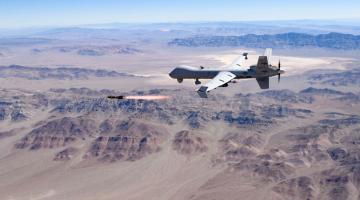
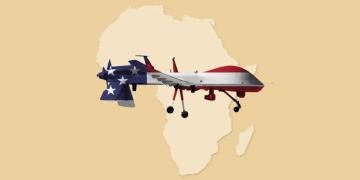
In the remote, arid landscapes of Puntland and the contested central regions of Somalia, the distant hum of a Reaper drone is the sound of a recurring nightmare. It is the herald of an explosion, of anonymous death delivered from the sky, and of a conflict that has been meticulously engineered to be endless. The United States, under the second Trump administration, has not started a new war in Somalia; it has simply intensified a long-standing project of imperial domination, cloaking it in the familiar, tattered rhetoric of counterterrorism. This escalation is not a deviation from U.S. policy but its purest expression: a neo-colonial endeavor designed to keep a nation fractured, dependent, and perpetually in the crosshairs.
The data, scattered across sterile AFRICOM press releases and critical reporting, tells a story of relentless aggression. Since the beginning of 2025, the United States has launched at least 77 airstrikes in Somalia, a staggering number that already shatters the previous annual record of 63 set during Trump’s first term. This bombardment is conducted with chilling opacity. As noted by researchers at New America, AFRICOM has ceased sharing casualty estimates or assessments of civilian harm, operating in a fog of war of its own creation. Each press release is a study in Orwellian language, announcing strikes in the “vicinity” of towns like Ceel Dheer or Badhan, coordinated with a “Federal Government of Somalia” that exercises little to no actual sovereignty beyond select districts of Mogadishu.
This so-called authorization from the Somali government is the foundational lie upon which this entire illegal war is built. This “authorization” is nothing more than a hallmark of neo-colonial governance. The regime in Mogadishu is a classic comprador regime, a client state installed and maintained by Western imperialism whose primary function is not to serve its people but to facilitate foreign control. Its recent $600,000 contract with the Washington lobbying firm BGR Group is a telling transaction: it trades what remains of Somalia’s sovereignty for military aid and a veneer of international legitimacy. It is a government that exists not to govern but to consent, providing a legalistic fig leaf for the perpetual U.S. military operations that ensure its own survival, and in doing so, ensures the nation's continued subjugation.
Operating as a key comprador force for Western imperial interests, the United Arab Emirates conducts its own shadow war within Somalia, acting as a militarized proxy that furthers the goal of balkanizing the nation and enforcing foreign control. While the U.S. publicly announces its airstrikes in Puntland, the UAE simultaneously conducts its own clandestine bombings, as it did on January 2 and February 4, 2025, against ISIS positions in the same mountain ranges—operations for which it takes no public credit. This partnership is a hallmark of neo-colonial strategy, where a regional power, funded and armed by Western nations, performs the dirty work of empire, allowing for plausible deniability while ensuring perpetual conflict. The UAE’s deep investment in fractious Somali regions, from creating and funding the Puntland Maritime Police Force (PMPF) to supporting breakaway states like Jubaland, is not about fostering Somali sovereignty but about enforcing a divided and dependent political landscape, ensuring no central authority can emerge to challenge the rules-based colonial order orchestrated from Washington and its partners.
The historical through-line is undeniable and damning. The current crisis is not an organic phenomenon but the direct result of decades of foreign intervention. The 1993 Black Hawk Down incident led not to introspection but to a punitive withdrawal, creating a power vacuum that was first filled by the Islamic Courts Union (ICU) and then, following a U.S.-backed Ethiopian invasion in 2006, by the very al-Shabaab militants the U.S. now claims to fight. This pattern is the playbook of imperial strategy: create chaos, then offer militarized solutions that deepen the chaos, justifying an ever-expanding presence.
Under President Trump, this playbook has been executed with brutal efficiency. His first term saw over 200 airstrikes, more than Bush, Obama, and Biden combined, fueling the instability that strengthens al-Shabaab’s recruitment. The much-touted 2020 troop withdrawal was not an end to the war but a tactical “reorganization of imperial strategy,” shifting the burden from ground troops to remote-controlled drone warfare and proxy forces. This allows for a campaign of violence with no U.S. body bags and, consequently, no media coverage and no domestic political accountability. The war is rendered invisible to the U.S. public, a silent, endless procession of strikes documented only by obscure blogs and Somali media outlets like Garowe Online, which reported the death of at least seven Somali soldiers in a single September battle, a human cost entirely absent from AFRICOM’s sanitized statements.
The justification for this perpetual war collapses under the slightest scrutiny. As foreign policy analyst Alex Madajian correctly argues, the notion that al-Shabaab poses a credible threat to the U.S. homeland is “practically nonexistent.” Their most frequent U.S. victims are U.S. service members and contractors stationed in East Africa, a textbook example of a self-created threat. The argument that the U.S. must secure the Gulf of Aden for international trade is equally hollow; disruptions there primarily harm rivals like China and could even economically benefit U.S. ports. The true motivation for this endless war is twofold, reflecting the broader anxieties of a declining empire.
First, Somalia is a laboratory. It is a playground for private mercenaries, and a military testing ground for AFRICOM’s latest weapons and drone technology. The ungoverned spaces become proving grounds for a new form of warfare, remote, deniable, and profitable for the military-industrial complex. The constant tactical fight against a hydra-headed enemy (both al-Shabaab and the ISIS affiliate) provides a permanent justification for this testing.
Second, and more critically, it is about containing African sovereignty. The rise of the Alliance of Sahel States (AES) and the deepening of strategic partnerships across the continent with China and Russia have sent shockwaves through Washington. The era of uncontested Western hegemony is over. In this new context, the U.S. will likely pursue a much more aggressive military strategy in Africa, being that all they know is drone warfare, proxy militias, and strategic partnerships with neo-colonial regimes to maintain its grip.
Somalia is a key front in this offensive. A truly stable, united, and sovereign Somalia, one that could control its own territory and resources, is a direct threat to the neo-colonial model. It is far more useful to U.S. interests to keep the nation divided, pitting Mogadishu against regional governments like Puntland and Somaliland, and ensuring that no central authority can ever emerge strong enough to reject foreign diktats. The bombs falling on the Golis Mountains are not just targeting ISIS militants; they are bombing the very possibility of a cohesive Somali state.
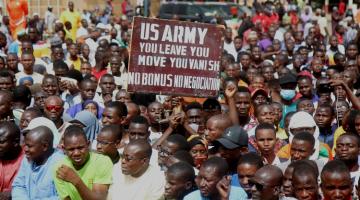
The path forward is not a different U.S. strategy but the complete and total rejection of the U.S. military presence. The false choice between U.S. occupation and al-Shabaab domination is a propaganda tool. The Somali people have the right to self-determination, to build their own future without Washington’s bombs, without AFRICOM’s presence, and without the interference of comprador regimes and Gulf State proxies. The movement to end the forever war is not just a moral imperative; it is a strategic necessity in the broader struggle for African liberation. As the U.S. war on Africa rages on with Somalia in the crosshairs, solidarity means demanding an end to the imperialism that creates the very terrorists it claims to destroy. It means listening not to the generals at AFRICOM headquarters in Stuttgart, Germany, but to the people on the ground in Mogadishu, and joining their call: U.S. Out of Africa Now.
Tunde Osazua is the National Co-Coordinator of the Black Alliance for Peace and a member of the Steering Committee of the International Campaign to Free Kamau Sadiki.