Then Somali President Mohammed Abdullahi Mohammed, Eritrean President Isaias Afwerki, and Ethiopian Prime Minister Abiy Ahmed after signing a regional cooperation agreement in 2018.
The Horn of Africa was filled with hope in 2018, when Somali President Mohammed Abdullahi Mohammed, Eritrean President Isaias Afwerki, and Ethiopian Prime Minister Abiy Ahmed signed an agreement promising regional cooperation on trade, culture, and security, but that hope has been dashed by renewed conflict.
The Sahel region, stretching between the Sahara and the savannas of Africa, is once again emerging as a battleground, not only of geography but of ideas, sovereignty, and neocolonial entrenchment.
The formation of the Alliance of Sahelian States (AES), uniting Burkina Faso, Mali, and Niger into a confederation, marks a bold attempt to reclaim Pan-African agency and assert sovereignty free from foreign domination.
Officially established on July 6, 2024, in Niamey, Niger, the AES reflects a transitional phase toward a unified federation, a development met with celebration across Africa and the Global South, but with growing alarm in Western capitals.
Historical Parallels with the Horn of Africa
To understand the risks and responsibilities facing the AES today, one must examine the shattered promise of regional integration in the Horn of Africa. In 2018, Eritrea, Ethiopia, and Somalia signed a Joint Declaration on Comprehensive Cooperation called the Tripartite Agreement, sparking hope for intra-regional harmony. However, that initiative quickly collapsed under the weight of foreign interference, both overt and covert, from powers that saw African unity as a threat to their geopolitical and military interests.
Western powers are now actively engaged in undermining and sabotaging the Sahelian States as they did in the Horn. The U.S. Africa Command, or AFRICOM, led by General Michael Langley, has thrown out some veiled threats, warning of “instability and consequences” if AES states keep moving away from Western influence. These threats don't come from a place of caring about stability in Africa, but from fear of losing military bases, access to natural resources, and the ability to project influence through their loyal African elites.
At the same time, France, whose colonial fingerprints are etched deep into the Sahel, has not hesitated to destabilize the region through the deployment of covert networks, disinformation campaigns, and even support to non-state actors. It’s a throwback to the days when France supported proxy groups just to keep their grip on former colonies through chaos and dependency.
What’s even worse is the fact that some African collaborators of imperialism, such as President Bola Tinubu of Nigeria and President Alassane Ouattara of Côte d’Ivoire, have joined in this destabilization campaign. They’re using ECOWAS as a cover to call for military intervention, sanctions, and political isolation of AES states. Far from serving their people, they act as instruments of Western hegemony, echoing threats crafted in foreign embassies and think tanks.
Pan-Africanism as a Strategic Shield
The Alliance of Sahelian States is not just another political initiative, it is a symbol and a shining example of what genuine Pan-Africanism can accomplish. A strong, united Sahel could reduce reliance on exploitative international partnerships, a collaborative approach to tackling cross-border threats, and a real stand against those divide-and-rule tactics that imperial powers have used throughout history.
Let us not forget also that the parallel failures of IGAD in the Horn of Africa and ECOWAS in West Africa reveal how regional bodies can be weaponized to enforce the will of external foreign countries. To avoid falling into that trap, it is crucial for the AES to remain autonomous and independent, driven by the hopes and dreams of its own people, rather than the dictates of foreign capitals.
Concerning the collapse of the Joint Declaration on Comprehensive Cooperation that initiated the Tripartite Alliance in the Horn of Africa, what the region lacked was a unified continental solidarity and protection from narrative warfare. After the tripartite agreement was signed in 2018, the region was flooded with so much misinformation that even some well-known Pan-Africanists got the situation all wrong. The AES simply cannot let that happen again and lose control over the narrative.
Safeguarding AES: A Continental Imperative
The survival and success of the Alliance of Sahelian States is not just important for the Africa continent. It’s a necessity for the entire world as it suffers the ecological and social catastrophes caused by late stage capitalism and imperialism. This movement embodies the right of African nations to shape their own destinies. It also represents a challenge against a global system that has thrived on keeping African countries divided, deep in debt, and dependent on others.
Africans, across the continent and in the diaspora, must mobilize and rally together to defend AES from AFRICOM’s militarization, France’s neocolonial retaliation, ECOWAS’ betrayal, and the complicity of compromised African elites.
Now, if AES can weather these storms, it might just shine as a guiding light for a new Pan-African era, one in which Africa truly defines its own future, protects its sovereignty, and commands global respect, not as a collection of fragmented states, but as a united people eager to reclaim their history, resources, and ultimately, their destiny.
From Solidarity to Strategy: April 30 as a Turning Point
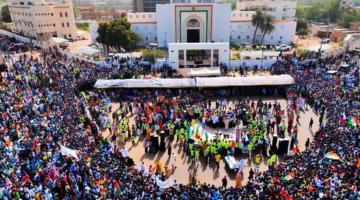
On April 30, 2025, something incredible happened: a wave of global African solidarity washed over cities from Ouagadougou to New York. Thousands of People, both on the continent and in the diaspora, came together to celebrate World Support Day for Captain Ibrahim Traoré, the revolutionary leader of Burkina Faso.
In places like Bamako, Niamey, Dakar, Johannesburg, and even in Paris, London, and Washington, D.C., the streets were alive with chants of unity and pride. It was a powerful display of defiance against imperial meddling. That day marked a real turning point, not only in the public consciousness of Pan-African identity but also, in the demonstration of Africa’s transcontinental popular power on a global stage.
Yet, while these mobilizations are important, Africa needs to take it a step further. Solidarity cannot just stay as a feeling; it must evolve into strategy. The AES and the broader African liberation movement must reinforce defensive capabilities, develop continental legal frameworks, and establish robust information ecosystems to counter the relentless disinformation campaigns launched by Western media and intelligence and their soft power networks.
It is not enough to just march and hit the streets in defense of our sovereignty; Africa must institutionalize that defense through strategic communications, cyber-resilience, education campaigns, and legal safeguards.
Africa’s next victories will not only be won on the streets, but also in courtrooms, data networks, over the airwaves, and yes, even in boardrooms. It’s a multifaceted battle, and Africans need to be ready for it.
Abdirahman M. Ahmed, a native of Djibouti, is an expert in environmental governance and sustainable development with over two decades of international experience spanning Africa, the Middle East, Asia, and Latin America. Multilingual and culturally fluent, Abdirahman has contributed to complex development and governance challenges in diverse geopolitical contexts. Since 2025, he has been voluntarily serving as the Technical Advisor to the regional government of SSC-Khaatumo, Somalia’s Sixth Federal Member State, where he offers expertise in development strategy, economic planning, and international cooperation.




 “It is perfectly clear that the war of aggression waged by Morocco against the [Western] Saharan people is a purely colonial war.”
 The Congressional Black Caucus electoral strategy has turned the 2026 midterm elections into a dumpster dive for corporate interests and Zionist approval.
 The Democratic Party's continued support for Israel's genocide is not just a moral and political liability but also an economic one which impacts its voters, yet the party refuses to frame it as such.
 "hand ‘em another $350 billion to fight Communism?" is the latest from BAR's Poet-in-Residence.
 Corporate media require American identity politics which contradict African authenticity.


