Leaders of the ECOWAS bloc. Photo: ECOWAS
The West African trade bloc has lifted a majority of the sweeping sanctions it had imposed on Niger, including border closures and a freezing of state assets. The move followed soon after Niger, Mali, and Burkina Faso declared their withdrawal from ECOWAS after forming the Alliance of Sahel States.
Originally published in Peoples Dispatch.
The Economic Community of West African States (ECOWAS) has lifted the majority of economic and border-related sanctions imposed on Niger. Following an Extraordinary Summit held in the Nigerian capital of Abuja on Saturday, February 24, the regional trade bloc withdrew the measures on “purely humanitarian grounds.”
The decision came around three weeks after Niger, Burkina Faso, and Mali announced their decision to withdraw from the bloc, stating that ECOWAS had “become a threat to its member states.”… “under the influence of foreign powers.” Mali and Burkina Faso, both landlocked countries, had been subjected to similar sanctions from the bloc after successive military uprisings since 2020, which had received popular support from the people.
On July 26, 2023 military leaders in Niger, who formed the National Council for the Safeguard of the Homeland (CNSP), ousted President Mohamed Bazoum. While the move was welcomed by large sections of the population, ECOWAS proceeded to impose sweeping sanctions on the land-locked state. This included border closures with Nigeria and Benin which were the main transit routes for imports of food, medicine, and other essentials to Niger. These measures led to massive food price hikes and medicine shortages.
The sanctions were imposed at a time when approximately 40% of Niger’s budget was being financed through external loans and grants. The sanctions imposed on Niger did not include any humanitarian exemptions, and aid agencies warned that over four million people in the country were in urgent need of aid, with 185,000 children under the age of 5 facing “moderate acute malnutrition”.
Among the measures that the bloc has lifted include the closure of land and air borders between Niger and other ECOWAS countries, the imposition of a no-fly zone on all commercial flights to and from the country, the suspension of all commercial and financial transactions between Niger and other members of the bloc, and the suspension of Niger from all financial assistance and transactions with financial institutions including the ECOWAS Bank for Investment and Development (EBID) and the West African Development Bank (BOAD).
The bloc has also lifted the freezing of all service transactions including utility services and electricity to Niger. This was particularly important given that 70% of Niger’s electricity supply came from Nigeria, which Abuja had suspended following the coup leading to blackouts in the country.
Significantly, ECOWAS has revoked the freezing of assets of the Nigerien government in the bloc’s central bank (BCEAO) as well as the assets of the state, state enterprises and parastatal entities held in commercial banks.
What made this seizure of state assets possible was the fact that Niger is among eight countries in West Africa that uses the common CFA Franc currency, pegged to the Euro, and issued by the BCEAO. As a result, the central bank, which on paper is an independent entity, was brought into the ambit of the sanctions. Niger had been barred access from the West African Economic and Monetary Union’s (WEAMU) regional market, leaving it unable to finance its budget and service its debts.
Since July 2023, Niger has defaulted on approximately USD 591 million of its debt payments.
The seizure of Niger’s assets was also called out at a summit of the Alliance of Sahel States (AES) held in Burkina Faso earlier this month, with ministers condemning the “illegal and illegitimate confiscation” of Niamey’s assets by the WAEMU via the regional central bank.
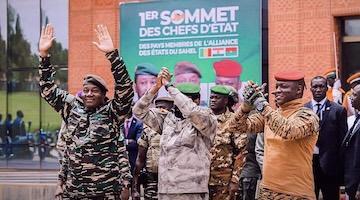
While ECOWAS was threatening an unpopular military intervention in Niger, Niamey joined Burkina Faso and Mali to form the AES in September 2023, which would serve as a collective defense pact to respond to armed violence in the region, and potentially expanded cooperation in political and economic matters.
The AES countries were working to enhance security cooperation after expelling French troops from their soil, nearly a decade after the beginning of France’s failed intervention in the region, purportedly to help combat armed insurgencies. In December 2023, Burkina Faso and Niger followed in Mali’s footsteps and withdrew from the G5 Sahel coalition with Paris, stating that “independence and dignity is not compatible with G5 participation in its current form.”
The Alliance has since held several rounds of multilateral meetings to discuss defense cooperation, food and energy security and economic integration. Finance ministers from the three countries also met in November to discuss steps towards establishing a stabilization fund to help cope with shocks and to create an investment bank.
Within their domestic contexts, these countries have also taken steps to establish greater control over their own resources, particularly in the mining sector.
During a television address on February 11, the president of the CNSP, General Abdourahamane Tchiani had spoken of the possibility of creating a common currency within the AES. “Currency is a sign of sovereignty. We are engaged in the process of recovering our full sovereignty. There is no longer any question of our states being cash cows for France. France has robbed us,” he declared.
Up until recently, countries using the CFA France had to mandatorily place at least 50% of their foreign reserves with the French Treasury, and French officials sat on the boards of the central banks of the CFA Franc zone — all while Paris was able to perpetuate the neocolonial loot of raw materials and natural resources.
France’s promises of “stability” and “macroeconomic strength” have failed to materialize, with countries like Burkina Faso and Niger ranking among the world’s poorest countries despite their immense mineral wealth. Recent reforms to the CFA franc have been dismissed as merely cosmetic by experts, with Paris remaining the guarantor and lender of last resort.
An extraordinary summit of the WAEMU was also held in Abuja following ECOWAS’ meeting to discuss the “socio-economic situation in the region.”
The decision of the AES countries to withdraw from ECOWAS, the formal procedure of which could take up to one year per the 1993 ECOWAS Revised Treaty, dealt a major blow to the credibility of the regional bloc. After its initial threat of an invasion of Niger fizzled, the bloc struck a conciliatory tone, calling on Niger to hold negotiations.
In its communique on Saturday, the bloc reiterated “its commitment to maintaining dialogue with the Government of Niger with a view to securing the release of President Bazoum and agreeing on a transition timetable.” On the withdrawal of the AES states, it stated that the move would affect security cooperation in terms of intelligence-sharing and participation in regional counter-terrorism initiatives.
It also pointed to other financial, socio-economic and political implications, including the “political isolation at the international scene.” In its attempt to urge the three countries to remain in the bloc, ECOWAS has called for their inclusion in technical, consultative, and security-related meetings.
What was also of importance in the communique was the bloc’s statement on the Republic of Senegal, where President Macky Sall recently mounted an unsuccessful bid to postpone the country’s election and extend his time in office — a move widely condemned in the country as a “constitutional coup.”
“The Authority takes note of the end of President Macky Sall’s term of office on 2 April 2024 and commends him for the tremendous achievements in infrastructure and economic development he has realized as President of the Republic of Senegal… The Authority calls on all Senegalese stakeholders to give priority to dialogue with a view to preserving the democratic gains of Senegal through a free, inclusive and transparent Presidential election.”
The bloc’s initial response to the situation in Senegal, “saluting” Sall “for upholding his earlier decision not to run for another term” — a decision he only announced after several people had been killed by security forces during protests in June 2023— drew comparisons by anti-imperialist observers to ECOWAS’ immediate condemnation and sanctioning of the “coups” in Burkina Faso, Mali, and Niger, despite the fact that these had public support.
It also pointed to a broader crisis of legitimacy of governments like Senegal in West Africa, considered a “bastion” of peace and stability, where leaders held close ties to France to the detriment of their population.
“The threat of the military invasion against Niger discredited ECOWAS in the eyes of the populations in the bloc. ECOWAS is an instrument that has been used by France,” Demba Moussa Dembélé, the director of the Forum for African Alternatives in Dakar, had told Peoples Dispatch.
“In principle, the west states that it is against military coups, but they do not care about the realities that led to these coups. It is almost the same reality that led to the big mobilization against Macky Sall and his administration in Senegal. It is economic failure, political failure, social failure, and foreign interference that is the background to the current situation… We are fed up with the neocolonial system… The west wants to continue this system of domination, to plunder our resources and to dictate to our presidents.”
Tanupriya Singh is a writer at Peoples Dispatch.

 European puppet states have undermined themselves and their peoples' needs at the behest of the U.S. Now, that subservience may lead to war.
 Marco Rubio's appeals to Western civilization, Christian heritage, and the defense of Western dominance are fundamental to the consolidating global fascist project, functioning to transform a crisis…
 “So we started to preach the doctrine of self-organization. And we made it very clear what we were after — the genuine multiracial and democratic power of the working people.”
 Artificial intelligence and hyperscale data center buildout constitute a new front of environmental racism and a project to optimize white supremacy, with Black communities targeted as sacrifice…
 Erik Prince's mercenary operations in the Democratic Republic of the Congo serve U.S. imperial and corporate interests in critical minerals and violate the Congolese peoples' sovereignty.


