In this series, we ask acclaimed authors to answer five questions about their book. This week’s featured author is Naa Oyo A. Kwate. Kwate is associate professor of Africana studies and human ecology at Rutgers. Her book is White Burgers, Black Cash: Fast Food from Black Exclusion to Exploitation.
Roberto Sirvent: How can your book help BAR readers understand the current political and social climate?
Naa Oyo A. Kwate: Unfortunately, for a book that begins in the early 1900s and ends in the early 2000s, there are many resonances with the current moment. That is, too many of the inequities that pervaded Black life decades ago continue to persist in the contemporary moment. For example, redlining of Black space by a wide swath of the retail industry remains commonplace. Even the conditions for Black franchisees echo earlier concerns. Just three years ago, a group of Black McDonald's franchisees filed a class-action lawsuit alleging exactly the same kinds of problems that characterized the business for Black operators in the late 1960s and 1970s. The suit charged that McDonald’s was a “financial suicide mission” for Black franchisees, who faced racial steering, disparate treatment, poor store locations, false promises, and more. To read the filing is like reading chapters from my book.
But beyond fast food itself, I think the book relates to the current climate because the issues that are at the core of White Burgers, Black Cash have continually been brought into sharp relief in this moment. If fast food is the quintessential American meal, but Black people have for most of its history been excluded or ill-treated both as consumers and businesspeople, then who is American? Right now, that question of who, ultimately, this country will count as a full member of American society is one that grinds away unanswered. Another example is that food culture, even if it takes place at a restaurant rather than home kitchens, can be charged with fond, but uncritical memories, and nostalgic remembrance rarely stands up to the historical record. Here again, the resonances with the current moment are sharp, because we are in a time when many Americans are rejecting histories that challenge emotionally-laden ideas of what America has been. They would rather a truth-free history.
What do you hope activists and community organizers will take away from reading your book?
I’m thankful for the work activists and organizers are doing in so many spaces, whether housing, environmental justice, policing, maternal & infant mortality, and so much more. I think a take-away from my book is to reinforce how needed their work is. The book does recount some of the ways activists have grappled with fast food, both for (e.g., the Cleveland McDonald’s boycott in 1969; Operation PUSH’s agitation for access to franchises and other business contracts in the early 1980s) and against (e.g., the fast food ban in South Los Angeles in 2008). But the broader fight is against anti-Blackness, which has been at the core of fast food’s operations. Fast food’s relationship to Black communities, whether in exclusion or exploitation relied on so much more than the industry’s specific practices—it required residential segregation, devaluing of Black space, assumptions about the sanctity of Whiteness, the state’s constant turn to capitalism as a “solution” to entrenched inequities, and on and on. All of these are the urgent concerns with which activists and community organizers are currently engaged.
We know readers will learn a lot from your book, but what do you hope readers will un-learn? In other words, is there a particular ideology you’re hoping to dismantle?
I hope readers will un-learn the idea that the retail (and many other things, for that matter) visible on the streets in Black neighborhoods must necessarily reflect the desires and demand of the residents. Many assume that if fast food is prevalent in Black communities, it must be because there is huge demand for these products—the notion that retailers only “see green.” The converse is certainly not true. Retailers routinely avoid Black neighborhoods regardless of how much demand there is, and stereotype the communities as places where residents lack savvy and sophistication. When it comes to fast food, there was never a time, during the long timeline I studied, where Black folks were clamoring to eat as much fast food as they possibly could. To be sure, activists agitated for franchises to be brought in, but that was because fast food franchises was a financial instrument. It had nothing to do with individual consumers eating fast food by the metric ton. As I detail in the book, there were many forces operating to create the food landscape we currently see in Black neighborhoods, including the federal government.
Which intellectuals and/or intellectual movements most inspire your work?
I’m very interdisciplinary in my research, which is reflected in the book—I’ve been inspired by many bodies of work. I don’t know if I have a singular intellectual or movement that stands above them all, but for sure, the work that Black scholars are doing in food studies has been critical. I also gained a lot from urban sociological and urban historical scholarship, both classic and contemporary. As well, I initially came to the project from a public health perspective. The seeds were planted when in 2009 colleagues and I conducted an analysis of the distribution of fast food across the five boroughs of New York City. Public health research on food environments was exploding, and there was a lot of attention to links between fast food, access to fresh fruits and vegetables, and health. We found that the strongest predictor of fast food location was the percentage of Black residents, and that was true after accounting for many key variables, foremost among them being area income. Those results were what led me to what ultimately became White Burgers, Black Cash, because I wanted to know how that racial patterning came to pass. So another important area of work has been fundamental cause theory, which comes out of social science scholarship in public health. It asks what puts people at risk of health risks—causes that are much further upstream than the individual health behaviors people are often fixated on, like diet or exercise. Attention to the risks that cause health risks is critically important for the health of Black folks in this country.
Which two books published in the last five years would you recommend to BAR readers? How do you envision engaging these titles in your future work?
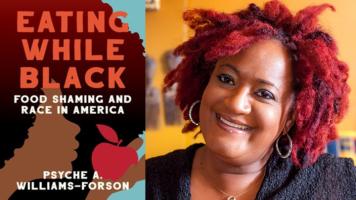
Can I cheat and offer three books? Two are from 2019: Race for Profit: How Banks and the Real Estate Industry Undermined Black Homeownership, by Keeanga-Yamahtta Taylor and Black Food Geographies: Race, Self-Reliance, and Food Access in Washington, D.C., by Ashanté Reese. Taylor’s historical analysis advances the idea of predatory inclusion, which in the case of the housing market meant that African Americans were no longer excluded as they had long been; rather, they were now included, but in a way that was favorable to the industry, not to the African American homeowners. That idea hones in precisely on what happened with fast food’s racial trajectory. The industry went from a stance where it utterly excluded Black people to one in which Black people became central to the bottom line. Reese’s work is ethnographic, and is an interrogation of how people negotiate a context of food apartheid, and as she put its, geographies of self-reliance. She critiques the idea of “nothingness” that pervades scholarly and public discourse about “food deserts”, a term that she calls overly simplistic and that elides the systemic racism at the heart of food environments. The third book just came out last year, and that is Psyche Williams-Forson’s Eating While Black: Food Shaming and Race in America. Her work is a close, interdisciplinary study of what food means, how it figures in Black cultural life, and how Black food practices are distorted and deployed to cast Black people as in need of surveillance and regulation. She draws on a rich tapestry of evidence, including her own experience in a variety of contexts. All three of these books will continue to inform my work going forward.
Roberto Sirvent is editor of the Black Agenda Report Book Forum.


 “The most direct consequence of over-policing is mass incarceration,” said Sergio Hyland, an incarcerated commentator for Prison Radio.
 “The issue of political prisoners goes to the heart of US treatment of African American resistance in the radical tradition,” said former Black Panther political prisoner Dhoruba bin W
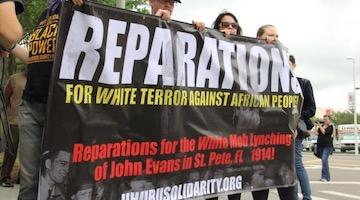 The December 12th Movement has called for nationwide demonstrations demanding Black reparations on August 15, which is the 18thanniversary of the 2002 “Millions for Reparations” rally in Washi
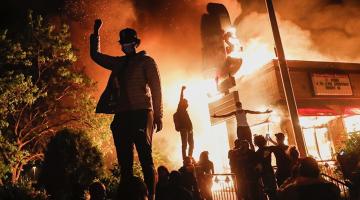 Adam Bledsoe, a professor of Geography, Environment and Society at the University of Minnesota, has compiled a comprehensive “Minneapolis Uprising Syllabus” containing articles and
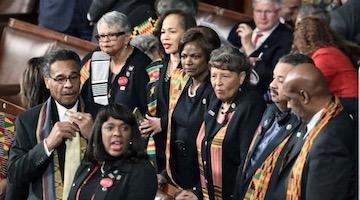 Black politics does not exist in the Democratic Party, because the duopoly system serves only the corporate rulers.


