Reparations for slavery? What about imperialism? A 1932 statement on Dutch imperialism as the exploiter of the masses of Curaçao suggests why.
Late in 2021, Prime Minister Mark Rutte apologized for the Dutch state’s participation in the slave trade and their role in the enslavement of millions of African peoples in the Caribbean colonies of Surinam, Curaçao, St Maarten, St Eustatius, Saba, Bonaire, and Aruba. He also apologized for the Dutch history of slavery in the East Indies. Rutte described slavery as a “criminal system which caused untold numbers of people untold suffering” and acknowledged that that suffering persists into the present. He admitted that “for centuries, the Dutch State and its representatives facilitated, stimulated, preserved and profited from slavery,” while noting that it was not the enslaved, but the owners of the enslaved, who received financial compensation at slavery’s end.
The apology came as a surprise, especially given Rutte’s right wing politics. But as with most apologies for slavery, it was not enough. Many argued that the apology should have come from the Dutch king, Willem-Alexander, not the prime minister, and the announcement should have been made on July 1, 2023 in Suriname, to mark the 150th anniversary of the end of slavery, and not in front of a select audience in the National Archives in The Hague. Moreover, while the government promised to set up a €200m educational fund that would give the history of slavery “the visibility, attention and action that is needed,” a program of reparations was ruled out.
Yet even if reparations were proposed, would it be enough? A price tag certainly needs to be attached to the 250 years of atrocities against those African people whose sweat and blood lent luster to the Dutch Golden Age. But the Dutch history of atrocities did not end with the end of slavery. After emancipation came imperialism. The Dutch territories of enslavement became new lands of extractivism, supported by repressive labor practices and racist legislation.
A 1932 statement on Curaçao in The Anti-Imperialist Review gives one a sense of the conditions of labor under Dutch imperial rule. The statement, written by The Anti-Imperialist League of the United States, a section of the League Against Imperialism and for National Independence, points to how the Dutch state colluded with Dutch capitalists – here, in the form of the Royal Dutch Shell Oil Company – and worked to suppress, brutalize, and impoverish labor in the Caribbean colony at every possible opportunity. (Shell has also left a toxic environmental legacy in Curaçao). For the League, class was as important as race or ethnicity in Dutch imperial practice, and they called for solidarity among the Curaçao masses to push for the end of imperialism and for national independence.
Almost a century later, Curaçao remains a territory of the Kingdom of the Netherlands and the scars of imperialism remain in the Caribbean, and throughout the Dutch world. Yet while Dutch leaders, like their counterparts in the West, seem eager to apologize for slavery, no one wants to apologize for imperialism. And no one wants to compensate the victims of either.
The League’s call for the masses to, “Organize the Struggle against Dutch and Other Imperialist Powers!” is as relevant today as it was in 1932.
A Call to Workers and Peasants of Curaçao
The Anti-Imperialist League of the United States
The situation of the workers and peasants in Curaçao — of native workers, of Chinese, of Venezuelan, of Dutch and other nationalities — is becoming constantly worse under the iron heel of Dutch Imperialism. The Dutch Imperialists in the oil refineries and on the oil tankers have cut wages repeatedly. The Dutch Government has recently levied another head tax. These are only a few of the measures of Dutch Imperialism to throw the burden of the crisis on the shoulders of the workers and peasants of Curacao.
Unemployment is growing rapidly and the unemployed are left to starve. The strikes of the workers against wage cuts are ruthlessly suppressed. A few months ago, two thousand seamen employed by the Royal Dutch Shell Oil Company went on strike against a wage cut. Not long before this, this company discharged over ten thousand workers, both white and Negro, from its refineries. The others were given a wage cut of about one pound sterling. Since then wage cuts, lay-offs, and speed up have been the order of the day.
The recent strike of the seamen, mostly Chinese, came because of the trickery of the Royal Dutch Shell Company, in giving ten Dutch dollars for a pound, instead of the twelve they contracted to pay. Despite exercise of terror and threats of deportation, the strikers carried on a militant struggle. The Dutch Government has already deported about 200 Chinese seamen to Holland, from where they are being sent to China, where they face death at the hands of the Wang Ching Wei Kuomintang butchers.
Dutch Imperialism is the exploiter of the masses of Curaçao pushing living standards down further and further, in an attempt to maintain the super-profits which the exploiters obtain from Curacao. Dutch Imperialism does in Curacao what it does in Java and its other colonies and semi-colonies; just what American, British, French and Japanese Imperialism do in the colonies and semi-colonies under the influence. The masses of workers and peasants in Curacao, regardless of nationality or color, should unite in the struggle against Dutch Imperialism and for immediate and unconditional independence of Curaçao.
The Anti-Imperialist League of the United States, Section of the League Against Imperialism and for National Independence, which is carrying on a struggle against American Imperialism, and for national independence of the colonies and semi-colonies, calls on the anti-imperialist masses in Curaçao to organize themselves into an Anti-Imperialist League of Curaçao. On our part, we promise to carry on agitation inside of the United States, for complete independence for Curaçao from Dutch Imperialism.
We call on all those organizations which agree with the program of the League against Imperialism to get together and to send delegates to a Conference, where a provisional committee of the Anti-Imperialist League of Curaçao can be elected. Especially do we appeal to the Chinese and Venezuelan groups, which in the past have carried on anti-imperialist activities, to take the initiative in the organization of a powerful Anti-Imperialist League. They should draw in the existing trade unions and workers in the basic industries. All individuals agreeing with this program, wherever there are no organizations to take the initiative, should themselves proceed to form branches of the Anti-Imperialist League, which can then send delegates to a Provisional Committee. The Anti-Imperialist League should consist of branches of individual members of the League, and also of affiliated mass organizations already in existence.
Organize the Struggle against Dutch and Other Imperialist Powers!
Organize the Anti-Imperialist League of Curaçao!
Long Live the Anti-Imperialist Struggle of the workers in the Imperialist Countries together with the Colonial Masses!
On with the Struggle for Immediate and Unconditional Independence of Curaçao!
“The Anti-Imperialist League of the United States,” A Call to Workers and Peasants of Curaçao,” The Anti-Imperialist Review 1 Nos. 4-5 (March-June 1932)

 Ngũgĩ wa Thiong'o reminds us that the primary contradiction in Africa is imperialism and its meek comprador bourgeoisie enforcers.
 Over a year in advance, the Black Misleadership Class has kicked their efforts to corral Black people into the Democratic party, despite the Dems’ apathy toward Black politics or the concerns of…
 The US empire is continuing its psychological warfare campaign by conducting a mass mobilization of resources and waging a propaganda offensive to protect its interests in the Middle East.
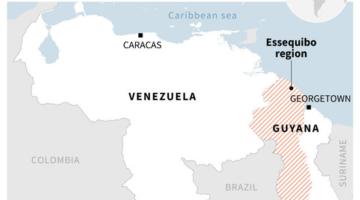 Despite the reality of US intervention causing inhumane conditions in the region, Venezuela’s push for the annexation of Guyana’s Essequibo region prioritizes its own political objectives,…
 Survivors open up about struggles with lingering post-traumatic stress disorder 18 years after the storm


