The Dakar Declaration 2022 calls for Pan-African, South-South cooperation and global solidarity against global economic and political crisis and Africa’s adverse incorporation into the capitalist order.
The Black Agenda Review is proud to reproduce below the Dakar Declaration 2022, with a contextualizing introduction from the Rosa Luxemburg Foundation.
In the last week of October 2022, scholars, activists, and policymakers from around the world gathered at the Museum of Black Civilizations in Dakar, Senegal for the conference “Facing the Socio-Ecological Crisis: Delinking and the Question of Global Reparations”, organized by the African Monetary and Economic Sovereignty Initiative with the support of the Rosa Luxemburg Foundation. Over four days, attendees discussed the lessons learned from the COVID-19 pandemic and their implications for alternative economic models that emancipate the Global South from the domination of Western capital.
At the conclusion of the conference, attendees adopted the “Dakar Declaration”, codifying the principles emerging from the conference and appealing to allies in the Global South and North to build a global movement for economic sovereignty and socially just development. We document the declaration here.
Dakar Declaration 2022
In the spirit of the Arusha Declaration and the Porto Alegre Declaration, we have come together in Dakar from all corners of the world to face a world in crisis under the theme of “African Economic and Monetary Sovereignty”.
We are a group of scholars, policy-makers, and activists from Africa, Asia, Europe, and North America, some of us economists, others political scientists, historians, sociologists, and anthropologists. We address this declaration to African governments, African institutions, and external actors and agencies that constrain Africa’s economic and monetary sovereignty.
Our existing international economic order is at the heart of the contemporary crises. The Global South suffers disproportionately from these multiple crises. Africa’s adverse incorporation into the capitalist order is the problem. We are integral to the system which could not thrive without our exploitation. We dissent from the dominant paradigm in economics which conceptualizes the economy in almost quasi-natural terms and describes a benign world devoid of unequal power relations.
Our global crises are multifaceted: climate breakdown, biodiversity depletion, pollution, speculative finance, war, and rampant inequalities. There is a general crisis of the neoliberal capitalist order with a turn to a resistant form of imperialism. Geopolitical turmoil is a dangerous symptom of both.
We do not accept this set of crises, but confront and seek alternatives to it in solidarity with workers, the landless, peasants, women, climate activists, and similar groups. For these reasons, we launch the Dakar Declaration with the aim of initiating lasting and trusting cooperation with initiatives and movements that share its spirit.
Ten strategic aims serve as our yardstick for action:
- Most of our governments will not implement the transformations we need. We need to become the masses that always push for more.
- Yet, we need strong states, democratic and responsible states. But even more than that, we need stronger peoples to defend those states and push them to always do more for the majority. African states can and should mobilize African labour and resources to meet Africa’s own needs, resuscitating the developmental ambitions of the early post- independence period.
- With a world breaking apart into more regional trade blocs, building regional alliances becomes necessary and possible. The reassertion of our economic and monetary sovereignty and the subjection of foreign interests to our internal needs and interests becomes easier. This growth in policy sovereignty to structurally transform our economies and societies can enable us to fundamentally tackle long-standing issues of poverty, social development, and democratization.
- We must work to build a new multilateralism where global policy fora and institutions are inclusive, democratic, and reflective of the concerns of the Global South’s populations.
- Militarism and imperialism cannot continue to politically mould the world system. We defend a positive neutralism with respect to the historic colonial-imperial bloc, and non-cooperation with their interference in African affairs.
- Global inequalities arising from ecological breakdown and exposure to volatilities in finance and commodity prices put the Global South at a particular disadvantage which we need to overcome.
- Recurrent debt crises have to end. We need to develop a global approach to correct the harmful impact of excessive foreign currency debt — including that issued by the IMF — and odious debts. Widespread, deep, and swift debt write-downs are essential. They must be focused on supporting economic transformation.
- We need to stop the ongoing theft of wealth, committed by transnational corporations (TNCs), which flows into the Global North when TNCs transfer their earnings in tax havens and then invest them in financial markets, all this clothed in the harmless language of “Foreign Direct Investment”. To that end, measures such as capital controls, restrictions on tax evasion and illicit financial flows, and fair taxation of TNCs must be actively promoted and implemented.
- We have to tackle historically persistent inequalities rooted in the emergence and global expansion of the capitalist system. We also need a global reparations agenda to address in a fair manner the multifaceted ecological crisis. We must seek to elaborate this agenda technically, legitimize it, advocate it, defend it, and implement it. We support the efforts of our African American and Caribbean sisters and brothers in their specific labours for reparatory justice.
- We act, teach, research, and mobilize in our local and national contexts, regionally, and transnationally. We do these with the aim of building a lasting movement and acquiring real influence in our political processes.
We are calling for a Pan-African, South-South cooperation and global solidarity for our collective cause. We invite you all to our gatherings during which we share our experiences, evaluate our progress, and plan the next steps.
The time is now!
The Dakar Declaration 2022, Museum of Black Civilizations, Dakar, Senegal, October 2022. Reprinted from MES Africa: The African Economic and Monetary Sovereignty initiative.

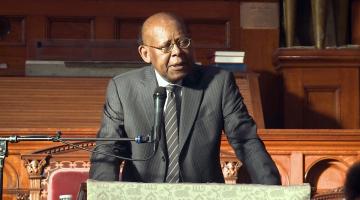 The nation’s best known political prisoner noted the passing of Dr. James Cone, the renowned Black scholar who played a central role in the development of Black liberation theology.
 Three out of four evicted famiies would not have been kicked out of their homes if they had had adequate legal representation, according to a report by the National Law Center on Homelessness and P
 “Solidarity in building an anti-imperialist movement is a fundamental responsibility” of all people that want peace, said Ajamu Baraka, lead organizer of the Black Alliance for Pea
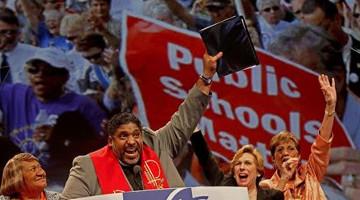 Rev. William Barber II, leader of the Poor People's Campaign, spoke at the New York Avenue Presbyterian Church in Washington, DC, on May 6.
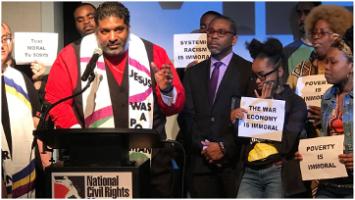 "Rev. Barber speaks for the politically leftish wing of the Institutional Church in the US, which has pretty much anointed him the mantle of the Rev. Dr.



