In this series, we ask acclaimed authors to answer five questions about their book. This week’s featured author is Miguel Valerio. Valerio is Assistant Professor of Spanish at Washington University in St. Louis. His book is Sovereign Joy: Afro-Mexican Kings and Queens, 1539-1640.
Roberto Sirvent: How can your book help BAR readers understand the current political and social climate?
Miguel Valerio: Sovereign Joy: Afro-Mexican Kings and Queens, 1539-1640 explores the performance of festive black kings and queens among Afro-Mexicans between 1539 and 1640. It illustrates how the first African and Afro-creole people in colonial Mexico transformed their ancestral culture into a shared identity among Afro-Mexicans, with particular focus on how public festival participation expressed their culture and subjectivities, as well as redefined their colonial condition and social standing. By analyzing this hitherto understudied aspect of Afro-Mexican Catholic confraternities in both literary texts and visual culture, I tease out the deeply ambivalent and contradictory meanings behind these public processions and festivities that often re-inscribed structures of race and hierarchy. Were they markers of Catholic subjecthood, and what sort of corporate structures did they create to project standing and respectability? Sovereign Joy examines many of these possibilities, and in the process highlights the central place occupied by Africans and their descendants in colonial culture. Through performance, Afro-Mexicans affirmed their Being: the sovereignty of joy, and the joy of sovereignty.
My book can help readers see the centrality of joy for the Black struggle. How our ancestors never gave up. How they used creative ways to seek and wrought joy for itself, as a transformative force, and as outright resistance. How sovereignty was never taken away from us because we could recreate it in the joyful communities we formed in the diaspora.
What do you hope activists and community organizers will take away from reading your book?
The importance of joy for transformative struggle. The struggle demands that we self-care in defiant ways, that we express our defiance in joyful ways. There is nothing as transformative and as assertive of our humanity as joy. I have had the opportunity to see this in my work and during the summer of 2020. In my research, in Chapter 2 of my book, I discuss a case where Afro-Mexicans were persecuted for their festive practices. Despite all the persecution, they did not stop their fiestas. Likewise, in the summer of 2020, I saw many people (and I myself) expressed their (and my) indignation and claims that Black Lives Matter through music and dance. Like many, I see joy as a transformative experience that carries us through the struggle.
Sovereign Joy shows that our ancestors never gave up, that they found creative ways to resist, be it through daily acts of navigating colonial society or grand acts of resistance, at the symbolic and political level. I believe our people have these lessons in them. We come out when police and state violence kill our sons. We protest when our communities are threatened. These are lessons learn not just from the Civil Rights Movement. They predated and fueled the movement. They come from our ancestral roots of resistance.
We know readers will learn a lot from your book, but what do you hope readers will un-learn? In other words, is there a particular ideology you’re hoping to dismantle?
I hope readers will unlearn the single story of Blackness, that odious story of helplessness in the face of oppression. Slavery is not the only story we have to tell about our past. Slavery and racism did not define us. We rose above them to assert our Being in joyful ways. Imagine Black men and women performing as kings and queens in a slave society. That is what our ancestors did. We must do something analogous—express our defiance in nuance ways that assert our Being. We did this with BLM, but we have fallen silent as the violence continues. I live in St. Louis, where Black lives are wasted, disposed of by the state every day. How do we respond to that? How can we allow the same brand of supermarket to sell good products in white neighborhoods and bad ones in Black neighborhoods? This is an immorality that demands our action. Yet we do not say anything, because this supermarket has a monopoly on letting us die, in feeding us death. We must stop buying the death we are sold. Our ancestors refused to buy the death handed down to them by building joyful lives. We must do the same.
Which intellectuals and/or intellectual movements most inspire your work?
The sometimes opposing currents of Afro-pessimism and Afro-futurism inspire me. Afro-pessimism makes sense given our past and help us distill the anti-Blackness underpinning our world. Afro-futurism tells that is not the only story, as I show in my book. Afro-futurism is present in my book in the performances Afro-Mexican staged, projecting a world of Black sovereignty. But Afro-pessimism is there too because Afro-Mexicans were the only Black group that was executed for their festive practices in the Americas. In other, the racism of the time reached its highest level of violence on them. But Afro-Mexicans did not let this racism define their lives. By continuing to practice their festive customs they defied that world and asserted their Being and sovereignty.
If we look to what is being done in Latin America today, we will see a great deal of Afro-futuristic visions coming out, especially in Brazil and the Caribbean. One artist-writer in particular, Marcelo D’Salete, is using stories of Black resistance to challenge the single story, to inspire Black people to resist in a country that is very similar to the US in the way it treats its Black citizens. So, I also hope readers will learn to look beyond the US to expand their understanding of the African diaspora.
Which two books published in the last five years would you recommend to BAR readers? How do you envision engaging these titles in your future work?
Montgomery, Nick, and Carla Bergman. Joyful Militancy: Building Resistance in Toxic Times. AK Press, 2017.
Warren, Calvin L. Ontological Terror: Blackness, Nihilism, and Emancipation. Duke University Press 2018.
These two books are very different and not. Joyful Militancy is an invitation to remember the centrality of community in our activism. Ontological Terror helps us understand the ontological violence visited on Black people by Western philosophy. Joy is a powerful tool in countering that violence, in asserting the Black Being Western philosophy denies. My book is an example of how our ancestors have been doing this from the first days on Western incursion on the Black Being. In other words, how our ancestors knew what they were. As Warren has put it, Black nihilism is not the same as Afro-pessimism—it can be a response. Western philosophy has never recognized our Being. I teach a class about race that starts with St. Paul and goes through the Classics to the moderns, like Warren and Charles Mills. To the white world, we are the nothingness they fear. But is that what we are to ourselves, what we ARE? No! Naturally. We must assert the sovereignty of our Being, the joy of Sovereignty, and the sovereignty of Joy.
Roberto Sirvent is editor of the Black Agenda Report Book Forum.

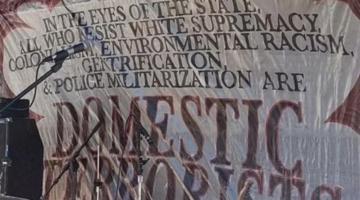 It is clear that Stop Cop City represents one of conjunctural spear tips for expanding the existing systems of counterinsurgency that span Africa, Asia, and the Arab world.
 This week we discuss the bipartisan consensus on punitive immigration policies and a community organizing solidarity event in the Bronx and call for freedom of a political prisoner. But first we talk…
 Frank Chapman and Hatem Abudayyeh join us from Chicago to discuss the city council vote calling for a ceasefire in Gaza and update us on events in Palestine and in Chicago.
 Aly Wane is on the advisory board of the Immigrant Justice Network. He joins us from Syracuse, New York to discuss the failure of the recent immigration bill and the bipartisan consensus on punitive…
 We're joined by Kevin Steele and Raven, two organizers of the Spirit of Mandela Coalition and About the People. We discuss their work and the "People's Senate Giveback & Genocide Convention…



