In this series, we ask acclaimed authors to answer five questions about their book. This week’s featured author is Sami Schalk. Schalk is Associate Professor of Gender and Women’s Studies at the University of Wisconsin–Madison Her book is Black Disability Politics.
Roberto Sirvent: How can your book help BAR readers understand the current political and social climate?
Sami Schalk: Black Disability Politics helps readers understand how disability has regularly played a role in the political and social organizing of Black people by analyzing how the Black Panther Party and the National Black Women’s Health Project engage with disability in their work. The book argues that this history of Black disability politics is often overlooked because the tactics look different than the mainstream pre-dominantly white disability rights movement. I then place this history in conversation with contemporary Black liberation work through interviews with contemporary Black disabled activists and cultural workers. There are two praxis interlude chapters in the book that explicitly discuss lessons we can learn from the missteps of previous Black activists in order to do better Black disability political work today. My hope is that the book helps readers to see the critical necessity of disability to our political organizing and to better comprehend the way racism relies upon ableism to function and vice-versa, therefore we cannot dismantle one without dismantling the other. I hope this understanding of ableism’s relationship to racism improves readers’ ability to identify the role of disability in our current political and social concerns, from the crisis of the unhoused to the COVID-19 pandemic.
What do you hope activists and community organizers will take away from reading your book?
I hope activists and community organizers take away a sense of history and legacy for their work. I think it’s important to recognize that we are not the first and to build on the lessons of our elders and ancestors, to build a political and social movement to responds to our contemporary circumstances. In this particular case, I hope the book helps activists and community organizers see the necessity of including anti-ableism in their work and encourages them to commit to accessible organizing in the future, no matter what social or political issue they’re attempting to address. I hope this book makes more Black activists and community organizers come out as disabled and move toward models of disability justice in their work and their lives—growing the Black disability political community the book documents. Activists, organizers and cultural workers are a central audience for this book. That’s why I worked to ensure the book would be made open access online so that anyone who wants to read and learn about this topic can do so. I care way more about the information being out there and being useful than I do about book sales. I hope organizations and activist groups will be able to read, talk about and process the book together like the consciousness-raising groups of the early women’s liberation movement did.
We know readers will learn a lot from your book, but what do you hope readers will un-learn? In other words, is there a particular ideology you’re hoping to dismantle?
First and foremost, I hope that readers unlearn the idea that Black people have primarily avoided or denied disability within our communities. That’s a common narrative, especially in disability studies, that I believe has been used to overlook the really interesting, important, and innovative ways Black cultural workers have addressed disability as a political concern specifically tied to anti-Black violence, including the violence of state neglect. It’s not that Black people aren’t disabled or aren’t addressing ableism, we’re just doing it (and have been doing it for a long time) differently than the disability rights movement with has historically been very civil rights and single-issue focused. Black disability political work tends to work different, more holistic and broad and more focused on the how anti-Black racism creates and exacerbates disability in our communities. I want to help dismantle the idea that disability is a white thing or that Black people don’t do anti-ableism work. Just because we’re not using the same language or the same tactics doesn’t mean we don’t have similar goals for liberation.
Which intellectuals and/or intellectual movements most inspire your work?
I’m most inspired by Black feminism as an intellectual movement. Black feminist changed if not straight up saved my life. I keep my favorite classic Black feminist texts—Audre Lorde’s Sister Outsider, bell hooks’ All About Love, Patricia Hill Collins’ Black Feminist Thought, and Hull, Bell-Scott and Smith’s …But Some of Us Are Brave—close to me in my home office and my walls have lots of Black feminist inspired quotes and art. My intersectional approach to Blackness and disability in most grounded in my intellectual lineage as a Black feminist. I think frequently about Black women attempting to address racism within the women’s liberation movement and sexism within the Black liberation movement and it feels so similar to my experiences being an academic, writer and organizers in Black/POC and disability spaces. I have long desired an intellectual home where I don’t have to explain disability or race to people; where I am not the only Black or (openly) disabled person in the room. Disability justice has become the space for that for me so that would be my other major intellectual influence. For that I have been heavily influenced by the work of TL Lewis, Thompson, Leah Lakshmi Piepzna-Samarasinha, Mia Mingus, and the group Sins Invalid (disabled people of color)
Which two books published in the last five years would you recommend to BAR readers? How do you envision engaging these titles in your future work?
This is hard! I would say first is definitely Pleasure Activism: The Politics of Feeling Good by adrienne maree brown. Maybe that’s cheating since I have a chapter/interview in the book, but truly it was a transformative text for me. The concept of pleasure activism—the idea that pleasure is political and a barameter for freedom and liberation—helped me bring together things I am passionate about in my professional and personal life under one conceptual umbrella. I identify as a pleasure activist (and artist!) now and my next project aims to explore how multiply marginalized people are engaging in pleasure activism through the creation of identity-specific safe spaces and events. The second book I’d recommend is Beyond Survival: Strategies and Stories from the Transformative Justice Movement, edited by Ejeris Dixon and Leah Lakshmi Piepzna-Samarasinha. I read this book in 2020 very very slowly because there was so much complex and hard information about how to actually do the work of transformative justice in ourselves, our relationships and our larger communities. The book is a toolkit, a model and a map. It’s an activist text that I think a lot of academics invested in social justice and reaching audiences outside of academia would benefit from reading.
Roberto Sirvent is editor of the Black Agenda Report Book Forum.

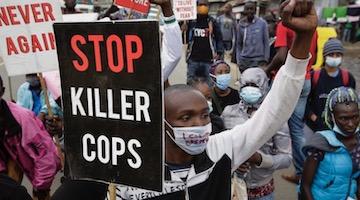 The Black judge listed the injustices of “qualified immunity,” which allows police and other government officials to escape liability for their law breaking.
 Some coronavirus deaths, especially early on, were mistakenly attributed to other causes.
 The same corporate media that shamelessly boosted Biden’s candidacy, even when his popularity plummeted, never question his sudden comeback at the polls.
 Harris’ identity as a woman of color has been propped up to cover for her decades-long loyalty to the ruling class, locking up working-class and poor people and deporting migrants.
 “Voluntourists” in Africa are actually jihadists for the West who defecate all over the continent in every way that defecation is possible.



