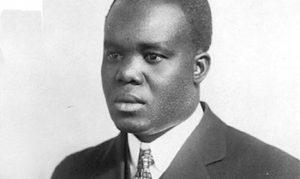
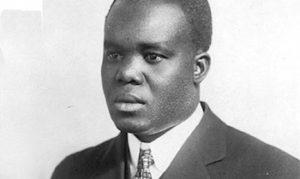
Hubert Henry Harrison was one of the foremost Black socialist and nationalist thinkers of the early 20th century. He was known as "the father of Harlem radicalism." This is the first of a three-part commentary on works about Harrison beginning with A Hubert Harrison Reader, which will be followed by Hubert Harrison: The Voice of Harlem Radicalism, 1883-1918, and Hubert Harrison: The Struggle for Equality, 1918-1927.
Over the past two decades there has been an upsurge of interest in the life and work of Hubert H. Harrison. As a leading socialist and subsequent proponent of what he termed the mass based “Race First” approach to organizing, Harrison exercised a direct seminal influence on his contemporaries including A. Philip Randolph, W. A. Domingo, Marcus Garvey, Richard B Moore, Chandler Owen, Arturo Schomburg, Cyril Briggs, Claude McKay, James Weldon Johnson, Hodge Kirnon, J. A. Rogers and William Monroe Trotter. As W. A. Domingo, childhood friend of Garvey and first editor of the Negro World would later explain, “Garvey like the rest of us followed Hubert Harrison.”
Other literary figures, Harrison’s contemporaries, such as Eugene O’Neill, Henry Miller and Max Eastman, acknowledged his contributions. Radical socialists such as “Big Bill” Haywood and Elizabeth Gurley Flynn shared the podium with him at the Patterson Silk Strike rally in 1913. In 1922 when Claude McKay was commissioned by the Comintern in the Soviet Union to write an analysis of the condition of the Negro in the US, the Soviet leaders handed McKay Harrison’s books for reference. Of course, McKay was already a friend and comrade to Harrison prior to his visit to Moscow.
Interest in Harrison has been spurred in large part by the release of A Harrison Reader (Wesleyan University Press, 2001) edited by Jeffrey B. Perry and the 2-volume biography, Hubert Harrison: The Voice of Harlem Radicalism, 1883-1918 (Columbia University Press 2009) and the recently released Hubert Harrison: The Struggle for Equality, 1918-1927 (Columbia University Press 2021). Perry also assisted with the Diasporic Press reprint of Harrison’s When Africa Awakes: The “Inside Story” of the Stirrings and Strivings of the New Negro in the Western World first published by Porro Press in 1920. These books bring to our attention important writings and organizing efforts undertaken by Harrison at a critical conjuncture of national and international events between 1910 and 1927.
Perry has also traveled at his own expense around the country to give numerous free public talks on Harrison, many of which may be viewed online through his website: https://www.jeffreybperry.net/
Jeffrey Perry is the literary executor for Theodore W Allen (The Invention of The White Race, Verso, 1994, 1997) and a well-trained, independent scholar with degrees from Princeton and Columbia Universities. He has conducted his research for the Harrison volumes while living and working among the people, as an anti-white supremacist activist and labor union leader, husband, and father based in Northern New Jersey.
A Hubert Harrison Reader
A Hubert Harrison Reader and the two-volume biography are the product of a 40-year research project based on primary sources including Harrison’s own papers which had been preserved by his family in Harlem apartments after his early death at 44 in 1927. The Harrison Papers have now been archived in the Columbia Rare Books and Manuscripts Section available to the public: http://www.columbia.edu/cu/lweb/archival/collections/ldpd_6134799/
A Hubert Harrison Reader and the 2 volume biographies provide a window for those interested in: the struggle against white supremacism; capitalism and Imperialism in the early 20th century; the rise of the New Negro Movement; the Garvey movement; early efforts to build mass based radical Black organization; questions of leadership arising in mass based radical organizations; and the signal importance of education and culture to the growth of social movements. Labor and Black activists, students and educators interested in such topics such as Critical Race Theory and Black Marxism may find in Harrison an early, though heretofore unacknowledged, resource.
A Hubert Harrison Reader contains published and unpublished articles, book reviews, letters and diary entries organized thematically and preceded by brief contextual remarks by Perry. Harrison’s own words will readily engage the modern reader just as his talks and writings influenced a wide audience in the socialist and New Negro movements between 1911-1927. The iconoclastic author Henry Miller, reflecting 40 years later on his days as a young socialist in Manhattan, described Hubert Harrison as his “quondam idol.” The noted historian J. A. Rogers described the program that Harrison espoused as the “sanest.” Harrison’s relationship with Marcus Garvey and the United Negro Improvement Association (UNIA) are well documented and examined in detail in the most recently published second volume, Hubert Harrison: The Struggle for Equality,1918-1927.
A cursory look at the “Contents” in A Hubert Harrison Reader brings to mind William Faulkner’s oft quoted phrase; “The past is never dead. It’s not even past.” Some titles included are: “The Duty of the Socialist Party” (1911); “The Negro and the Labor Unions” (1917); “The Liberty League’s Petition to the House of Representatives of the Unity States, July 4, 1917”; “The East St. Louis Horror”(1917); “The Women of Our Race” (1919), “Race Consciousness” (1924), “Lincoln and Liberty: Fact versus Fiction” (1921), “U-Need-A Biscuit” (1920), “Marcus Garvey At the Bar of United States Justice” (1923), “The White War and the Colored Races” (1917), “Wanted – A Colored International” (1921), “The Cracker in the Caribbean” (1920); “The Virgin Islands: A Colonial Problem” (1923);“A Cure for the Ku-Klux” (1919); “ ”Democracy” in America” (1921); “The Program and Principles of the International Colored Unity League” (1927).
The two-volume biographies are prodigious, scholarly tomes, chronological, thoroughly documented and richly evocative of Harrison’s struggles to juggle family and personal relationships with his political commitments often in the face of dire poverty. They stand as a challenge to historians and serious students of US social history who have, with few exceptions, overlooked Harrison’s seminal contributions and leading roles in both the Socialist Party and the New Negro Movement.
Sean I. Ahern is a retired NYC public school teacher, father, grandfather and husband. He was previously active in labor struggles in the Postal Service and NYC Transit Authority.





 The Vienna Convention on Diplomatic Relations protects the rights of Alex Saab. But the Trump administration violated international law in charging him with a crime and the Biden administration…
 Intelligent observers know that the state uses corporate media to spread its narrative. Recently the Biden administration admitted what was already obvious.
 Despite its promises of universalism, international law has clearly not yet shaken its foundation as a racial order. The author observes the contradictions in South Africa.
 Noosim Naimasiah interviews Irene Asuwa and Cidi Otieno about food sovereignty, ecologically appropriate production, distribution and consumption, social-economic justice, and local food systems…
 President Joe Biden is proposing $30 billion in new funding to states and localities to hire more police. He and other democrats make clear they want to silence the demand for defunding the police.…


