Black Agenda Report
Black Agenda Report
News, commentary and analysis from the black left.

  • Home
  • Africa
  • African America
  • Education
  • Environment
  • International
  • Media and Culture
  • Political Economy
  • Radio
  • US Politics
  • War and Empire

Black Agenda Radio for Week of April 20, 2020
Black Agenda Radio with Margaret Kimberley and Glen Ford
20 Apr 2020
🖨️ Print Article

Covid-19 and the Black Working Class

“Social distancing is sometimes not an option for us,” said New York City activist Betty Davis at a Black is Back Coalition national teleconference. “When they close the schools, many working class people don’t have a partner, so they have to rely on extended family.” Coalition chairman Omali Yeshitela called Covid-19 “a colonial virus. Colonialism is when somebody else controls every aspect of your life,” including your ability to resist a pandemic.

Public Housing Neglect Creates Lethal Trap

“You have these areas that are not clean and, on top of that, you have folks that don’t have access to health care because of racism and capitalism,” said Philip McHarris, a Yale University doctoral student active in public housing. McHarris wrote an article for Essencetitled, “Public Housing Residents May Be Some Of The Hardest Hit by the COVID-19 Outbreak.”

“Decolonizing” Science in Multi-Language Africa

South African communicator and journalist Sibusiso Biyela wrote an article on “decolonizing” science so that it is accessible to the country’s many indigenous language groups. “What’s most important for me is the idea of democratizing science, so that more people will be participating in it,” said Biyela. It’s important that Africans “learn the skills that come of science, such as critical thinking and skepticism.

Black Agenda Radio on the Progressive Radio Network is hosted by Glen Ford and Nellie Bailey. A new edition of the program airs every Monday at 11:am ET on PRN. Length: one hour.

Black Agenda Radio

Related Podcasts

Black Agenda Radio
Black Agenda Radio with Margaret Kimberley
Black Agenda Radio March 8, 2024
08 March 2024
This week, Deborah Jones and Thandisizwe Chimurenga joins us to discuss the book, "What We Stood For: The Story of a Revolutionary Black Woman", an
Black Agenda Radio April 1, 2022
Black Agenda Radio with Margaret Kimberley
Black Agenda Radio April 1, 2022
01 April 2022
Left Voices are Censored
 Black Agenda Radio for Week of July 19, 2021
Blsck Agenda Radio with Maergaret Kimberley and Glen Ford
Black Agenda Radio for Week of July 19, 2021
21 July 2021
Black Agenda Radio for Week of July 19, 2021 Class Struggle Shapes Haiti Political Conflict

More Stories

  • Digital apartheid: Palestinians Being Silenced On Social Media
    Omar Zahzah
    Digital apartheid: Palestinians Being Silenced On Social Media
    19 May 2021
    Social media companies, from Zoom to Facebook and Twitter, are reinforcing Israel’s erasure of Palestinians.

  •  Afro-Pessimism and the (Un)Logic of Anti-Blackness
    Annie Olaloku-Teriba
    Afro-Pessimism and the (Un)Logic of Anti-Blackness
    19 May 2021
    Entrenched in anti-racist theory and practice today is the belief that all racial and ethnic domination is structured around a global hierarchy, with “white” people at the top and “black” people at
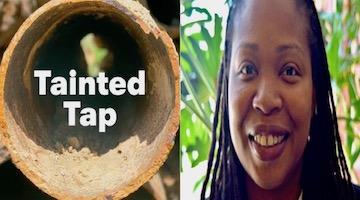
  • BAR Book Forum: Katrinell M. Davis’ “Tainted Tap”
    Roberto Sirvent, BAR Book Forum Editor
    BAR Book Forum: Katrinell M. Davis’ “Tainted Tap”
    19 May 2021
    Activists and community organizers should be inspired by the work of elders engaged in social change.
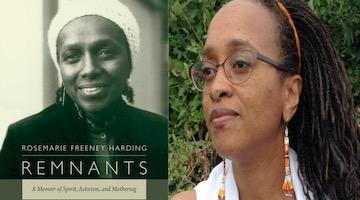
  • Forum: Rosemarie Freeney Harding and Rachel Elizabeth Harding’s “Remnants”
    Roberto Sirvent, BAR Book Forum Editor
    BAR Book Forum: Rosemarie Freeney Harding and Rachel Elizabeth Harding’s “Remnants”
    19 May 2021
    There is a need and desire among folks in activist communities for resources of ritual and spiritual grounding.
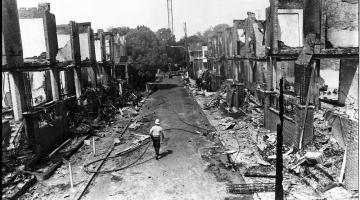
  • Saying Her Name
    Heather Ann Thompson
    Saying Her Name
    19 May 2021
    Remains that were found to be those of a Black MOVE teen-ager who was killed by Philadelphia police in 1985 were treated as an anthropological specimen.

  • Load More
Subscribe
connect with us
about us
contact us