The author examines the framing power of sexuality as an ideology of respectability and control.
“Artists often work at the boundaries of the historical and the imaginary.”
In this series, we ask acclaimed authors to answer five questions about their book. This week’s featured author is Amber Jamilla Musser. Musser is Associate Professor of American Studies at George Washington University. Her book is Sensual Excess: Queer Femininity and Brown Jouissance.
Roberto Sirvent: How can your book help BAR readers understand the current political and social climate?
Amber Musser: We're in a moment when a lot of people seem to be very anxious about encountering what they perceive to be otherness. We see this especially in terms of attacks on black people, immigrants, LGBT people, etc. While this book does not explain this demonization, a lot of what it focuses on is how these groups have already been subject to more subtle forms of oppression through cultural ideas surrounding sexuality. Sensual Excess: Queer Femininity and Brown Jouissance identifies many of the different ways that these forms of domination work through attempts to control people's bodies, behaviors, and feelings. The book contains some of the historical arcs of this cultural policing in addition to showing us how these discourses appear now. One of the things that the book talks about is how narratives of “appropriate” familial relationships, which tend to center on the idea of a nuclear family have been used to deem other family formations perverse. In many cases, this demonizes (or at least de-prioritizes) many particularly important relationships that lie outside of these bounds. But, mainly, this is a book that is full of hope; in many ways it is a wish toward a new vision of sensuality that is unfettered from these forms of oppression, but it is also making the argument that these modes of thinking about sexuality have always already existed. We just need to apprehend them!
What do you hope activists and community organizers will take away from reading your book?
The main thing I hope activists and community organizers will take away from the book is the importance of changing how we know what we know. So many of the discourses that have been used to oppress others come from world views that we have been trained to take for granted. There is a huge power in learning how to see how power has been structured—in this book I talk about the framing power of sexuality as an ideology of respectability and control—AND a huge amount of power in being able to produce alternative narratives. Much of this process of imagining new worlds comes from un-learning things and imagining worlds and logics anew. This means not only producing an alternative interpretation, but prioritizing sources of knowledge that can help create that world view. In this book these other sources of knowledge are very much based in the knowledge that comes through the non-visual senses of the body—through touch, smell, etc. Thinking about these as vibrant sources of knowledge and world making is empowering.
We know readers will learn a lot from your book, but what do you hope readers will un-learn? In other words, is there a particular ideology you’re hoping to dismantle?
In a lot of ways this book grew out of my previous work, Sensational Flesh: Race, Power, and Masochism, which argued (among other things) that our concepts of modern sexuality have taken for granted a certain relationship between subjectivity and agency that makes it theoretically impossible for racialized people to access sexuality, but, of course, people do. So, in this book I was interested in thinking about these spaces of racialized erotics that move outside of established frameworks for thinking about subjectivity and agency. I found art to be a particularly compelling site to think with because artists are often working at the boundaries of the historical and the imaginary.On the one hand, the book uses works of art to illustrate how racialization activates particular projections of gendered sexuality, a process that Hortense Spillers calls pornotroping. On the other, I argue that these artists simultaneously show us how to think about modes of relationality that lie beyond these projections, a space that I call brown jouissance. It is a book that grapples with the legacies of racialized sexuality while also working to center race in order to explore other modes of relating to and being with others. I actually envision this whole thing as a trilogy with the next part of the project working further beyond the pornotrope to see how folks have distorted representation to come up with new/old ways of relating to others. I’m hoping that the book dismantles our current ways of thinking about sexuality and moves us toward thinking about the politics of the aesthetic and the power of sensuality.
Who are the intellectual heroes that inspire your work?
While my work is obviously very indebted to scholars like Hortense Spillers and Frantz Fanon, I feel very fortunate to be a scholar in this moment when so many of my contemporaries are also doing such exciting and fabulous work. I am particularly inspired by Omise’eke Natasha Tinsley, whose work pushes boundaries of how we can think about race and gender by focusing on the Caribbean. Her first book, Thiefing Sugar, has beautiful and careful analyses of racialized sexuality in the Caribbean and her second, Ezili’s Mirrors, is a model for centering diaspora in thinking about US formations of gender. It is also methodologically amazing in that it weaves together history, performance studies, and personal memoir. I’m in awe of the ways that she weaves together the personal with the political while keeping the scholarly rigorous and creative. I also love that she is especially invested in femininity, which I hope is experiencing a theoretical and political resurgence.
“Octavia Butler and N.K. Jemisin make clear the different types of ways of thinking about bodies, power, and how to relate to others.”
Christina Sharpe’s work is also really amazing. I already loved Monstrous Intimacies because it shows us so much about how to think through the power dynamics between blackness and whiteness and how they play out in lots of different subtle dynamics, but In the Wake is a really dynamic exploration of the place of blackness in the world now. It is beautiful, evocative, and theoretically rich. It is also a model for political thinking that transforms; it acknowledges suffering but moves us beyond that space. I also learn a lot from the fiction of Octavia Butler and N.K. Jemisin because both really make clear the different types of ways that we have for thinking about bodies, power, and how to relate to others. I especially find a lot of inspiration in Butler’s Lilith’s Brood trilogy and Jemisin’s Broken Earth trilogy. Both of which really show us how to imagine new worlds starting from things we already know.
In what way does your book help us imagine new worlds?
I really hope that by centering art, Sensual Excess helps us to see what might be possible. It is a book that really asks us to sit with art in that it explores the different types of sensual knowledge that art can produce. This knowledge, in turn, is what I hope can help us build new worlds. Not only because of its content, but because it tells us how to pay attention to the world differently. It helps us to activate knowledges that have been held by many others, but has often been suppressed through the disciplining of bodies and frames of knowledge. This knowledge is the sensual excess that the book’s title refers to. In addition to this, I hope that by centering imaginaries that themselves center people of color—in addition to discussing black artists like Mickalene Thomas, Kara Walker, and Carrie Mae Weems, I also discuss Latinx artists Nao Bustamante and Xandra Ibarra and Asian/American artists Patty Chang and Maureen Catbagan—we can learn to prioritize these forms of racialized knowledge. I also hope that this multi-racial arrangement helps us to see modes of organizing coalitions and forms of knowledge that bring together multiple marginalized peoples, not by asserting that struggles are the same or interchangeable, but by working to share tactics for subverting oppressive forms of knowledge.
Roberto Sirvent is Professor of Political and Social Ethics at Hope International University in Fullerton, CA. He also serves as the Outreach and Mentoring Coordinator for thePolitical Theology Network. He’s currently writing a book with fellow BAR contributor Danny Haiphong called American Exceptionalism and American Innocence: A People’s History of Fake News—From the Revolutionary War to the War on Terror.
COMMENTS?
Please join the conversation on Black Agenda Report's Facebook page at http://facebook.com/blackagendareport
Or, you can comment by emailing us at comments@blackagendareport.com

 What is it about Chávez and the national-popular movement bearing his name that is so threatening to the US Empire to this day?
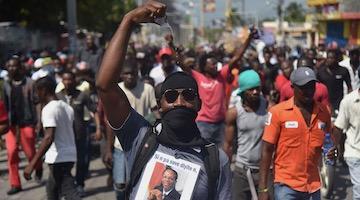 The West’s treatment of Haiti confirms that white supremacy has still not abandoned its plan to impose a racially racist, violent, capitalist and imperial world order.
 Community Control is Best Route to Abolishing Policing As We Know It
 To justify US and European military occupation of much of Africa, migrants seeking jobs in the north of the continent or in Europe “are labeled as criminals and terrorists” when they are “just look
 At a webinar last week, Jericho Movement chairperson Jihad Abdulmumit said the Black Is Back Coalition’s National Black Political Agenda for Self-Determination “covers everything,


