“Cutting-edge biomedical technology actually perpetuates certain inequalities.”
In this series, we ask acclaimed authors to answer five questions about their book. This week’s featured author is Ari Larissa Heinrich. Heinrich teaches in the Literature Department at the University of California, San Diego. His book is Chinese Surplus: Biopolitical Aesthetics and the Medically Commodified Body.An open access version of the book is now available here.
How can your book help BAR readers understand the current political and social climate?
Mainstream media tend to praise new developments in biotechnology unconditionally. After all, biotechnology just gets more and more amazing: You can trace your DNA, transplant a face, regulate (or try to regulate) a market in kidneys; you can be a surrogate mother; you can even donate fecal matter to repopulate a partner’s faulty flora. But there is always a price. Often, one person’s profit comes at another person’s expense. My book describes ways in which cutting-edge biomedical technology actually perpetuates certain inequalities—as well as ways that artists can respond critically to these inequalities. My book offers case studies of representations of Chinese people and cultures in experimental art and popular science, but you can find examples from any context where art and popular science use biotechnological innovations to describe historically disenfranchised groups.
What do you hope activists and community organizers will take away from reading your book?
The book is very academic, especially the introduction, which focuses a lot on political theory. This theoretical introduction outlines how various critics have explained the structural inequalities that contribute to distribution of “wealth” when it comes to the products of modern biotechnology (“products” like organs for transplant, plasma for transfusion, or wombs for surrogate pregnancy). But individual chapters, organized as overlapping case studies, examine how both popular science exhibits and contemporary artists respond to these inequalities in their work. In the case of popular science, for instance, sometimes we find that what is presented as “universal” or “human” actually reproduces social structural inequalities, rather than illuminating them.
“Zhang Dali used plastinated human cadavers to draw attention to the plight of migrant laborers in Mainland China.”
A case I explore in detail concerns notorious traveling anatomical exhibits featuring plastinated human cadavers—cadavers often rumored to come from executed Chinese prisoners. Incredibly successful from New York to Beijing, most plastinated cadaver exhibits claim to use the bodies for anatomical education, but in fact their production and consumption depend historically on a complex network of economic and social arrangements that perpetuate stereotypes about Chinese cultural practices (not to mention about race, gender, class, and ability).
By contrast, certain contemporary Chinese artists have found ways to use biotechnological materials to express profound critiques of social inequalities; the artist Zhang Dali, for instance, at one point used plastinated human cadavers as sculptural materials to draw attention to the plight of migrant laborers in Mainland China. Other artists I discuss in the book deploy controversial corporeal materials like blood, skin, and preserved fetuses to critique inequalities in China at the turn of the 21stcentury. Chapters 2, 4, and the epilogue might offer activists and community organizers examples of how some artists use their work to resist larger global trends in the commodification of the human body.
We know readers will learn a lot from your book, but what do you hope readers will un-learn? In other words, is there a particular ideology you’re hoping to dismantle?
In a very basic sense, an ideology that I hope to dismantle is the ideology of “progress” that assumes a) that biotechnological innovation is always purely scientific, and b )that science is inherently blind to social inequalities. The latter in particular will always be a fight. We want to believe that advancements in medicine and science can apply universally to any human, and this philanthropic outlook can help drive innovation. Yet in real terms many innovations in biotechnology come at someone else’s expense (or are transacted at someone else’s expense). The case of Henrietta Lacks (1920-1951), an African-American woman whose genetic material was collected and cultured without consent, is a classic example of this kind of imbalance. [1]
“Many innovations in biotechnology come at someone else’s expense.”
In my book, an example of biotechnological innovation that promises universality but delivers inequality concerns kidney transplant practice in Hong Kong in the late 1990s, on the eve of the handover from British Colonial to Mainland Chinese rule (Chapter 3). Where State public health rhetoric encouraged everyday people to donate organs, for example, the lived experience of some of Hong Kong’s underclass was that kidneys were distributed unequally; that healthcare accessibility was uneven; and that Mainland Chinese governance was unlikely to make things any better. My book examines social inequalities like this not through sociology but through art: in this example, through close readings of independent films by the director Fruit Chan (in particular his film “Made in Hong Kong” (陳果)), and also of millenial “horror” films like the Pang Brothers’s classic The Eye(見鬼).
Who are the intellectual heroes that inspire your work?
Some scholars and thinkers whose work has directly inspired this book include Lydia Liu and Lisa Lowe, as well as Walter Benjamin and Stuart Hall. Presently I am inspired by the work of the artist Jes Fan, who grew up in Hong Kong and is now based in New York (www.jesfan.com). As an artist, Fan’s fearless engagements with medical science through laboratory collaborations and incorporation of biological materials—ranging from skin-creams made from estrogen extracted from their mother’s urine, to melanin cultured in the lab according to certain specifications and then applied to the surfaces of sculptures—use cutting-edge biomedical technologies as art to expose the constructed foundations of race, of gender, and of kinship in genuinely original and exciting ways.
In what way does your book help us imagine new worlds?
Like many academics in the humanities whose work originates in a kind of idealism, I hope to contribute in some way to imagining a new and better world. But I have no illusions about the struggle that must happen along the way. One area to explore more deeply is the mutual interconnectedness of art and science in the age of biotech. We default too easily to the assumption that art is always distinct from science, when in fact art and science are deeply intertwined and always have been. What would it look like to expose the inequalities that inform innovations in biotech, and then to imagine more equitable processes for developing (and applying) that biotechnological innovation? Some of the best art challenges the authority of science. Sometimes it does so by incorporating (and “flipping” or appropriating) scientific materials; sometimes it does so by reinventing science itself; and sometimes it does so by providing a fearless glimpse of what the future can look like, in all its beautiful ugliness.
Roberto Sirventis Professor of Political and Social Ethics at Hope International University in Fullerton, CA. He also serves as the Outreach and Mentoring Coordinator for the Political Theology Network. He’s currently writing a book with fellow BAR contributor Danny Haiphong called American Exceptionalism and American Innocence: The Fake News of U.S. Empire.
[1] On the story of Henrietta Lacks, see Rebecca Skloot, The Immortal Life of Henrietta Lacks, New York City: Random House, 2010.

 SCOTUS, Roe v Wade and left politics, Racism in UK immigration policy, and Workers' Struggle in Haiti in this week's Black Agenda Radio.
 Pascal Robert is co-host of the This is Revolution podcast. He is also a long-time contributor to Black Agenda Report as well as to Newsweek. He joins us from Miami, Florida to discuss the recent…
 Glenroy Watson is a Pan-African trade unionist who is Secretary of the Global Afrikan Congress, UK Chapter. He joins us to discuss the continuation of Hostile Environment immigration policies in the…
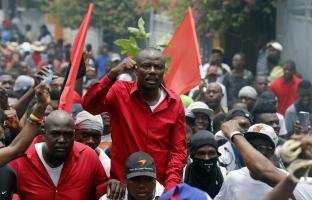 Dahoud Andre is a member of KOMOKODA, the Community to Mobilize Against Dictatorship in Haiti, and host of Eritye Papa Desalin, the Heirs of Jean Jacques Dessalines, a daily Haitian community radio…
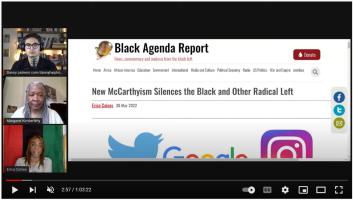 Erica Caines, Editor of Hood Communist and Coordinating Committee Member for the Black Alliance for Peace, joins the stream to discuss the New McCarthyism and its implications.


