“When the bubble bursts we will need a network of worker cooperatives and people’s assemblies to sustain us.”
“Revolution is based on land. Land is the basis of all independence. Land is the basis of freedom, justice, and equality…. — Malcolm X
Jackson Rising is the most important book I have read in a long time. Organizers are going to love it. If you wonder what democracy might look like in our time — here it is.
Jackson Rising is the rarest of things: a real strategic plan. You will not find a simple wish list that glosses over the hard questions of resources, or some disembodied manifesto imploring the workers forward, but a work-in-progress building the capacity of people to exercise power.
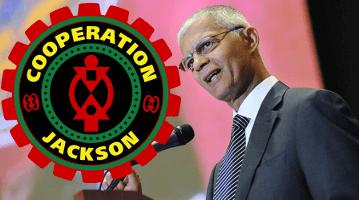
And that project is Cooperation Jackson. Cooperation Jackson is an emerging network of cooperatives and grassroots institutions that aim to build a “solidarity economy.” By seizing on the crisis and weak links of modern capitalism and building on the historic struggles for racial equality by the black people of Mississippi, Cooperation Jackson has created a model we can all learn from.
“Cooperation Jackson is an emerging network of cooperatives and grassroots institutions that aim to build a “’solidarity economy.’”
Just as important, Jackson Rising shows the value of deep organizing. Decades of persistent organizing efforts have empowered the people of Jackson to purse agendas of their own creation.
The editors, Kali Akuno and Ajamu Nangwaya, are both writers and organizers. They have contributed comprehensive, insightful and historically grounded accounts of the struggle in Jackson. The interview with Sadajewea Hall, another organizer, reveals just how central issues of patriarchy are to any attempt to achieve the solidarity economy Cooperation Jackson aims to bring into being. While some essays will be easier for readers acquainted with socialist and anarchist discourse, the general themes transcend ideological borders.
Almost all progressives value, or should value, economic democracy and direct, participatory democracy; cooperation rather than competition; environmental restoration rather than environmental destruction; and the need for a fundamentally transformative political vision. The land is the first and most essential commons — the original means of production — and all progressives should stand for the return of land to the people.
“Akuno and Nangwaya have contributed comprehensive, insightful and historically grounded accounts of the struggle in Jackson.”
Decades of experience in Jackson demonstrates that democracy walks on two legs: one economic, the other political. Peoples Assemblies and worker cooperatives are the foundations to both. The People’s Assembly combines both direct democracy and the representative democracy of various coalition partners. Worker and farmer cooperatives institutionalize sound environmental practices, promote food security and establish beachheads of a cooperative economy on the margins of the corporate order.
Cooperation Jackson fuses prefigurative projects, like worker controlled cooperatives, with social change movements, like black freedom struggles. We can combine what George Jackson called “the commune” with political protest as the Black Panthers did with community organizing designed for “survival pending revolution.”
Environmental concerns are inseparable from both survival and revolution in this visionary book. In fact the power of both book and project draws, in part, from the dawning awareness that survival itself demands revolution. And, the project of transformation — the task of turning one thing into another thing through struggle, sweat and study — motivates the essays chronicling this experiment in taking power.
“Democracy walks on two legs: one economic, the other political.”
Because Jackson Rising is deeply rooted in the history of the black community and other experiments in worker control around the world it gives us a model for the future that can apply to all of us. Dig into your own radical roots, wherever you might be, and learn from others. Start experimenting in your town. Prepare. When the bubble bursts — and burst it will — we will need a network of worker cooperatives and people’s assemblies to sustain us in the struggle for an authentic democracy.
One of the terrible contradictions of the current struggle for economic democracy is that workers require capital to fight capitalism. I strongly urge you to make a donation today.
Cooperation Jackson has a long complex history and the book it inspired has many moving parts. But for the people of Jackson — and for Chokwe Lumumba who was the leader, organizer and Mayor before his untimely death — one ideal rose above and encompassed all their projects and dreams. This ideal echoes in the streets and meeting halls of Jackson and throughout this remarkable collection of essays: “Free the land!” “Free the Land!” “Free the land!”
This article previously appeared in befreedom.co and Counterpunch




 A segment of African Americans has long been obsessed with promoting images that are positive representations of The Race, but recurring police atrocities show the necessity to “expose the regime o
 The US has historically been a place where “fairness is adjudicated unevenly, it’s based on inequality” in which “certain people deserve more than others,” said Ampson Hagan,
 Community control of the police means empowering the people to shape and oversee the mechanisms of their own security and end forever the armed occupation of our communities by hostile forces.
 Besides not being Trump, the Democrats offer nothing, but think they can win with a candidate who has no constituency, charisma or any platform positions that would attract more voters.
 Community control of the police offers a concrete vision for what the beginnings of police abolition might look like.



