“American aircraft were dropping strange objects including live spiders, flies, bees, snakes, fleas, ticks, dead rats, and mosquitos encased in U.S. military tubes.”
TeleSUR spoke with retired Prof. Stephen Endicott about his definitive book on the U.S. use and cover up of biological warfare during the Korean War.
“You may rest assured that I stand by every word of The United States and Biological Warfare: Secrets of the Early Cold War and Korea, Stephen Endicott told teleSUR about his 1999 book co-authored by the late Edward Hagerman. The book looks in-depth at the U.S. military’s use and coverup of banned biological weapons against the Korean and Chinese people during the Korean War of 1950-53.
For Endicott, the United States' use of germ warfare during its war against Korea is both personal and professional. He told teleSUR his father, James G. Endicott, a Canadian and former missionary in China, “witnessed the American germ war campaign during a return visit to the country in 1952. The Canadian government threatened to try him for treason for his report affirming the charges made by China and North Korea that the U.S. had engaged in biological warfare.” This was the impetus to his academic research on the topic.
Endicott and Hagerman conducted extensive archival research and interviews with Chinese, U.S., Canadian, Japanese, and British officials and civilians. The authors were the firsts to gain access to declassified U.S. records regarding the Korean War, which Endicott says showed the “U.S. engaged in shameful tactics employing many kinds of weapons whose use was banned by international law” by the 1925 Geneva Protocol, and later the 1972 Biological Weapons Convention and 1993 Chemical Weapons Convention.
“The U.S. engaged in shameful tactics employing many kinds of weapons whose use was banned by international law.”
With the dropping of two atomic bombs on Japan and the end of WWII, the U.S. took over Japanese territories in Asia, including redrawing Korea, splitting it into the northern and southern regions at the 38th latitudinal parallel. In the south, the United States occupied and set up a military base, which has remained to this day, while the Soviet Union sent troops to the north.
Workers' Party of Korea leader Kim Il-sung had Soviet support and was well-equipped, quickly taking over all but a small portion of the peninsula’s southeast tip. Left-wing movements were mounting in the region and Endicott says, the “United States was determined to turn back the tide of change and revolution in East Asia.”
The United States sent troops to prop up its Korean allies in the south and China sent troops to support forces under Il-sung. By late 1951 the Chinese/North Korea alliance was gaining the upper hand. The United States answered by using germ warfare, among other tactics.
In the winter of 1952 Chinese military members in the north reported, “American aircraft were dropping strange objects” including live spiders, flies, bees, snakes, fleas, ticks, dead rats, and mosquitos encased in U.S. military tubes. Even dropping pork, dead crow and chicken feathers.
Endicott told teleSUR the U.S. military created a policy of using “a secret covert channel as well as on overt channel for conducting biological and chemical warfare … whenever it was militarily advantageous and without regard to precedent.”
“The United States was determined to turn back the tide of change and revolution in East Asia.”
A follow-up report the authors released in 2016 detailed how 46 Chinese medical experts investigated the creatures and found fleas with bubonic plague, unprecedented in Korean history. Sixteen Chinese troops contracted the disease. Civilians were diagnosed with smallpox and typhus. Korean military documents Endicott and Hagerman uncovered show that 44 Korean troops contracted encephalitis and meningitis and 16 died, while three died of cholera. The U.S. military was crafting these very pathogens at the U.S. Biological Warfare laboratories.
Some 20 military personnel died suddenly of “acute diseases” after the presence of the odd objects and insects in the area. The very presence of such animals, insects and diseases were unheard of during snowy Korean winters. Additionally, several times during the winter of 1952, the U.S. bomb-shelled the Chinese and Korean military forces with “poisonous gas shells” immediately killing several troops in each instance.
A book published by the Beijing Academy of Military Science in 1982 found that “384 Chinese soldiers were infected” with a variety of diseases across several northern Korean provinces during the war, while 126 of them died.
Endicott and Hagerman revealed U.S. military documents from August 1953 where U.S. military leaders wanted to continue “the operational use of biological agents, perhaps putting GB (nerve gas) agents into the munitions mix." What's more disturbing than the U.S. use of banned warfare is that the military was seemingly disappointed with the results.
The U.S. military told its “Canadian and British partners they were unable to achieve a “highly lethal, stable, viable, easily disseminated, low cost" agent. U.S. Chairman of the Joint Chiefs of Staff Admiral Arthur Radford lamented that the campaign against the north, “suffered from over-optimism and consequent attempts to get a job done quickly.”
Endicott told teleSUR there have been few revelations since he and Hagerman first published their book almost 20 years ago. However, Endicott noted that “shortly before his death,” retired CIA agent Norman Cournoyer who worked in the Biological Warfare Center in Fort Detrick “broke his oath of secrecy to the government” for a 2002 documentary titled, "Code Name Artichoke," revealing, “There were people who had biological weapons and they used them. I won't say anything more than that. They used them.”
“Several times during the winter of 1952, the U.S. bomb-shelled the Chinese and Korean military forces with poisonous gas shells.”
Endicott said that despite the evidence, “The United States government continues to make every effort to cover-up, deceive and deny its criminal use of biological weapons in the Korean War,” adding, “One of the defenses of the U.S. was that the Chinese scientists (who investigated the matter in 1952) were poorly trained and not able to properly identify what was happening. In fact, many of the Chinese scientists were highly trained. A number of them had been trained in the West, including the U.S., or studied at the Rockefeller funded Beijing Medical College. They were well qualified to carry out the investigations and draw valid conclusions.”
Additionally, Endicott said some “U.S. airmen who carried out the attacks” admitted to using germ warfare after being captured by the Chinese. When they returned home, U.S. military leaders alleged the soldiers “were forced to confess to something that they did not do, but that what actually happened is that when they returned home to the U.S., they were threatened with court martial (including possible death sentences) if they did not repudiate the confessions that they gave to their Chinese captors.”
Despite the official coverup, G. Cameron Hurst, head of the East Asia Department at the University of Pennsylvania called the authors' expose book “far and away the most authoritative writing on the subject.”
Endicott concluded, “This was a shameful episode in American history.” The U.S. military remains immune and unaccountable for the deaths it caused of Chinese and Korean military as well as civilians during the Korean War, only adding insult to injury by covering up its germ and biological warfare campaign.
This article previously appeared in TeleSur and Portside.

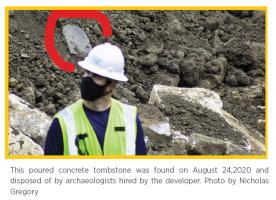 Activists secure a legal victory in the fight to save the Moses African Cemetery in Bethesda, Maryland.
 Recent debates about Critical Race Theory (CRT) have been abysmally uninformed at best and utterly inaccurate at worst.
 Bird, strings, Big Chief: 100: Harlem (For Charlie Parker/Donald Harrison/Harlem Symphony Orchestra) Gathering witnesses bearing beautiful collisions—
 In this series, we ask acclaimed authors to answer five questions about their book. This week’s featured author is Erica R. Edwards.
 Richard and Roberto would like to dedicate this feature to Glen Ford, one of the fiercest critics of U.S. corporate media the country has ever known.



