by Mision Verdad
The U.S. and the world’s largest corporation, ExxonMobil, have prioritized the overthrow of Venezuela’s socialist government. Venezuela and neighboring Guyana claim sovereignty over “one of the biggest oil discoveries of the last decade.” ExxonMobil already finances much of the Venezuelan opposition. The company is now trying “to maneuver into Guyana and politically and economically reconfigure the Caribbean Basin to serve it purposes.”
US Occupation Has Already Begun and Is Being Conducted by ExxonMobil
by Mision Verdad
This article previously appeared in Mision Verdad and Portside.
“ExxonMobil would be very pleased to retake the Caribbean by overthrowing the Venezuelan government.”
ExxonMobil awarded contracts to Guyana for infrastructure, drilling and storage with a view to extracting the huge oil and gas reserves from the so-called "Liza Project" located in maritime territory claimed by Venezuela as stipulated by the Geneva Agreement of 1966. In 2015 the first oil discovery in the area provoked a diplomatic conflict between the nations due to the activities of the oil company on the Atlantic front of the Essequibo river.
According to Gulf Oil & Gas, Dutch oil holding company SBM Offshore NV has been granted a contract awarded by ExxonMobil, a U.S. company that owns 45 percent of the Stabroek Block located on the Atlantic front of the Essequibo through its subsidiary Esso Exploration and Production Guyana Limited Atlantic, where the rich deposits of Liza-1 and Liza-2 were found.
The CEO of the Dutch holding company Bruno Chabas commented on the contract, "We are proud that ExxonMobil has awarded the Liza contracts to SBM Offshore. Liza, the offshore field in Guyana, is one of the major oil discoveries in the industry over the past decade."
However, this contract is not the first by ExxonMobil to accelerate its plans for oil and gas extraction in the territory claimed by Venezuela. In May, a subsidiary of the Italian oil company ENI named Saipem, took over the rights to carry out "the engineering, acquisition, construction, installation of associated bands, structures and bridges" to Liza-1, according to the World Oil website.
“The offshore field in Guyana is one of the major oil discoveries in the industry over the past decade."
Recently teleSUR, citing the U.S. Geological Survey, informed that the area concentrated in the "Liza Project" is the second largest untapped oil fields in the world.
With this latest contract awarded, ExxonMobil seeks to produce 120,000 barrels of oil and 170 million cubic feet of natural gas, with a storage capacity of 1.6 million barrels of crude oil. In total, the Stabroek Block occupies an area of 26 thousand 800 km2 and it is estimated that 1.4 billion barrels of high-quality oil is deposited in the Liza-1 field alone.
In 2015, Rex Tillerson, the current U.S. secretary of state and former general manager of ExxonMobil, commented with joy to his shareholders that this well (Liza-1) was the largest found anywhere in the world that year, thus giving a strategic character to future projects of the U.S. oil company.
Geopolitical Urgency
The priority of this U.S. oil company to topple Venezuela is geopolitical and geo-economic, as a fundamental pillar of a new political, economic and financial configuration of the continent (with Russia and China as alternative strategic partners), which poses a threat to the strategic advantages and the almost absolute control of the energy resources of the region that these corporations boasted throughout the 20th century. Securing that source of supply not only enabled it to carry out its arms race and military campaigns in the Middle East, but to maintain a global superpower status which is challenged today by emerging rivals.
In the demarcation reinforced by this second round of contracts in the Liza-1 and Liza-2 fields, there is an implicit interest in appropriating an energy corridor as an Exxon exclusive exploitation zone that runs from the Orinoco Oil Belt, through the Essequibo, reaching the mouth of its Atlantic front.
The details drawn into the plans of the oil company are not only energetic but also move to the political and diplomatic terrain, as the takeover of political power in Venezuela by extraconstitutional means would conclude in the appropriation of the other end of the corridor — the richest on earth if the reserves of the Orinoco Belt and those off the shore of the Essequibo and the Stabroek Block are added together. In the thick of it, Russian and Chinese oil companies (Rosneft and Cnooc) are ahead in investments and exploration projects that represent a serious threat to what the largest U.S. oil company sees as a strategic source of supply for their geopolitical global control plans.
Inescapable data. ExxonMobil's awarding of contracts came just days after Venezuela and China signed four large-scale energy partnership projects, ranging from increased oil production to refining projects in the Asian giant.
The Coup Master
In an investigation presented by Mision Verdad a few weeks ago, ExxonMobil's financing of Venezuelan opposition organizations to generate acts of violence was revealed, while at the same time diplomatic maneuvers were being carrying out by the U.S. State Department to revive the internal political conflict and to repudiate the Venezuelan government in international organizations such as the OAS.
The last meeting of foreign ministers of the OAS on Venezuela, prior to the organization's general assembly in Mexico, served to illustrate how the oil corporation also manages the threads of the international siege against the country. The Guyanese government, subordinate to its investments and currently the chair of CARICOM, tried to impose a resolution not agreed upon by the Caribbean states and identical to the one presented by the U.S. at the last meeting, with the aim of condemning the Venezuelan National Constituent Assembly. The "red line" drawn by the U.S. to camouflage rounds of much more aggressive sanctions against the Bolivarian nation.
The Caribbean as a Strategic Objective
The Caribbean is a mix of the circumstantial and strategic. The need to overthrow Petrocaribe is not just a circumstantial calculation to break Venezuela's alliance with the Caribbean and the support it receives against the diplomatic siege.
It is also run in parallel to the objectives of ExxonMobile, as the company tries to maneuver into Guayana and politically and economically reconfigure the Caribbean Basin to serve it purposes.
We have already mentioned that the U.S. oil company aims to make the Caribbean dependent on the United Sates both politically and in terms of energy by using its natural gas surplus (Exxon is a global leader producer and exporter), while at the same time lining up its batteries against Petrocaribe to regain geopolitical control of its key maritime and commercial position, placing a barrier to stop Chinese and Russian capital from investing in areas not only in the energy sector but also infrastructure and transport.
“The U.S. oil company aims to make the Caribbean dependent on the United Sates both politically and in terms of energy.”
Changes to the energy sector over the last decade have displaced its core centers, both in supply and demand, to the Middle East, Central Asia and Eurasia, and its productive matrix toward the production of unconventional oil and gas (oil shale). Whoever insures this source of energy supply will undoubtedly have enormous geopolitical advantages to dictate the global rules of the game in the coming decades. According to a recent report of the Inter-American Development Bank, more than 70 percent of global oil and gas reserves are in the Atlantic basin.
ExxonMobil would undoubtedly be very pleased to achieve its plans and retake the Caribbean by overthrowing the Venezuelan government, the Petrocaribe pillar.
ExxonMobil's strategy is long-term, directed at the entire continent and has Venezuela as its primary objective. It is not in vain that a crew of business elites has assumed the reins of U.S. foreign policy today. There and not elsewhere you will find the reasons for the aggressive siege we face.
This article was translated by Telesur [1].

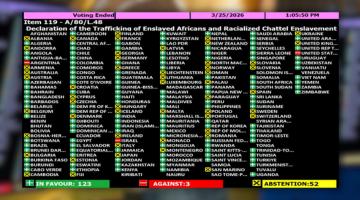 Kwesi Pratt Jr. is General Secretary of the Socialist Movement of Ghana.
 The SAVE Act would require proof of U.S. citizenship to be presented in person in order to register to vote in this country and would disenfranchise millions of people who are currently able to vote…
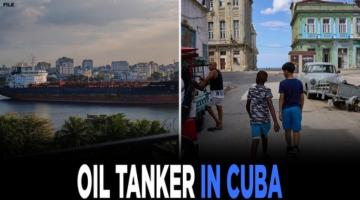 Russia finally makes good on promises to help Cuba, but its level of commitment is unclear. The left are clearly immobilized, even as Iran demonstrates how to fight back.
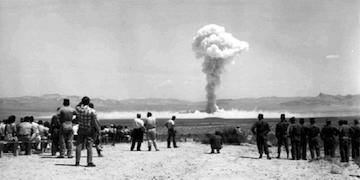 “We are not freeing ourselves from centuries of imperialism and colonialism only to be maimed and destroyed by nuclear weapons.”
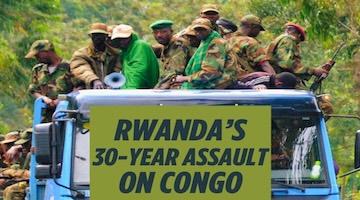 Rwanda’s 30-year Assault on the Democratic Republic of Congo, a new 80-page title from Baraka Books, gets straight to the essentials.


