by Herbert Ekwe-Ekwe
From de Gaulle in 1958 to Hollande in 2017, and for all members of the French establishment, the operational principle of the French towards Africa has been: “invade, intimidate, manipulate, install, antagonize, ingratiate, indemnify, expropriate.” Nothing in this election will change that – only Africans can.
Africa Has No Stake in the French Election
by Herbert Ekwe-Ekwe
“French politicians, irrespective of ideological/political leanings, do not find France’s relationship with Africa contentious.”
For the first time since the 1958 founding of the French 5th Republic by Charles de Gaulle, two supposedly outside politicians not from the alternate “right” (spectrum of Gaullist republicans) and “left” (socialists) parties of the country’s political establishment have won the stipulated first round of the recent French presidential election. Marine Le Pen of the front national and Emmanuel Macron of the en marche! (not totally an “outsider”, having been economy minister in the outgoing, unpopular Hollande government, quitting in August 2016 to form his so-called centrist movement) will now go on to contest for the decisive second round later this month.
Tenor
Despite the tenor of the epigraphs (above) that illustrate, definitively, the role of Africa in France and French life, Africa hardly features as a substantive subject in French elections, not least in the first round vote. Apart from the course and consequences of non-EU immigration in the country and tangentially Islamist terrorism which is viewed more as one in a range of manifestations of the aftermath of its history with the Middle East/Islamist world, French politicians, irrespective of ideological/political leanings, do not find France’s relationship with Africa contentious. Whatever may be differences in the “vision” of the future of France between Le Pen and Marcon, in the wake of the tumultuous “anti”-establishment aftermath of the poll, both accept the salient formulations encapsulated in each of the epigraphs on Africa and France, beginning with the founder of their 5th Republic, a right-wing politician, and including that of the respected socialist Mitterrand.
“Africa hardly features as a substantive subject in French elections.”
Equally, the duo Nicholas Sarkozy (“right”) and François Hollande (“left”) illustrate this trend. Even though Sarkozy belongs to the so-called establishment right, his thinking on Africa (see, for instance, his infamous Dakar, Sénégal, address at the Cheikh Anta Diop University, 2007) is more gratuitously racist and dehumanizing than anything Le Pen or, indeed, Jean-Marie Le Pen, her father, founder of front national, both members of the “non-establishment right”, have said or written on this very subject.
What is precisely at stake here, for the French state, is that incorporated in the provisions of the 1958 5th Republic conceptualization, following the humiliating defeat and collapse of its “French Indo-China” in 1954, its age-long French-occupied African states and peoples, a total of 22 countries, become effectively la terres richesse -- wealthlands, to serve France and the French in perpetuity.
Plaque
This is why the French have such a supercilious antagonism to any conceivable notion of African restoration-of-independence and sovereignty (see Herbert Ekwe-Ekwe, “African American Son”). This is the background to Gary Busch’s excellent study in which these countries which France still controls, occupies, calls “francophonie,” “deposit the equivalent of 85% of their annual reserves in [dedicated Paris] accounts as a matter of post-[conquest] agreements and have never been given an accounting on how much the French are holding on their behalf, in what these funds have been invested, and what profit or loss there have been” (Gary Busch, “Africans Pay for the Bullets the French Use to Kill Them”, nigeriavillagesquare, 29 July 2011).
This is why the French military has invaded this African enclave 53 times since 1960 (“‘African American son’, US foreign policy and Africa”).
Such invasions provide the French the opportunity to directly manipulate local political trends in line with their strategic objectives, install new client regimes, if need be, and expand the parameters of expropriation of critical resources even further as unabashedly vocalized by many a sitting president in Paris. For the French president, from de Gaulle in 1958 to Hollande in 2017, and all members of the French establishment, the operational plaque for action in the Elysée palace has been: invade, intimidate, manipulate, install, antagonize, ingratiate, indemnify, expropriate, invade, intimidate.
This plaque awaits either Le Pen or Macron, “non-members of the French establishment,” to implement as usual, as it has been in the past 59 years, irrespective of which of them wins the second presidential poll on May 7. Unless, of course, the African peoples in the 22 states bring this staggering expropriation and indescribable servitude to a screeching halt.
“Francophonie”-exit: freedom
The first move of the Africa “francophonie” to exit from this debilitating conundrum couldn’t be more predictable: do not transfer your hard-earned revenues, the “85 per cent,” not one euro, to that dedicated Paris bank account. This transfer must stop at once, now. One mustn’t ever be a party to their own subjugation. The African publics in Bujumbura, Yamoussoukro, Dakar, Bamako, Ouagadougou, Ndjamena, Buea, Douala, Brazzaville, Kinshasa, St Louis, Bangui, Lome, Younde, Cotonou, Abidjan, Touba... should at once embark on consultations with their varying state officials to work out the parameters of implementing this great freedom movement and other interlocking features in each and every space of this occupied hemisphere.
“Liberté, égalité, fraternité” must surely be for all…
Herbert Ekwe-Ekwe is a professor of history and politics and Director of the Centre for Cross-Cultural Studies, Dakar. He specializes on the state and on genocide and wars in Africa in the post-1966 epoch.


 The compilation of Glen Ford's work, "The Black Agenda" was published by OR Books posthumously. In the introduction he recounted his life story and career.
 This week’s featured author is Last Moyo. Moyo lectures in the Department of Communications and Multimedia Design at the American University, Nigeria. His book is The Decolonial Turn in Media Studies…
 This week’s featured author is Karen Jaime. Jaime is Assistant Professor of Performing and Media Arts and Latina/o Studies at Cornell University. Jaime’s book is The Queer Nuyorican: Racialized…
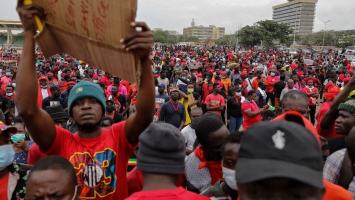 Ghana has initiated talks with the International Monetary Fund to seek a potential bailout amid a major economic crisis. This has been rejected by the Socialist Movement of Ghana and trade unions who…


