by Anealla Safdar
The NYPD did not forgive Ramsey Orta for showing the world how cops choked the life out of Eric Garner. “After filming Garner's death, he was increasingly harassed and targeted by police and was arrested at least eight times in fewer than two years.” The cops finally got their revenge, sending Orta to prison for four years on drug and weapons charges. “I'm praying that I can come right out and continue my life as an activist," he says.
Man Who Filmed Eric Garner's Death Begins Prison Term
by Anealla Safdar
This article previously appeared in Al Jazeera.
“They want to create an environment where people are terrified to speak up and out and be good citizens."
On July 17, 2014, Ramsey Orta took out his mobile phone and filmed a police officer in New York killing his friend, Eric Garner. But as soon as he stopped recording, Orta says his own life also took a dramatic turn for the worse.
Viewed millions of times, Orta's clip shows Daniel Pantaleo, a white officer, gripping his arms around Garner's neck in a chokehold.
Garner, a black American, was 43 years old at the time, and an asthmatic.
"I can't breathe. I can't breathe. I can't breathe. I can't breathe. I can't breathe. I can't breathe. I can't breathe. I can't breathe," Garner said, as he was being pinned to the ground and asphyxiated.
They were his last words.
Garner, a father of six, was selling loose cigarettes in Staten Island, New York, when officers tackled him. His case was ruled as a homicide, meaning that his death was caused by human beings, but Pantaleo was not indicted. In 2015, Garner's family reached a $5.9m settlement with the city of New York.
Orta's recording of the killing has been praised by many for bringing to light police brutality, and setting off what has been described as a citizen journalism trend exposing injustices.
But ever since releasing the footage of Garner’s killing, Orta, 25, says he has become the target of police retaliation.
“Behind enemy lines”
On Monday, Orta began a four-year prison sentence, after taking a plea deal in July for a weapons and drug case.
It is the result, he and his lawyers argue, of a police campaign to harm his life. After filming Garner's death, they claim, he was increasingly harassed and targeted by police and was arrested at least eight times in fewer than two years.
Of several criminal cases against him, only two charges stuck. Two weeks after filming Garner's death, Orta was arrested on charges of possessing a handgun and was later caught selling heroin to an undercover policeman.
"[Hours after] Eric died, at 4am in the morning, there was a spotlight shining through my window. I looked out the window and there was a cop [police] car outside," Orta told Al Jazeera on Friday.
"They parked outside my house and stopped people coming in and out of my house. That was going on until the day they ruled it [Garner's case] a homicide. I've been arrested and let out many times. And now I am convicted of only two of seven cases."
According to reports, Orta is suing New York City for $10m for unwarranted arrests by the NYPD that he says were attempts to discredit his video of Garner's final moments.
Al Jazeera contacted New York City police for comment, but did not receive a response at time of publication.
In August 2014, Pat Lynch, president of New York's biggest police union, said it "is criminals like Mr. Orta who carry illegal firearms who stand to benefit the most by demonising the good work of police officers."
Orta has been diagnosed with post-traumatic stress disorder, and suffers from depression, anxiety and paranoia.
“Orta is suing New York City for $10m for unwarranted arrests by the NYPD that he says were attempts to discredit his video of Garner's final moments.”
"My biggest fear about prison would be not coming out alive. I fear for myself being behind enemy lines," he said. "I'm going in there with a level head. I'm praying that I can come right out and continue my life as an activist."
Since Garner's death, Orta joined the police watchdog organisation Copwatch, has given talks at universities, and become a symbol of the Black Lives Matter movement.
At a recent event in Brooklyn, New York, Jewel Miller, the mother of Garner's youngest child, told Orta: "You took the video … you really filmed up to the last seven and something minutes that he was here on Earth. And even though those words of 'I can't breathe' are in our heads … it is the only voice for my daughter she'll ever know. And because of you I'll forever be grateful. Thank you, thank you, thank you."
Orta, a husband and father to two daughters, said he watches the video often.
"I watched it the day before yesterday," he said. "It just stays in my head. I try not to watch certain parts."
While he does not regret filming the killing, he wishes he had posted the clip anonymously.
"The only regret I have is not making my identity safe," he said.
Still grieving the loss of Garner, he said: "I miss his sense of humour the most."
“Shattering the myth of racial equality”
Orta is among several citizen journalists who say they have been hounded by police, including those who filmed the recent deaths of Alton Sterling, Philando Castile and Freddie Gray, which sparked a wave of protests across the US
In August, filmmaker David Sutcliffe wrote an open letter in favour of the "right to record", which was signed by more than 100 documentarians, including Asif Kapadia, Laura Poitras and Nick Broomfield.
"Armed only with camera phones, citizen journalists have shattered America's myth of racial equality," the letter said. "Instead of garnering Pulitzers and Peabodys, they have been targeted, harassed and arrested by members of the very institution whose abuses they seek to expose."
Shaun King, a New York-based journalist focusing on justice, told Al Jazeera that harassment was not uncommon.
"I have seen many cases where people who film police are unlawfully targeted and harassed by them in response - sometimes for months or even years as a result," he said.
"My question is always this: what are you afraid of? Why does being filmed bother you so much? It's our right to film the police. In fact, if you ever see police in action and you have the time to film them, do so."
A petition by The American Civil Liberties Union calling on US Attorney General Loretta Lynch to investigate harassment cases has gathered almost 21,000 signatures.
“Vicious intimidation”
Stanley Cohen, a New-York based lawyer and former social worker who in the 1980s held community cohesion sessions with the city's police departments, said that Orta's case was an example of "vicious, retaliatory and vindictive" intimidation.
"They want to create an environment where people are terrified to speak up and out and be good citizens," he told Al Jazeera.
"It's [harassment] not to undo the events of the murder of Garner as is it to deter the next [filming of a police killing]."
He added that after Garner's death, he felt a glimmer of hope.
"I had hoped, naively, that the Garner situation would change the relationship between police and community. It did for a short run, but more out of police concern of an explosion. Recently, it seems to be business as usual. There are more stories of the arrogant, abusive attitudes of cops in communities they control … When you combine the militarization of police with citizen journalists, you get a toxic confrontation."
According to Mapping Violence, police have killed at least 217 black people so far this year. Last year, they killed at least 346 black people.
As he prepared for jail, Orta said he has little hope for the near future.
"I expected this [police killings] to end up where it is now, it's only gotten worse since it started. I knew from our past history that that video wasn't going to change anything," he said.
"I don't want my situation to be a deterrent to people who continue to film, though. I encourage others to take a stand."

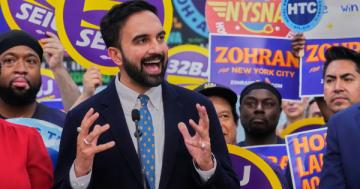 Lance Hawkins joins us from New York City to discuss the recent election of Zohran Mamdani, who will take office as the mayor of New York City on January 1. Lance Hawkins is a community, labor, and…
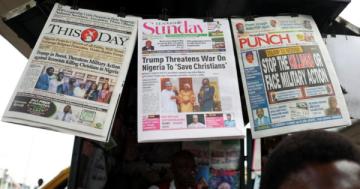 David Hundeyin is a Nigerian investigative journalist, bestselling author, and founder of West Africa Weekly, an independent Pan-African digital news publication focusing on West Africa and the Sahel…
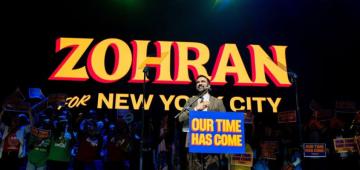 New Yorkers experienced some democracy with Zohran Mamdani's victory in the mayor's race and are inspiring voters across the country to believe that change is possible. But the outcome is a challenge…
 “Black Brazilians have been suffering … since the establishment of slavery more than 400 years ago.”
 The conflict in Sudan is a neo-colonial takeover, with United States ally the UAE using a proxy force to exploit that nation for its resources and strategic position.


