by Julian Cola
The United States is expert at expropriating other people’s property: land, bodies and culture. It has expropriated jazz, alienating the art form from the people that created it, who are blandly labeled “Americans.” “This citizenry tag name, seemingly innocent and harmless at first sight, wholly dismisses the sociopolitical minefield in which these artists mastered their craft.”
Rewind: Is Jazz America’s Greatest Artform?
by Julian Cola
“It tactfully veils America’s bigotry and terrorism inflicted upon these musicians, and the black populace at-large, during the innovative years of jazz.”
Imagine a world where Satchmo’s trumpet wails in honor of vagrancy laws? Now imagine Coltrane composing Alabama to celebrate a climate of so much hate that four young girls would be dynamited to smithereens in a church in 1963. Can you fathom officials stating that they were inspired to conceive and implement the war on drugs and prison industrial complex after hearing “A Love Supreme”? Who’s to say if Darren Wilson would feel tremendous sorrow if he listened to Nina Simone’s rendition of Strange Fruit? What he did say is that he wants to stop thinking about what happened in Ferguson.
Jazz, hailed as black classical music by Nina Simone and John Coltrane has become a target of revisionist Wikipedia contributors who want us to stop thinking and imagine a world that never existed. Their online posts describe Sarah Vaughn, Miles Davis, Duke Ellington, Billie Holiday, Charlie Parker, Coltrane and a slew of other jazz luminaries simply as Americans. This citizenry tag name, seemingly innocent and harmless at first sight, wholly dismisses the sociopolitical minefield in which these artists mastered their craft. Similar to enslaved Africans being characterized as workers in recent educational material published by McGraw-Hill, conferring a label upon a group of people, one that presumes entitlement to full citizen rights, when in fact they were subjected to Jim Crow racism, is wholesale forgery. It tactfully veils America’s bigotry and terrorism inflicted upon these musicians, and the black populace at-large, during the innovative years of jazz. Notwithstanding a two-term black president, America has not been purged from its grave human rights violations.
“Garveyism, Tulsa, Black Liberation Struggles and calls for black power cohabited the dawn and evolution of all musical styles perched under the canopy of black classical music.”
The extraordinary heydays of jazz emanated from organized black communities. Its roots stretched deep into Congo Square, Harlem, black neighborhoods in St. Louis, Chicago, New Orleans and other cities. Meanwhile, progressive social movements were the congenial neighbors of this groundbreaking artform. Garveyism, Tulsa, Black Liberation Struggles and calls for black power cohabited the dawn and evolution of all musical styles perched under the canopy of black classical music. Though jazz musicians may or may not have directly participated in the aforementioned movements, common anti-social denominators, purposefully designed and implemented by American racism, ultimately forged a pact between revolutionary artistic genius and aspirations for freedom. Music and social struggle, and the untold gamut of ways in which these two conscientious forms of energy express themselves, are indivisible factors that exemplify the heart and soul of the black experience in America and beyond. They don’t play out in a compartmentalized vacuum. Gumbo can’t be served until all vital ingredients are stirred and simmered in the pot.
However, Wikipedia contributors seek to cleave jazz artists from progressive black social struggles by affixing quaint American labels over their ashes. Miles responded to these infractions long before the website existed. During an interview he was asked what does jazz mean to Americans. His response: “It means that you uh nigga, and you playin' an instrument that you didn't study. That's what I get from it. So I ignore the critics.”
Once amnesia reigns over the artistic and sociohistorical agencies that breathed life into jazz, the rotten underbelly of white supremacy casually steps in to fill the void with its pseudo-cohesive, American apple-pie trademark, depriving jazz pioneers and organized black communities of their rightful place in history. A façade of square-dealing America usurps their creation. While the originators of jazz were active members, shall I say citizens, of the black community, dominant white society decried their artform as being the devil’s music, hypnotic tunes that, supposedly, readied fair white maidens for wild, pornographic sex with deranged black men.
“Common anti-social denominators, purposefully designed and implemented by American racism, ultimately forged a pact between revolutionary artistic genius and aspirations for freedom.”
That jazz emerged within America’s borders, supposedly making it uniquely American, lends more to mythical ethos than actual fact. During the iconic times of jazz mastery, the self-proclaimed home of the free was no harmonious melting pot. It was, indeed, a cesspool of legal racism. For black people it meant having to adhere to, under the pain and penalties of the law, state-sanctioned and socially codified subservience, even if you were blessed to be a renowned jazz musician. Jazz, never operating in tandem with dominant white power structures, lest certain artists succumbed to being bought and sold at the right price, could have never emerged from America. Here was an artform genuinely nurtured by black communities. Black people weren’t deemed Americans, for if they were there would have been no need for white-only restaurants; there would have been no need for black people to defecate in toilettes designated for colored people; there would have been no need for hospitals to refuse treatment to black patients (remember heavyweight boxer Jack Johnson?); Nina Simone, as a young musical prodigy, wouldn't have been refused entrance to an elite music conservatory reserved for white musicians; Louis Armstrong and Duke Ellington wouldn't have had to hire private railcars in order to travel with their bands across the nation. A surplus of statutory negations and, often times, brutal allowances – like famed jazz pianist, Bud Powell, arbitrarily beaten by the police and given electroshock therapy after repeated complaints of racial persecution – shadowed black people throughout the country. This was America's Apartheid, a plethora of coulds and couldn’ts made to shatter a group of people whom citizens disparagingly called negroes, recipients of no law endowed upon white people at birth. Jazz artists, no matter how much fame or notoriety they achieved, were subjected to these racist laws and social codes.
“Black artistry and struggle are still being defined in America.”
Is jazz America’s greatest artform? Time is said to heal old wounds. But time attests that lesions of old still run fresh. If Darren Wilson wants to forget what happened in Ferguson just imagine how many people would prefer to turn a blind eye to the sociopolitical realities in which jazz emerged. Black artistry and struggle are still being defined in America. For whose sake shall history be ignored, forgotten and rewritten?
Bygone jazz musicians are resilient survivors of America’s treachery. Sure their status should be hoisted, but not in a way that fuses their lasting memory with a nation-state that legally practice(d/s) and tolerate(d/s) white supremacy. For all its worth, black classical music is an anthem stretching back time immemorial – an autonomous edict cultivated by Africa's abducted children. Their music drifts in the whirlwind of the diaspora, call-and-response, talking drums, syncopation, improv, freestyle and freedom.
Raised in the city of jazz, New Orleans, Julian Cola currently works as a freelance translator. He has a BA (cum laude) in Portuguese.

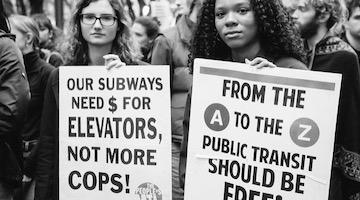 A thousand young people demonstrated in Brooklyn, jumping over turnstiles in solidarity with others arrested and brutalized by the cops.
 Whether Trump tried to make an impeachable arms deal with Ukraine or not, “the last thing Ukraine needs is more weapons of any kind.”
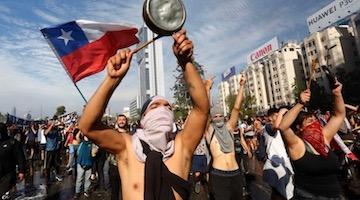 Black political captivity in the Democratic Party has a lot to do with why there is no clear peace movement in the United States.
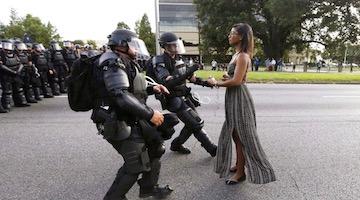 Much of the internet chatter over low- hanging fruit issues fails to address our material realities within a settler colony.
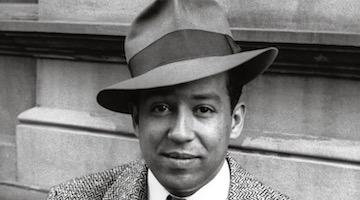 In Langston’s home Harlem You do as Langston Did Love the Jazz, the Blues, Words, acts, pages and stages In Langston’s home Harlem You do as Langston Did



