by BAR executive editor Glen Ford
After bringing the University of Missouri to its knees, Black students wanted some privacy in a “black space,” away from the peering eyes and suspect motives of the media. Media does, however, have its privileges. When Black activists and their allies challenged media privilege, their heroic struggle against racism was instantly downgraded to the actions of a “mob.”
The Corporate Media is Never Your Friend
by BAR executive editor Glen Ford
“White media don't understand the importance of respecting black spaces."
If only for a brief moment, Black protesters and their allies at the University of Missouri let it be known that the corporate media is as much a foe of racial and economic justice as any other rich man’s institution, and should be treated as such.
Media privilege in America looks and smells much like white privilege – or some derivative of it – even when claimed by a person of color. When Tim Tai, an Asian student photographer freelancing for ESPN, tried to crash the “Black space” that protesters had established around a small tent city on campus, two white faculty allies intervened. Janna Basler, whose job is to assist the school’s Greek organizations, asked Tai to “back off” and respect the protesters’ boundaries. After all, it’s hard work forcing the resignation of the university president and the chancellor. In putting their futures on the line for justice, the students were performing a huge public service, one that would benefit the entire nation. Ms. Basler warned the young photographer that he was “infringing” on what the protesters “need right now, which is to be alone.” But, Tai argued that his pictures would connect “people all over the country to what’s going on.”
Tai was not so much making a case for his right to “report” – which does not convey any special privilege to infringe on other people’s rights – so much as his right to hawk his pictures to ESPN, the media conglomerate owned by The Walt Disney Company and the Hearst Corporation. One cannot imagine two companies less worthy to package and transmit Black people’s images than the foundationally racist Disney and genetically reactionary Hearst outfits.
Black students understood perfectly well whose privilege Tai was really defending. "It's typically white media who don't understand the importance of respecting black spaces," one tweeted.
As far as the students were concerned, the “press” were just another element in a hostile environment. There were still decisions to be made and demands finalized that were none of the media’s business. According to the Daily Beast, students locked arms and shoved reporters away from their tent area, chanting “No comment! No media. Safe space!”
“In the late Sixties, reporters for the established media were often barred from Black political meetings, as agents of the oppressor.”
Another white ally, assistant professor of mass media Melissa Click, tried to chase away Tai’s video cameraman, Mark Schierbecker, as he crept towards the Black tents. When Click called for “some muscle” to settle the boundary issue, it guaranteed that Tai and Schierbecker’s little story would, indeed, reach hundreds of thousands of viewers, as the cable news networks exploded in indignation. Click’s excess of exuberance gave a white male anchor on CNN the chance to frame the story the way he’d wanted, all along. The media had been abused, he said, by a “student mob.”
It didn’t take long before Concerned Student 1950 – the Black activist group named in honor of the University of Missouri’s first Black graduate, Gus T. Ridgel, of the Class of 1950 – decided to repair its media relations. A leaflet was distributed. “The media is important to tell our story and experiences at Mizzou to the world," it said. "Let's welcome them and thank them."
One of the students’ demands is that the “University of Missouri meet the Legion of Black Collegians' demands that were presented in 1969 for the betterment of the black community.” Whoever saved a copy of the document should recount to the youngsters how, in the late Sixties, reporters for the established media were often barred from Black political meetings, as agents of the oppressor. In response, local newspapers and, especially, television stations, initiated what were often their first Black hires. This was a good deal for the corporate media, which gained credibility in the Black community. But it was disastrous for Black folks, who are now assaulted with lies by Black corporate media people, as well as whites. Different colors, same lies.
Black activists are encouraged to cultivate good media relations, as a kind of protection. But, in truth, corporate media is a weapon at the service of its owners – massed capital.
The rest of us need to lock arms, and make some “safe space.”

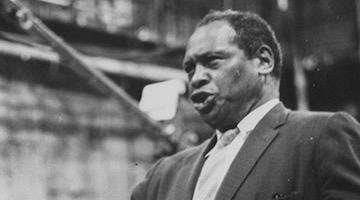 Brilliant and amazingly multitalented, Robeson was once among the most popular men in the U.S;, but became a non-person under relentless red-baiting.
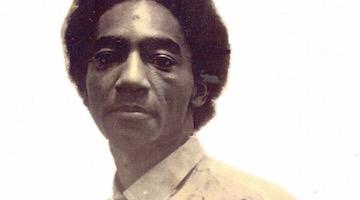 Ruchell Magee is the longest-held political prisoner in the United States and the world.
 Even as many more people around the world have access to education, schooling everywhere remains intertwined with systems of oppression, including racism and capitalism.
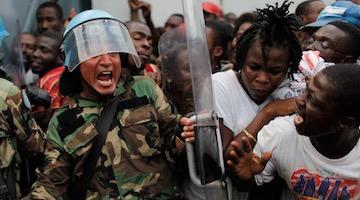 For fifteen years Latin American nations collaborated in the military occupation of Haiti, but have yet to apologize for their crimes.
 Insiders say Dataminr’s “algorithmic” Twitter search involves human staffers perpetuating confirmation biases, searching specific neighborhoods, streets, and even housing complexes for crime.


