by BAR managing editor Bruce A. Dixon
I've been asked why I didn't pick up the phone to talk personally to #BlackLivesMatter leaders before critiquing their published statements. Last year I was asked the same about Jesse Jackson, and years before I was asked repeatedly why I didn't contact President Obama and find out what he really meant before publicly examining his public statements. The question is always the same, and so is the answer.
How To Hold Prominent Movement Figures Accountable – With A Private Phone Call or a Public Discussion?
by BAR managing editor Bruce A. Dixon
"...these are not private and personal conversations, they are the collective property of the movement..."
I've been asked by many the last few weeks, including some who should know better, why I didn't pick up the phone and call the leaders of #BlackLivesMatter before publicly quoting and critiquing their written statements actions and interviews on July 23 and August 6. It's not the first time, not even the tenth time.
I was asked the same question in August 2014 when I criticized a letter from Rev. Jesse L. Jackson apparently penned on behalf of his corporate sponsors, and many other times. The answer is the same today as it was last year and ten years before that. Public interviews, speeches and writings are just that, they are public. Particularly when written or stated by prominent figures in what we call the movement, these are not private and personal conversations, they are the collective property of the movement, available for us all to agree or disagree with, to learn from or to dismiss.
Sure, I could have called Jesse or Ms. Garza or others and asked them privately what they meant. But if one has to contact everybody one quotes, presumably to give them a chance to review and re-interpret privately for you what they wrote publicly, one sets up a situation in which no public figure ever needs to mean what she says or say what she means.
Imagine some public figure telling you privately, over the phone,
“Yeah I SAID that, I WROTE that, but that's not what I meant. You s'posta ASK me what I mean, not just use my words...”
Imagine a public figure saying something completely different in private from their public statement, but with no intention whatsoever of publishing anything to correct the original statement. The prominent figure can then call me a liar and someone abusing a trust for publicly critiquing their public statement. It's a door I'd rather not open.
There's a name for people who call you up and hang on the phone with you for hours to convince you to do the right thing, to tease out the correct position. These people are called your personal friends, and everybody needs them. But there are other important roles to play as well. As a movement journalist I'm not Jesse's personal friend, nor Ms. Garza's. My obligation is to help others question and understand the public record so they can make informed decisions instead of simply following leaders or tweets or stuff that comes to them over the corporate media.
More so than other grownups, prominent persons in the movement ought to be responsible for what they speak in interviews and write for publication. Taking those conversations private hides them from the eyes and ears of those who might learn something. Restricting questions about the actions and writings of movement figures to private conversations makes the prominent person less accountable, not more accountable for his or her stands.
"...prominent persons in the movement ought to be responsible for what they speak in interviews and write for publication..."
Those who care about the state of the movement which our young people are urgently trying to rediscover have to help them insist on raising up accountable leaders and fashioning structures of accountability within the movement, including within the #BlackLivesMatter formation. That means there has to be plenty of deep debate and study, lots of informed and public back and forth principled disagreement and discussion about what the movement is, about how it does and should operate, about what its goals and guiding principles are, what its relationship is to electoral and other politics is, whether and how its prominent figures are accountable to its rank and file, and what lessons can be learned from history and recent practice.
This is something that's been seen before. Without this kind of open and public back and forth debate and discussion within the movement, organizations become the personal vehicles of their leaders. It happened to all the old-line civil rights organizations, it happened to the Nation of Islam. It even happened to the Black Panther Party, and it can happen to #BlackLivesMatter.
Many tendencies are represented under the #BlackLivesMatter flag, from those who are ready for Hillary to others who are ready for revolution. A few are just ready to get funded. They all need to come out and put their cards on the table, to reveal and discuss and debate their positions, if we are going to build a new movement and a new world.
Bruce A. Dixon is managing editor at Black Agenda Report, and a member of the state committee of the GA Green Party. He lives and works near Marietta GA and can be reached at bruce.dixon(at)blackagendareport.com.

 In this week’s segment, we see through supposed disagreements between the US and Canada and recognize their partnership in settler colonialism, enslavement, and imperialism. But we begin with a…
 Joseph Kabila, former president of the Democratic Republic of Congo, named himself president of the Front for the Rebuilding of the Nation. He is now formally allied with M23, the Rwanda-backed…
 Isaac Saney is a Cuba and Black Studies specialist and historian at Dalhousie University in Halifax, Nova Scotia, Canada. He discusses the U.S./Canadian partnership in settler colonialism,…
 European puppet states have undermined themselves and their peoples' needs at the behest of the U.S. Now, that subservience may lead to war.
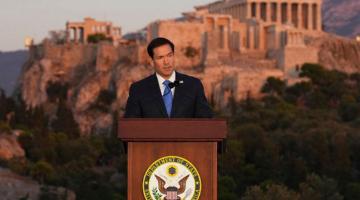 Marco Rubio's appeals to Western civilization, Christian heritage, and the defense of Western dominance are fundamental to the consolidating global fascist project, functioning to transform a crisis…


