by BAR executive editor Glen Ford
Finally, Black perceptions of the actual racial situation in the United States are catching up with reality, after years of collective delusion under The First Black President. “Black perceptions on race have swung 20 percent – from 48 to 68 percent negative – in the year since the emergence of an incipient movement against police violence.” Black pessimism about race relations is up 38% since the “’we HAVE overcome’ days of delusion, in 2009.”
Poll Shows Black People Have Begun to Recover Their Senses on Race Relations
by BAR executive editor Glen Ford
“’Good feelings’ in ‘bad’ and ‘dangerous’ times serve only to accelerate the processes of disaster.”
More Black Americans think race relations are generally bad than at any time since the Rodney King rebellion in Los Angeles, a generation ago. Whites feel pretty much the same way, according to a recent New York Times/CBS News poll.
Sixty-eight percent of Black people today believe race relations are bad, substantially more than the 59 percent negative recorded when Barack Obama was presenting himself as a candidate for president, back in 2008. The great dip in the statistics (or peak, depending on one’s perspective), was registered in 2009, the year of Black euphoria that began with Obama’s inauguration. By April of 2009, only 30 percent of Blacks told pollsters they saw race relations in a generally bad light. Half of Blacks’ negative perceptions on race disappeared the moment a Black family set up residence in the White House.
I don’t pretend to understand what white Americans generally mean by “bad” or “good” race relations – except that it is certainly very different than what Black Americans mean, when using the same terminology. I suspect that most whites think relations are “good” when they don’t have to hear Black people complaining too loudly. The perceptions of the people at the receiving end of racial oppression are usually more reflective of racial realities than the impressions of members of the dominant/oppressor group, who in all cultures minimize the degree of harm inflicted by their group. However, the oppressed are also quite subjective in their analyses of conditions. They hope against hope, or are overcome by despair – emotional swings directly related to their perception of the forces allied with, or against, them.
The polls show two recent periods of great volatility in Black perceptions of the general racial climate: the soaring euphoria of 2009, whose effects continued through 2010; and the dramatic year-long rise in Black discontent (translated in polls as pessimism on race relations) that began in August, 2014, when Ferguson, Missouri, rebelled against the police killing of Michael Brown. In between, we see a slow but steady erosion of Black perceptions of “good” race relations beginning in 2012, the year Trayvon Martin was gunned down in Florida, when Blacks’ negative ratings on race climbed above the 40 percent level for the first time since Obama took office.
Percentage of Blacks that viewed race relations as generally bad, according to New York Times/CBS News poll:
July, ’08 59
April, ’09 30
Jan, ’12 37
Aug, ’12 41
Apr, ’14 46
Aug, ’14 48
Dec, ’14 54
Feb, ’15 58
Apr, ’15 65
July, ’15 68
Black perceptions on race have swung 20 percent – from 48 to 68 percent negative – in the year since the emergence of an incipient movement against police violence. There has been a 38 percent rise in Black pessimism on race since the “we HAVE overcome” days of delusion, in 2009.
“Half of Blacks’ negative perceptions on race disappeared the moment a Black family set up residence in the White House.”
Race relations, as measured by Black perceptions, are now 9 percent “worse” than they were in 2008, before Obama’s election. The objective reality, of course, is that the Black economy collapsed during the financial meltdown that reached its peak in 2009 – the very year when Blacks perceived race relations as “least” bad, at 30 percent. So deep was the “Obama delirium” in 2009, that 39 percent of Blacks told pollsters for the Pew Research Center that African Americans were better off than five years before – even though Black unemployment was hovering around 16 percent, nearly twice the level of 2004, and Black wealth had fallen to one-twentieth of whites, as evidenced by wholesale home foreclosures in Black neighborhoods. Black people’s collective (subjective) perception at the dawn of the Age of Obama, according to the Pew poll, was that “the state of black progress in America [has] improved more dramatically than at any time in the last quarter century.” Every indicator of Black economic well being crashed in 2009, yet Black folks believed the opposite.
The steady rise in “bad” feelings about the racial situation – which is inextricable from the Black economic condition – is, therefore, a good thing. Gross misperceptions, wildly misplaced optimism, and the outright delirium experienced by so many Blacks at the start of the Obama presidency, greatly weaken and disarm a people. “Good feelings” in “bad” and “dangerous” times serve only to accelerate the processes of disaster. We need more “bad” feelings about racial oppression, mass Black incarceration, late-stage capitalism, mad-dog imperialism, and the survival of the biosphere.
No More Empty Celebrations and False Optimism
The Black Misleadership Class, which for two generations has pursued its own narrow interests with no regard for the masses of Black folks, thrives on the illusion of progress, which gives the false impression that their leadership has born fruit. This perfidious class celebrated not only Obama, but also the brief and delirious “era of good feeling” that accompanied his rise, offering no resistance whatsoever to The First Black President’s corporate neoliberalism and hyper-aggressive imperial policies. “Good” feelings led to disastrous results.
The most encouraging development since the emergence of an incipient, grassroots movement against police violence – an occurrence that is inseparable from the increase in “bad” feelings about race in the U.S. – is the growing rejection by young people of a Black Misleadership Class that strives for better “race relations” (peace) rather than a thorough transformation of U.S. society (justice). These are the kinds of Negroes that study the polls, wishing most of all for an increase in whites who sympathize with Blacks (whatever that subjectively means), rather than hoping that huge numbers of Black people get mad enough to make a MOVEMENT.
If an oppressed people don’t believe they are oppressed, they will not do much of anything to change their condition. In the words attributed to Harriet Tubman: “I freed a thousand slaves. I could have freed a thousand more if only they knew they were slaves.”

 “The chickens have come home to roost,” one resident said. “Our exact fears have come true.”
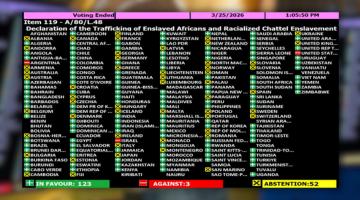
 In this week’s segment, we discuss the impact on the voting rights of Black people if the SAVE Act is signed into law. But we begin with a discussion of an historic vote at the United Nations which…
 Kwesi Pratt Jr. is General Secretary of the Socialist Movement of Ghana.
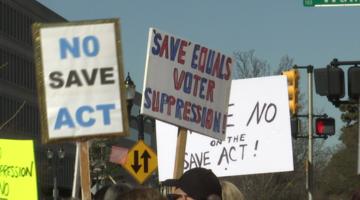 The SAVE Act would require proof of U.S. citizenship to be presented in person in order to register to vote in this country and would disenfranchise millions of people who are currently able to vote…
 Russia finally makes good on promises to help Cuba, but its level of commitment is unclear. The left are clearly immobilized, even as Iran demonstrates how to fight back.


