by Ann Garrison
The U.S. and its genocidal allies, Uganda and Rwanda, sought to destabilize the government of Burundi by painting its elected president as power hungry. President Pierre Nkurunziza seeks a third term in office. The leaders of Uganda and Burundi, as well as neighboring DR Congo, have all served long than Nkurunziza, but imperial stooges are accorded special privileges.
Authoritarian African Leaders with a Thin Veneer of Democratic Legitimacy
by Ann Garrison
This article previously appeared in Black Star News.
“In 2011, Museveni had so much money printed to buy the election that it caused drastic inflation in Uganda.”
Burundian President Pierre Nkurunziza is seeking a third five-year term in office, despite violent street protests and a failed coup détat. Burundi's Parliament elected Nkurunziza in 2005, and he now claims that the Burundian constitution allows him to run for election twice by voters enjoying "universal suffrage." The Burundian constitutional court has upheld Nkurunziza's claim, but the US, EU, and Western media have relentlessly decried his decision.
Western powers and press fail to note that neighboring DR Congo's President, Joseph Kabila, was appointed in 2001, not elected by universal suffrage, that Kabila then ran and claimed victory in 2006 and 2011, and that many were killed in election violence both times. They also fail to note that neighboring Rwanda's President Paul Kagame was appointed in 2000, not elected by universal suffrage, and that Kagame then ran and claimed victory twice, in 2003 and 2010, after imprisoning or terrorizing all other viable candidates.
Nkurunziza is claiming the same right that Kabila and Kagame claimed, but Western powers and press who didn't blink at their third terms have relentlessly demanded that he step down. This doesn't make Nkurunziza's decision right or wrong or politically wise or unwise. It simply puts his barrage of bad press in perspective.
Why is the US demanding that Nkurunziza step down, after so graciously tolerating both Kabila and Kagame's claims to the constitutional right to be elected twice by universal suffrage? Why has the US made no comment on Kagame's faux people's campaign to have the Rwandan Constitution amended so that he can run for a fourth term, or more likely, for life?
“Nkurunziza has fallen out of favor with the West by striking a deal with a Russian corporation to mine Burundi’s nickel reserves.”
And why hasn't Ugandan President Yoweri Museveni's announcement that he will run again in 2016, his thirtieth year in power, alarmed the West? Museveni, the really big "big man" in the region, is already jailing anyone trying to hold a public meeting about electoral reform or boycotting next year's election. In 2011, Museveni had so much money printed to buy the election that it caused drastic inflation in Uganda and inspired the Walk-to-Work protests, during which Human Rights Watch accused security forces of "firing randomly into crowded areas and throwing tear gas at people or into houses."
Writing in Global Research, and speaking on the CIUT Toronto Taylor Report, Gearóid Ó Colmáin credits Nkurunziza with rebuilding Burundi after 12 years of civil war, and giving Burundians hope and a sense of agency, but also says that he has fallen out of favor with the West by striking a deal with a Russian corporation to mine Burundi’s nickel reserves. He accuses the US of engaging in a low intensity campaign to destabilize Burundi and the surrounding region and blames foreign funded media, especially private radio stations, for frightening the population to destabilize the country.
Colmáin also writes that Nkurunziza might not be the USA's choice to manage Burundians' memory of their own suffering. "The US government is acutely aware that if the people of Burundi are to know the truth about the US-backed genocide of the Hutus in Rwanda and Burundi, it could jeopardize their foreign policy objectives in the region."
The American Security Project, a think tank founded to "create long-term consensus," accuses Nkurunziza of following in the footsteps of Zimbabwe's President Robert Mugabe and Equatorial Guinea's President Teodoro Obiang, whom they call "personalistic, authoritarian leaders with a thin veneer of democratic legitimacy." With the moral selectivity typical of Western intellectuals, the Security Project gives a pass to Nkurunziza's authoritarian neighbors Kagame and Museveni, both of whom have been key US allies and "military partners" throughout their decades in power.
Oakland writer Ann Garrison writes for the San Francisco Bay View, Black Agenda Report, the Black Star News,Counterpunch, Colored Opinions,, and her own website, Ann Garrison, and produces for AfrobeatRadio on WBAI-NYC, KPFA Evening News,KPFA Flashpoints, and for her own YouTube Channel, AnnieGetYourGang. She can be reached at ann@afrobeatradio.com. In March 2014 she was awarded the Victoire Ingabire Umuhoza Democracy and Peace Prize for promoting peace in the Great Lakes Region of Africa through her reporting.

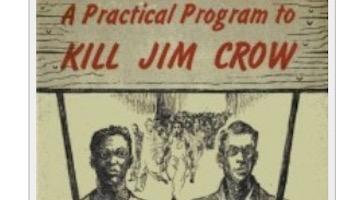 Alabama Communists helped lay the foundation for the organized civil rights movement that emerged in the late 1940s and early ’50s.
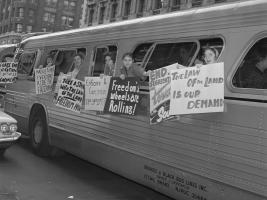 Prison and police abolition were key to the thinking of many midcentury civil rights activists.
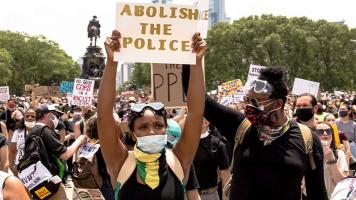 If there’s ever a time when a Reconstruction might actually lead to democratization and the end of American imperialism, this is the opportunity, says Robin D.G. Kelley.
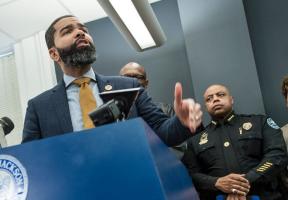 Jackson, Mississippi’s Black mayor is celebrated as a “radical” in some quarters, but his cops kill, maim and abuse Black people just like police forces everywhere in the US.
 Inequality: The American Ethos



