by Benjamin Woods
“Our common oppression is not what makes us African, it is our movement for freedom that give us consciousness of our identity.” Black people’s political and cultural revolutions go hand in hand. It’s cultural component “is a class struggle in the realm of ideas and culture wherein our current leaders must transform or be replaced.”
The Pan-African Cultural Revolution
by Benjamin Woods
“Let the martial songs be written, let the dirges disappear. Let a race of men [and women] now rise and take control.” – Margaret Walker in For My People
“Let a thousand flowers bloom and a hundred schools of thought contend” –Mao Tse Tung
“Our Cultural Revolution is a class struggle in the realm of ideas and culture wherein our current leaders must transform or be replaced.”
Two weeks ago, Black students at UC-Berkeley presented a series of demands to the university administration including renaming Barrows Hall after former Black Panther, Assata Shakur. At the same time, after a student threw human feces on the Cecil Rhodes statue at the University of Cape Town in South Africa, Black students began the “Rhodes Must Fall” campaign. One of its main objectives is to remove the monument of the mass murderer, Cecil Rhodes. While both campaigns have clear symbolic meaning, they include larger demands like an infusion of Black theorists in the curriculum, hiring more Black professors, on-campus workers rights and more.
The rise in student activism must be seen as connected to larger global rebellions such as #BlackLivesMatter in the United States and the Economic Freedom Fighters and NUMSA’s United Front in South Africa. Social movements help to produce a shift in culture and consciousness. For example, in the US, following the Ferguson uprising, hip-hop artists from the G-Unit to Lauryn Hill made songs to express their “Black Rage” at police terrorism. Even rapper J-Cole openly espoused anti-capitalist politics in an interview on mainstream radio in New York. As movements emerge, new possibilities are imagined, the impossible becomes possible.
“Social movements help to produce a shift in culture and consciousness.”
Culture is a product of history. Historically, under capitalism, white workers were exploited to produce commodities, but Black workers WERE commodities. So, although the oppression of Blacks is primarily economic, slavery and colonialism produced an ideological superstructure to legitimate and reinforce white supremacy in general and anti-Black racism in particular. Since all human beings have a history and culture, one of the primary means used to exclude Blacks from the human family is to write Black people out of history.
In response to centuries of dehumanization, Africans have resisted white domination through forming Maroon communities, plantation insurrections, Populist, Labor, Black Power, National Liberation Movements and more. While the colonizer uses history to deny our humanity, for us, our art and history is a weapon we use to cut the throat of our oppressor. The learning of history helps us to de-colonize our minds, but – to be clear – there is no pre-existing “African nation” prior to slavery that we are attempting to reclaim.
Our intent is to supplant white imposed definitions of reality with Black definitions of the world, therefore, we assert that Black or Pan African identity is principally a product of the Black Liberation Movement. Our common oppression is not what makes us African, it is our movement for freedom that give us consciousness of our identity. Therefore, we are not just acted upon but are agents of history.
“Slavery and colonialism produced an ideological superstructure to legitimate and reinforce white supremacy.”
The Cultural Revolution is not a Negritude project wherein we attempt to return to an idealized African past or promote what Leopold Senghor calls “intuitive reasoning” (Emotion is Negro, Reason is Greek). The primary purpose of the Pan African Cultural Revolution is to transform the values, consciousness, attitudes, norms, mores, etc. of African people. As we transform society, we transform ourselves. Our Cultural Revolution has four goals: 1) To eliminate corruption and bureaucracy among leadership 2) To promote intellectual independence 3) To encourage mass participation and 4) To instill a cohesive identity and an anti-authoritarian ethic.
Neocolonialism and neoliberalism have taken firm root in continental and diasporic African communities. Neocolonialsim requires the complicity of a comprador elite to facilitate labor exploitation and resource extraction. Our Cultural Revolution is a class struggle in the realm of ideas and culture wherein our current leaders must transform or be replaced. Furthermore, neoliberalism is more than a set of policies: it is an ideology that presupposes the individual as the primary actor and unit of analysis.
“Our art and history is a weapon we use to cut the throat of our oppressor.”
In opposition, mass-based social movements advance the communal values of solidarity, cooperation, self-sacrifice, and discipline. Finally, the neoliberal policies that facilitated the growth of NGOs and non-profits have assisted in the ideological and organizational domination of White Liberals. This is a perennial problem in Africa and the diaspora that can only be overcome by developing independent All-Black organizations. To ensure its success, the Pan African Cultural Revolution must have concrete policy objections. These include the creation of:
- Independent All-African mass based organizations (ex: labor, women’s, students, youth, religious, fraternal, political party, etc).
- Independent Educational Institutions (universities, K-12, youth programs, cadre schools, study groups, regular community political education, etc).
- Independent African Art Institutions (theatre houses, museums, publishing houses, music labels, distribution companies, etc.)
- Independent Systems of Communications (radio, television, movie studios, social media, etc).
- Self Defense Networks and/or a People’s Army
In addition, as a central component of the Cultural Revolution, all of the above institutions must create mass-based popular education regarding gender and sexuality in order to challenge the patriarchal and hetero-normative ideas inculcated through imperialism. The above organizations and institutions are the primary vehicles to advance our Political Revolution. Therefore, the Cultural Revolution does not occur before or after the Political Revolution but happens simultaneously and continues once we capture state power.
Our Cultural Revolution is inspired by the Black Arts Movement in the US, the Black Consciousness Movement in South Africa, and the Cultural Revolution in China. The fundamental objective of Political Revolution is to democratize the means of production i.e. the establishment of a Socialist system. Although we keep ‘Politics in Command,’ without the Cultural Revolution the Political Revolution is impossible.
Amandla! (Power)
Black Power!
Asijiki! (Forward)
#BlackLivesMatter!
A Luta Continua! (the struggle continues)
Benjamin Woods is a PhD candidate at Howard University and co-founder of Students Against Mass Incarceration. He can be contacted at benjaminwoods1@yahoo.com, or through his website FreeTheLand.
References
I Write What I Like by Steve Biko
Unity and Struggle by Amilcar Cabral
Wretched of the Earth by Frantz Fanon
A Dying Colonialism by Frantz Fanon
The Black Aesthetic by (Editor) Addison Gayle
Class Struggle in Africa by Kwame Nkrumah
Groundings With My Brothers by Walter Rodney
Revolution, Culture, and Pan-Africanism by Sekou Toure
The Unknown Cultural Revolution by Dongping Han
“On Contradiction” by Mao Tse-Tung

 No one better exemplifies the Democratic Party’s overarching identity politics than California Governor Gavin Newsom.
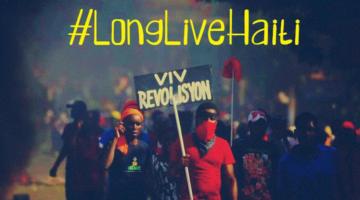 For the tenth time in the last 30 years, the United Nations vote to authorize an occupation of Haiti.
 Millions of people voted for Green Party presidential candidate Ralph Nader in 2000 but now he has denounced them and himself by proclaiming his support for Joe Biden’s re-election.
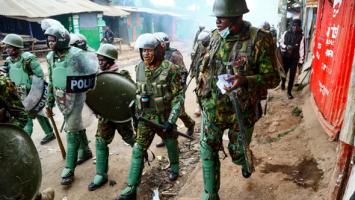 Kenya's decision to join a US led occupation of Haiti is an example of imperialism in Black face. According to a former Chief Justice the act is also a violation of Kenya's…
 In this week’s segment we discuss US policy towards African nations, Canada's revelations of Ukraine’s and its own connections with Nazis, and how the restriction on federal funds for abortion…


