What is the Real Reason Behind Obama’s New Cuba Policy?
by Pascal Robert
“Obama’s change in Cuba policy is not an indication of his foreign policy brilliance; it is a product of America’s foreign policy desperation.”
On December 17, 2014 president Barack Obama made a public statement announcing a change in America’s over fifty year-old Cold War strategy of isolating The Republic of Cuba. Since the Cuban Revolution of 1959, and the Island’s turn to Communism under the leadership of Fidel Castro, the United States has made a consistent effort to choke the life out of the Cuban nation through economic embargo. In a seemingly drastic change of that policy, President Obama stated he would further loosen travel restrictions to Cuba, open limited financial interaction with the country, and eventually move to building a U.S. embassy in Havana. Due to the 1996 Helms-Burton Act signed by President Clinton, Obama would still need Congressional approval to get much of this accomplished.
Obama’s statement was greeted with joy by many Americans who viewed this Cold War policy as antiquated and redundant. In a world where the Communist Soviet Union has long since collapsed, what sense does it make to keep punishing the Cuban people? Obama supporters used the president’s initiative as evidence of his superior statecraft in the face of Republican opposition by Cuba hard-liners like Florida Senator Marco Rubio.
What most Americans do not realize is that Obama’s change in policy is not the product of some enlightened awakening concerning foreign policy. Obama is reacting to occurrences that pose a significant geopolitical challenge to American hegemony in the Western hemisphere. The Russians and the Chinese have come knocking on America’s back door. From July 11 to 17, 2014, Russian President Vladimir Putin traveled through a multi nation Latin American tour ending with a summit of the BRICS nations (Brazil, Russia, India, China, and South Africa) in Fortaleza, Brazil. These nations are among the fastest developing economies in the world, and their combined efforts have been posing significant geopolitical challenge to America and its European allies all over the globe. This is particularly the case since the 2008 economic crash.
“Obama’s change in policy is not the product of some enlightened awakening concerning foreign policy.”
The first stop on Russian president Putin’s tour was the Republic of Cuba. It was announced by the Russian Kremlin’s news service that Putin agreed to absolve 90% of Cuba’s 32 billion dollar debt to Russia and, according to the Russian Times, the remaining 10% of Cuba’s debt would be re-invested back into Cuban infrastructure. For a relatively poor country like Cuba to have 90% of the debt to its once greatest economic benefactor forgiven is of epic importance to the Island nation. Furthermore, the Russians announced plans to develop infrastructure to build oil rigs for the valuable resource discovered off the coast of Cuba.
“The Latin America tour started with the visit to Cuba, where Putin signed a new agreement on oil exploration in Caribbean waters which contain most of the estimated 124 million barrels of the Island’s crude. The exploration will take place a few dozen miles from the US coast.”
Of even more strategic concern to the United States, Russia stated a desire to re-open a spying outpost once used by the Soviet Union to intercept American communication. The move by Russia to reoccupy that spy station, as well as modernize it, could open Russian access to American intelligence less than 200 miles away from U.S. shores.
“Russia has quietly reached an agreement with Cuba to reopen a Soviet-era spy base on America's doorstep, amid souring relations between Moscow and Washington.
“The deal to reopen the signals intelligence facility in Lourdes, south of Havana, was agreed in principle during president Vladimir Putin's visit to the island as part of a Latin American tour last week, according to the newspaper Kommersant.”
“Opened in 1967, the Lourdes facility was the Soviet Union's largest foreign base, a mere 155 miles from the US coast. It employed up to 3,000 military and intelligence personnel to intercept a wide array of American telephone and radio communications, but Putin announced its closure in 2001 because it was too expensive – Russia had been paying $200m (£117m) a year in rent – and in response to US demands.
“After Putin visited Cuba on Friday, the Kremlin press service said the president had forgiven 90% of Cuba's unpaid Soviet-era debts, which totaled $32bn (£18.6bn) – a concession that now appears to be tied to the agreement to reopen the base.”
“Putin agreed to absolve 90% of Cuba’s 32 billion dollar debt to Russia.”
Though Putin’s actions in Cuba were most significant to the change in American policy, his dealings in other Latin Countries were quite bold as well. On his visit to Argentina, Putin executed an agreement with the nation’s president Cristina Fernandez to construct two nuclear power plants in the face of that country’s frigid relations with the United States as a result of American hedge fund managers demanding Argentina satisfy all of its debt. Furthermore, in Brazil, Putin executed a memorandum of understanding to commence development of nuclear power plants as well as a spent fuel storage facility. What is most humiliating for the United States in all this is that these agreements are being executed at a time in which America has been trying to force international co-operation to isolate Russia resulting from the political crisis in the Ukraine. Putin’s actions in Cuba, combined with other Latin countries, illustrates that not only is Russia far from isolated, it is planting its geopolitical footprint directly in America’s back yard. As the The UK Guardian article above states:
“During Putin's Latin American tour, he also signed agreements to establish positioning stations in Argentina, Brazil and Cuba for Glonass, Russia's answer to the United States' global positioning system (GPS). He also made a surprise stop to discuss placing a Glonass station in Nicaragua, where president Daniel Ortega called Putin's first visit to the country a ‘ray of light.’ ‘The goal of Putin's visit to Cuba, Nicaragua and Argentina was to strengthen geopolitical connections with Latin America in response to the United States' attempts to isolate Russia,’ Alexei Pushkov, the chairman of the foreign affairs committee in Russia's parliament, tweeted after the trip.”
Yet that alone is not the degree to which the Russians are making a strategic pivot to Latin and South America. At the BRICS summit the member nations of Brazil, Russia, India, China and South Africa agreed to dedicate over 100 billion dollars to start a Central Bank among the nations with 100 billion in reserves as well. The ultimate goal of this Central Bank is to deleverage the BRICS nations from the U.S. dollar as the world’s reserve currency. This could pose a great threat to America’s position in the world.
Compounded with Russia’s geopolitical pivot, China has now strongly entered the Latin nations with its plan to build a canal through Nicaragua to rival the Panama Canal. This move would also greatly challenge American hegemony in the region.
“Not only is Russia far from isolated, it is planting its geopolitical footprint directly in America’s back yard.”
Contrary to popular belief, Obama’s change in Cuba policy is not an indication of his foreign policy brilliance; it is a product of America’s foreign policy desperation. The Russians have been making serious power moves in Latin and South America while American policies have been alienating countries like Argentina and Brazil. Over the weekend an delegation of Democratic Party senators lead by Pat Leahy met with Raul Castro to ascertain how to improve relations with the two Countries. This is not the action of a United States negotiating from a position of strength, but the behavior of a nation trying to catch up with its geopolitical challenger, the Russians. As stated in a recent article on the trip in the New York Times titled: “U.S. Lawmakers in Cuba for Three Day Visit”:
“In the statement, Mr. Leahy’s office said the trip was intended to ‘seek clarity from Cubans on what they envision normalization to look like, going beyond past rote responses such as ‘end the embargo.’ ‘The office said that the trip would “help develop a sense of what Cuba and the United States are prepared to do to make a constructive relationship possible.’”
By Leahy’s own admission, the Cuban’s are calling the shots and the United States is being forced to play catch up. Now the Cubans are in the old Cold War position many Third World countries found themselves in by being able to play the Russians against the Americans and ask one simple question: Which one of you is willing to offer more? It looks more and more like the Cold War all over again.
Pascal Robert is an iconoclastic Haitian American Lawyer, blogger, and online activist for Haiti. You can find his work on the web at Thought Merchant, and at Huffington Post. He can be reached via twitter at https://twitter.com/probert06 @probert06 or thoughtmerchant@gmail.com.

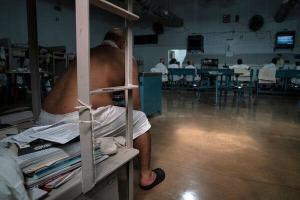 Days of extreme heat without access to enough water and cooled air become deadlier for an aging prison population.
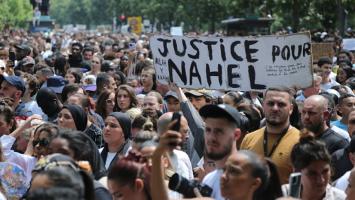 Protests erupted in France after police killed a teenager of Algerian and Moroccan ancestry. Just as in the U.S. racism in France is the cause of police violence.
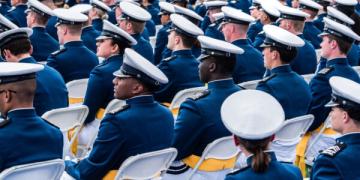 The recent Supreme Court ruling which bans affirmative action as an admissions' criteria does not apply to the military academies. White elites are secure in their advantages while the military…
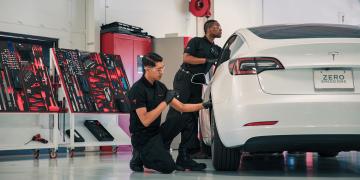 Multi-billionaire Elon Musk claims to practice freedom of expression on his Twitter platform. But numerous complaints of anti-Black racism at his Tesla plant make a mockery of any claims of freedom…
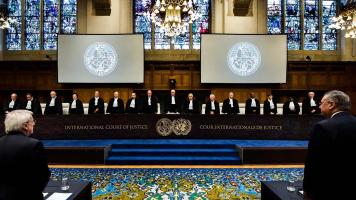 37 years after a 1986 International Court of Justice ruling, the United States still refuses to pay Nicaragua the reparations it legally owes. Today, the Nicaraguan government is demanding that the…


