December 20, 1989: The Day that Black Lives Did Not Matter in Panama
by BAR editor and columnist Ajamu Baraka
“U.S. state violence is not confined to ghettos and barrios of the U.S., but is a central component of the racist, colonial, capitalist project that is the U.S.”
December 20, 1989 is a day of infamy for the people of Panama. On that day, the most powerful military in the world descended on poor black communities in the middle of Panama City and carried out one of the most brutal war crimes of the late 20th century. Many in the U.S. have forgotten or never even knew that when George H. Bush ordered U.S. troops into Panama, Panamanians experienced their version of 9/11. By the time the carnage ended a few weeks later, U.S soldiers had murdered more than 3,000 Panamanians – changing the lives of Panamanians forever.
The attack was a brazen expression of ‘cowboy justice’ by a rogue state that took no heed of international constraints and instead took it upon itself to carry out an “arrest” of General Manuel Antonio Noriega, the de facto head of the sovereign state of Panama.
In the process of this “arrest,” the largely black community of El Chorillo, with a population of more than 25,000, was decimated by the U.S. military. Entire neighborhoods were destroyed in an act that predated and mirrored the destruction of Fallujah that would take place some twenty five years later in Iraq. Reports from human rights organizations indicated that beyond the attack, which in itself constituted a war crime, U.S. troops committed numerous other war crimes, from summary executions to the wanton destruction of civilian property and the failure to distinguish between civilian and military targets.
Buildings known to be inhabited by civilians were fire on by troops and there was the deliberate bombing of apartment buildings by the U.S. Air force. Survivors described how bodies were piled up and “disappeared” by U.S. troops. All of this death and destruction was carried out so that U.S. officials could demonstrate to the world that they were going to enforce their hegemony through force of arms – and to shed President George H.W. Bush’s image as a ‘wimp.’
The black lives taken by the murderous assault on Panama 25 years ago should be a sober reminder that U.S. state violence is not confined to ghettos and barrios of the U.S., but is a central component of the racist, colonial, capitalist project that is the U.S.
“The call for a demilitarization of Black and Brown communities cannot be made without a demand to demilitarize U.S. foreign policy.”
That connection is being made by the activists who have entered into political consciousness and taken up the tradition of black internationalism that has always informed radical black resistance and the struggle for our collective human rights. As brother Robin Kelly points out, the young organizers involved in the current resistance against the actions of the police in the U.S.:
“…remind us, not only that Black lives matter – that should be self-evident – but that resistance matters…. The young people of Ferguson continue to struggle with ferocity, not just to get justice for Mike Brown or to end police misconduct but to dismantle racism once and for all, to bring down the Empire, to ultimately end war.”
The invasion of Panama, the torture report, the ongoing occupation of Haiti, mass incarceration in the U.S. – all are linked by the global web of U.S. and Western institutions of domination. The understanding of those links, an understanding that has always characterized the anti-oppression lens of black resistance, recognizes that the call for a demilitarization of Black and Brown communities cannot be made without a demand to demilitarize U.S. foreign policy, to stop supplying arms and logistical support to terrorists in Syria under the guise of supporting a “moderate opposition,” to end support for Israeli colonial repression of Palestinian people, to stop the training and supplying of repressive police and militaries around the world, and to end the military occupation of dozens of countries with U.S. military bases.
The black victims of El Chorillo are still calling for justice and accountability. We stand in solidarity with those calls. We must remember them and keep their terrible experiences close to us. We will not forget them or the countless victims of this mad, rogue state that is only exceptional in its brutality and hypocrisy. Black lives matter when WE make them matter through the positive assertion of our collective humanity in the course of our fight for self-determination, people-centered human rights and the global defeat of a system of white supremacist colonial/capitalist hetero-patriarchy. History requires nothing less of us.
Ajamu Baraka is a human rights activist, organizer and geo-political analyst. Baraka is an Associate Fellow at the Institute for Policy Studies (IPS) in Washington, D.C. and editor and contributing columnist for the Black Agenda Report. He is a contributor to “Killing Trayvons: An Anthology of American Violence” (Counterpunch Books, 2014). He can be reached at www.AjamuBaraka.com

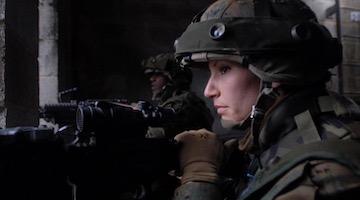 The war industry brags that five top weapons corporations are headed by women.
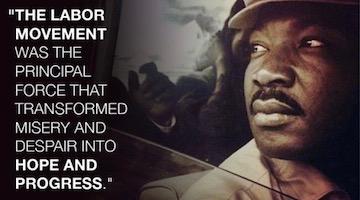 Dr Martin Luther King, who was killed supporting Memphis garbage workers, often noted that most Black people are working class, said labor historian Peter Cole.
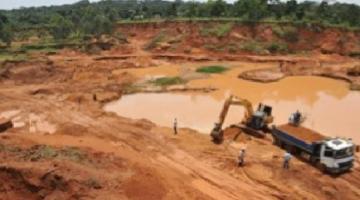 The fishermen of Kabarole District appear to have blown the whistle on an audacious act of bio-piracy.
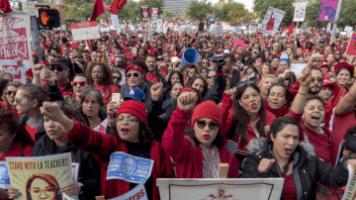 Corporate media absolutely won’t tell you this, but this year’s Los Angeles teachers strike is the latest chapter in the long running struggle against the privatization of public education in the U
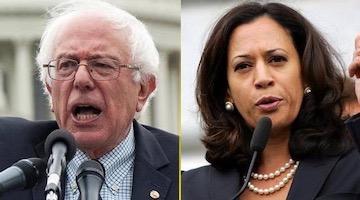 The best thing that can happen in 2020 is for Bernie Sanders to do fantastically in the primaries and be cheated out of the nomination, once again, thus giving millions of leftish Democrats a



