Ebola, Cholera and the Epidemiology of Anti-Blackness – Or, Black Lives Don’t Matter
by BAR editors and columnists Peter James Hudson and Jemima Pierre
“Black lives are demeaned and deemed disposable.”
The ravages of Ebola in West Africa and of cholera in Haiti – and the world’s response to both – remind us that the scourge of anti-Blackness is savage, deadly, and global. The response to the two epidemics suggests that Black people are expendable, unprotected from the most abject and degrading forms of suffering, immaterial – waste. And they raise the question: how do we begin to build a movement claiming Black lives matter when, clearly, they do not?
The United Nations brought cholera to Haiti in the fall of 2010. The cholera bacteria was present in the fecal matter of Nepalese soldiers who were stationed in the country as part of MINUSTAH, the United Nations force that has militarily occupied the republic since 2004. When the soldier’s shit was pumped from the MINUSTAH camp into the rivers of the Artibonite Valley in central Haiti, the bacteria quickly spread unchecked. To date, cholera has killed close to 9,000 people, and sickened more than 700,000.

For Haitians, cholera’s degrading symptoms – uncontrollable vomiting and diarrhea – reinforce the humiliation and indignity suffered at the hands of foreigners. So too does the international response to the epidemic. Despite reams of scientific evidence proving the source of the bacteria, the UN has refused to accept responsibility for the epidemic and its consequences. Their initial actions of literally shitting on Haiti and Haitians by callously dumping toxic matter into water that served as a source for drinking, bathing, and irrigation for thousands of Haitians, was shrugged off. They have also responded to Haitian requests for aid or compensation with a cruel impunity. When Haitians and their international allies tried to sue the UN for its actions in an attempt to get redress, UN Secretary general, Ban-Ki Moon asserted the organization’s immunity – and Haiti’s lack of sovereignty – by coldly asserting that the charges against it were, in legal parlance, “non-receivable” – and hence, inactionable. In essence, the assertion of non-receivable becomes a curt denial of Haitian humanity.
“Despite reams of scientific evidence proving the source of the bacteria, the UN has refused to accept responsibility.”
Similar circumstances have emerged, in West Africa, were Ebola has stricken primarily Liberia, Sierra Leone and Guinea. Like in Haiti, the symptoms associated with Ebola mark it as especially degrading, the disease particularly “dirty.” A virus of no known origin that is spread through contact with bodily fluids, Ebola shares with cholera certain symptoms, such as vomiting and diarrhea. Though while the victims of cholera die from organ failure and acute dehydration, those of Ebola often die from hemorrhaging.
But beyond the symptoms, the response to cholera in Haiti and Ebola in West Africa has been strikingly similar – though, perhaps, in West Africa the indifference to Black suffering, and the desire to preserve White life, has been startlingly blatant. Indeed, many in North America found out about the Ebola outbreak when news that two white missionaries were given an experimental drug and flown out of the Liberia to the U.S. (at a cost of $2 million for each evacuation and treatment) for further treatment. A third white U.S. citizen was flown to Nebraska for treatment. But warnings of an epidemic had been circulating since late 2013 and by the time news of the White flight reached the shores of the Americas, Ebola had already infected more than 1660 Liberians, killing scores. As of September 18th, there have been 5,300 infected with Ebola and 2,630 deaths, with most of the cases in Liberia, Sierra Leone, and Guinea.
Here, again, we see the pattern where African, -- Black -- lives are demeaned and deemed disposable. As Africans, including African doctors and aid workers were quickly dying from the disease, three white missionaries were given the experimental drug – itself under much speculation – and flown to safety. By mid-September, when the fourth African doctor, Dr. Olivet Buck, head of the Lumley Health Center in Freetown, Sierra Leone, died of the disease, it was revealed that the World Health Organization refused to send her to Germany for treatment. At the same time, two Dutch doctors stricken with Ebola were flown home to Europe. It has also emerged that the first African doctor to die of the virus, Dr. Sheik Umar Khan, the chief Sierra Leonean physician treating Ebola, was also denied the chance by Doctors Without Borders to receive the experimental drug, ZMAP, given to the two white missionaries. To add insult to injury, the U.S. government first announced that a $22-million, 25-bed Ebola hospital was intended for foreign (read: mainly white) healthcare workers. While outrage forced the U.S. to include African health workers in its plans, it was – and has been – clear that African lives don’t matter.
“Three white missionaries were given the experimental drug and flown to safety.”
The western, white, response to the cholera and Ebola epidemics ultimately teaches us that global white supremacy thrives on Black suffering, denigration, and death. Because, next to the stories of Black disease as endemic and linked to uncivilized and untamed Black cultural practices – as well as the way white media revels in publishing pictures of dead Blacks – we get the construction of the “brave” and “heroic” white saviors who risk their lives for the Blacks and non-whites: the “white savior industrial complex” at its best.
Of course, there is no mention of the decidedly non-heroic relationship of the white western world to countries like Haiti and those of West Africa. As Teju Cole demonstrates, the “white savior industrial complex supports brutal policies…[where] the banality of evil transmutes into the banality of sentimentality”: imperialism, neocolonialism, military occupation.
In a recent interview, Dr. Joia Mukherjee, of Partners in Health, explained the racism behind the west’s Ebola response by saying, “I think it’s easy for the world — the powerful world, who are largely non-African, non-people of color — to ignore the suffering of poor, black people.”
But we have to see this as more than ignoring the Black suffering poor; it is about white supremacy’s desire for Black death and Black suffering. It is about coming to terms with the fact that there is something systematic – and sinister – about Black killing globally. It is about the reality that in a universal context of anti-Blackness, Black lives don’t matter – anywhere.
Dr. Hudson and Dr. Pierre teach in the Department of African American Studies at the University of California, Los Angeles. They can be contacted at BAR1804@gmail.com.

 Donald Trump recently made several statements declaring his intent to commit a full-scale ethnic cleansing of Palestine's Gaza Strip. However, this idea, like many others, may be unfeasible and…
 This week, we speak to a journalist about the recent fires in Los Angeles County that destroyed the lives and homes of many, including a Black community located in Altadena. First, we get an update…
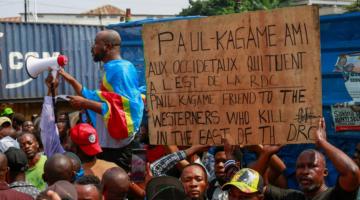 Maurice Carney is Executive Director of Friends of the Congo . He joins us from Washington to provide an update on the crisis in Congo. Since he last appeared on Black Agenda Radio the capital city…
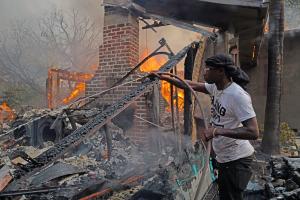 Thandisizwe Chimurenga is a Los Angeles-based journalist and host of RootWork, which can be seen on Black Liberation Media’s YouTube channel. She joins us from Los Angeles to discuss the impact…
 Donald Trump began his presidency with unconstitutional and possibly illegal orders that put the minority Democratic Party on the sidelines. Democrats have not utilized their own bully pulpit to…



