by Bill Quigley
The immigrant workers that helped rebuild New Orleans after Katrina have been targeted for removal from the city. “If they go to the laundromat or the barber shop or the grocery store, they will be targeted for nothing more than looking Latino.”
Why I Represent the New Orleans Immigrant Workers Who Committed Civil Disobedience
by Bill Quigley
“The workers and families who helped rebuild New Orleans live in terror today.”
In the thirty six-years I have been a lawyer, I have seen many people take brave moral actions. I have represented hundreds in Louisiana and across our country who have been arrested for protesting for peace, civil rights, economic justice, and human rights for all. It is amazing to see people put their freedom on the line when they risk jail for justice.
None are braver than the seventeen immigrant workers arrested in New Orleans at the office of Immigration and Customs Enforcement (ICE). These mothers and fathers, members of the Congress of Day Laborers at the New Orleans Workers’ Center for Racial Justice, are standing up for justice and risking being deported from the U.S. They risk being separated from their children, many of whom are U.S. citizens.
These workers simply ask for the right to remain in the city they helped rebuild. I was in New Orleans before, during, and after Katrina. Thousands of immigrant workers arrived and labored to help us rebuild our communities. They often did the dirty work, the unsafe work, for minimal wages. They stood with us in our time of need. Now it is our time to stand with them.
The workers and families who helped rebuild New Orleans live in terror today. One of them is Irma Esperanza Lemus. Irma is married with three children, two of whom are U.S. citizens. One morning, while Irma and her husband were getting ready to take their children on a fishing trip, ICE agents with bulletproof vests and guns stormed up to their door. The ICE agents forced Irma to put her baby down, fingerprinted and handcuffed her, and led her away while her husband and two children watched. Irma is now scheduled to be deported, and has to wear an electronic monitoring bracelet at all times.
Another is Jimmy Barraza, who lives with his wife and stepson Carlos. One night, while Jimmy and his wife were unloading groceries in their apartment parking lot, ICE agents surrounded them, guns drawn. They immediately handcuffed Jimmy and questioned his wife. When Carlos came out of the house, hoping to translate for his parents, ICE agents pinned him against a wall, cuffed him, and threw him to the ground in front of his mother. “For God’s sake, let him go,” his mother said.
An ICE agent answered: “There is no God here. I’m the only one in charge here.”
Immigrant workers and family members like these live in constant fear. If they leave their homes to walk their children to school, if they go to the laundromat or the barber shop or the grocery store, they will be targeted for nothing more than looking Latino, and their families will never see them again.
Stories like Irma’s and Jimmy’s, and there are hundreds of them in New Orleans alone, are the reason that we need an end to the raids and comprehensive immigration reform with strong worker protections. Until we do, people like these will have to continue standing up for justice: immigrants, people of faith, civil and labor rights leaders, and ordinary people from all walks of life who believe in that all workers deserve dignity and all families belong together.
I volunteered to represent these mothers and fathers because they are struggling for human dignity, human rights, and for social justice for their children and for others. I am a Catholic social justice lawyer. How could I not stand in solidarity with these mothers and fathers? I am inspired by their courage and passion for justice. It is an honor to defend them.
Bill Quigley is a human rights lawyer, professor of law at Loyola University New Orleans, and a volunteer advocate with the Center for Constitutional Rights. You can contact him at quigley77@gmail.com.

 In this week’s segment, we hear about the repatriation of skulls taken from the bodies of Black New Orleanians 150 years ago which were then sent to Germany for study in the practice of racist…
 Our guest is Abayomi Azikiwe, publisher of Pan African Newswire. He joins us from Detroit to discuss the U.S. Africa Command, AFRICOM, and Trump administration plans for continued U.S.…
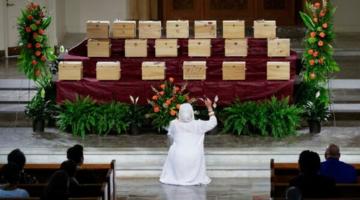 Nineteen Black people who died at Charity Hospital in New Orleans, Louisiana, in December 1871 and January 1872 were decapitated and their skulls were removed and sent to Leipzig, Germany for study…
 The U.S has been involved in every aspect of Ukraine’s military activity against Russia. The recent drone attacks and sabotage were likely committed with U.S. help. Of course, is possible that…
 “We cannot write in foreign languages unspoken and unknown by peasants and workers in our communities and pretend that we are writing for…those peasants and workers.”


