by BAR editor and columnist Jemima Pierre
Two organizations that give qualified support to U.S. adventures abroad, Amnesty International and Human Rights Watch, have issued reports critical of civilian deaths by American drone strikes. However, U.S. foreign policy is rooted in domestic practice. “U.S. Blacks have long been placed within a disposition matrix better known as ‘stop-n-frisk’ and they have long been the victims of normalized state assassination.”
Blacks & Drones
by BAR editor and columnist Jemima Pierre
“Drones hover twenty-four hours a day over communities…striking homes, vehicles, and public spaces without warning.”
Two separate reports about the impact of U.S. drone strikes in Yemen and Pakistan were released this past week. The first report, “Between a Drone and Al-Qaeda,” was from Human Rights Watch. After investigating six drone strikes during two trips to Yemen in 2012 and 2013, Human Rights Watch found large numbers of civilian casualties – with at least 57 known civilians killed. The second report, “Will I be Next?,” was from Amnesty International. Amnesty conducted extensive field research into nine of the reported 45 drone strikes that occurred in North Waziristan (Pakistan) between January 2012 and August 2013. Here are two examples of what they found:
On September 2, 2012, a Toyota Land Cruiser carrying 14 people was attacked by a warplane or drone near the provincial city of Radaa in central Yemen. The strike by a missile or a bomb killed 12 passengers, including three children and a pregnant woman.
On a sunny afternoon in October 2012, 68-year-old Mamana Bibi was killed in a drone strike that appears to have been aimed directly at her. Her grandchildren recounted in painful detail to Amnesty International the moment when Mamana Bibi, who was gathering vegetables in the family fields in Ghundi Kala village, northwest Pakistan, was blasted into pieces before their eyes.
Both reports challenge official U.S. claims that civilian casualties from drone attacks have been minimal. Both reports question the legality of targeted killings in Pakistan and Yemen. Both reports argue that civilian drone deaths violate international law, while demanding that the Obama administration explain its legal rationale for its targeted killing in Pakistan and Yemen. These reports were followed by the release of another, from the United Nations, calling for increased transparency in the U.S. drone program and for the release of data on civilian casualties.
“Both reports question the legality of targeted killings in Pakistan and Yemen.”
While these reports have forced mainstream media attention on the practice of extrajudicial killing by the Obama administration, they only represent the most recent of critiques of the drone assassination program. For years now the Bureau of Investigative Journalism has been tracking U.S. drone strikes and other covert actions in Pakistan, Yemen, and Somalia. It has found that in Pakistan alone, drone strikes have killed between 2550 and 3613 people, including between 168 and 200 children. In Yemen, drone strikes have killed between 148 and 377 people, including 25 children. In Somalia, drone strikes and other covert operations have killed between 48 and 150 people. Another report released last year by human rights experts at Stanford and New York University, “Living Under Drones,” documented the physical and psychological harm of drones in the communities under attack, stating: “Drones hover twenty-four hours a day over communities…striking homes, vehicles, and public spaces without warning. Their presence terrorizes men, women, and children, giving rise to anxiety and psychological trauma among civilian[s].”
Immediately after the Amnesty International and Human Rights Watch reports were released, the Obama administration forcefully insisted that drone attacks are precise and effective and therefore civilian deaths, or “collateral damage” cannot be considered illegal. This is, in fact, a reiteration of the administration’s policy. In 2010, the Obama administration defended their extrajudicial killings by stating that the U.S. is in “armed conflict with al-Qaeda, as well as the Taliban and associated forces, in response to the horrific 9/11 attacks, and may use force consistent with its inherent right of self defense under international law.” Since then, the administration has given us a cruel vocabulary to assign to its actions: kill lists, “signature strikes,” and a “disposition matrix” that defines as “terrorist” any “military aged male” in a targeted area.
“The policy of immoral and extrajudicial killings began at home.”
Let’s think about what this means for a moment: the US government can decide that someone (be it its own citizen or a foreigner) is an enemy without having to provide any proof, it can find that person anywhere in the world, and it can dispatch a drone to incinerate that person—no questions asked. No trial, no way for the intended target to surrender, and no need to prove it was the right target.
It is easy for foreign deaths to become a distant abstraction. But in many ways, the policy of immoral and extrajudicial killings began at home. U.S. Blacks have long been placed within a disposition matrix better known as “stop-n-frisk” and they have long been the victims of normalized state assassination. According to “Operation Ghetto Storm,” a study of extrajudicial killings in the U.S., in 2012 alone at least 313 Black people were killed by police, security guards, and vigilantes. By this count, a Black person was the victim of an extrajudicial assassination every 28 hours. And the number could be much higher.
However, while we are outraged, we see no moral equivalence between the violence against Blacks at home and the violence against Muslims in far away lands. What does it mean, then, to condemn such terrorism in the U.S. while turning a blind eye to our government’s terrorism abroad?
And what does it mean, in a democratic society, to normalize terror and murder, to elevate one set of children over another, and to give some lives more importance than others? Black folks should know the answer.
Jemima Pierre can be reached at BAR1804@gmail.com.

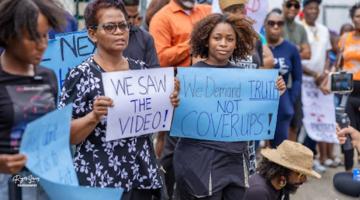 Trinidad and Tobago's Prime Minister says she backs Trump's conservatism and capitalism, and the criminal case against a hairdresser paralyzed in a police shooting shows exactly what that partnership…
 Former Bolivian president Evo Morales Ayma spoke with Black Agenda Report correspondent Clau O’Brien Moscoso.
 The World Cup is meant to be a celebration of global unity, not a propaganda shield for a superpower waging genocide abroad and running detention gulags on its own soil.
 The immigrants who revolted inside the Delaney Hall immigration jail are not criminals but prisoners of war, and their actions are those of resistance against a fascist detention system.
 Since early May, the World Health Organization and the African Centers for Disease Control and Prevention have been working to contain the spread of a rare and virulent strain of Ebola virus disease.


