by Mark P. Fancher
The carnage at a Kenyan shopping mall is a direct result of U.S. policy in Somalia. In 2006, Washington and Ethiopia invaded Somalia, overthrowing a moderate Islamic government and plunging the country into a war that has killed hundreds of thousands and left millions displaced. Kenya later joined the invaders, further escalating a U.S.-led conflict that has finally reached deep into Nairobi.
Innocent Kenyan Blood Drips from Imperial Hands
by Mark P. Fancher
“There has been speculation that the U.S. drive to dominate Somalia’s oil supply has prompted an interest in perpetual instability and division within the country.”
A 2011 report prepared for members of Congress lacks significant references to Kenya, but it details eye-opening events in Somalia that set the stage for the recent attack on a Kenyan shopping mall. The Congressional Research Service (CRS) report, titled “Somalia: Current Conditions and Prospects for a Lasting Peace” also contains facts that allow readers to conclude that much of the innocent blood shed by shoppers killed by al-Shabaab militants drips from western imperialist hands.
The recent shopping mall attack was reportedly in retaliation for Kenya’s participation in military operations against al-Shabaab in Somalia in 2011. Al-Shabaab became a force in Somalia after a 2006 military operation that dislodged a government run by “The Islamic Courts Union,” a network of tribunals that administered Islamic law. In 2006, the U.S. State Department’s point person for African affairs was Jendayi Frazer, and she was quoted as saying: “The top layer of the [Islamic Courts Union] courts are extremist to the core. They are terrorists and they are in control.”
Thereafter, the U.S. commenced a military collaboration with Ethiopia, a long-time foe of Somalia. The CRS report says: “According to a New York Times article, the United States actively coordinated with Ethiopian forces in targeting suspected terrorist and Islamic Union forces. U.S. Special Operations troops from Task Force 88 were reportedly deployed to Ethiopia and entered Somalia. Moreover, the United States reportedly shared intelligence with the Ethiopian military and used an airstrip in Eastern Ethiopia to launch attacks inside Somalia.”
The CRS report raises questions about the validity of the purported reasons for U.S. and Ethiopian aggression. The report says: “The Islamic Courts, while well received by the people in the areas the Courts controlled, received negative press coverage, especially in the West. The Courts’ activities were often characterized as extremist and jihadist. The ICU was accused of shutting down cinemas and prohibiting women from working. Some of these measures were taken by the Courts, although for reasons other than the Courts’ alleged jihadist and extremist ideology. For example, movies were banned in the morning in response to requests from parents because Somali children were going to movies in the morning instead of school. The ban on television did not take place, except for restrictions on watching soccer games late at night…because of disturbances and fighting late at night.”
“U.S. Special Operations troops from Task Force 88 were reportedly deployed to Ethiopia and entered Somalia.”
Why then would the U.S. take aim at such a government – particularly when it was Somalia’s first stable government structure in many years? The answer may be because it was a stable government. There has been speculation that the U.S. drive to dominate Somalia’s oil supply has prompted an interest in perpetual instability and division within the country. Although Somalia had been in chaos for years because of endless battles between clans directed by “warlords” it has been suggested that it was easier and more profitable for western oil companies to pit these warring clans against each other in the competition for oil exploration and extraction agreements than it would have been to negotiate with a single, stable, unified government. U.S. propaganda suggests that military intervention in Somalia during the early 1990s was purely a humanitarian mission to tame the warlords and restore order. However, WikiLeaks noted that informed observers “…wonder about the lucrative U.S. oil exploration going on at the time…[W]hat are we to make of the U.S. using oil company Conoco’s offices as a temporary embassy?”
Oil industry exploitation of division in Somalia has not only been continuous, but it recently captured the attention of United Nations monitors. A confidential report to the Security Council’s sanctions committee explains how various Somali clans have begun to grant oil exploration licenses for overlapping territories. Reuters quotes the report as saying: “Potentially, it means that exploration operations in these blocks, conducted by [Norwegian and Swedish/Canadian oil companies] under the protection of regional security forces, its allied militia or private forces, could generate new conflict…” The report goes on to comment: “It is alarming that regional security forces and armed groups may clash to protect and further Western-based oil companies interests.”
It is therefore understandable why the stability brought by the Islamic Courts Union was welcomed by many of Somalia’s people, but was at the same time a cause for alarm among western imperialists. After U.S. and Ethiopian military forces drove the Islamic Courts Union government from power in 2006, resentment grew among certain sectors of the Somali youth organization known as al-Shabaab. After the Islamic Courts Union government fell, al-Shabaab stepped in to try and fill the void. The group controlled some territory until an African Union coalition that included Kenyan and Ugandan troops moved them out of key areas of the country in 2011. The militants of al-Shabaab began to threaten revenge against Kenya for its role in the ouster. They recently made good on their threat in a Kenyan shopping mall by carrying out unconscionable acts of terrorism.
Those who carried out the killing of innocents have been rightly condemned by the media and others. But justice demands that the world not allow the western military-industrial alliance that in many ways has been responsible for setting off this tragic chain of events to slink away into the night like a vicious jackal leaving carnage and destruction in its tracks.
Mark P. Fancher is an attorney who writes frequently about the U.S. military presence in Africa. He can be contacted at mfancher@comcast.net.

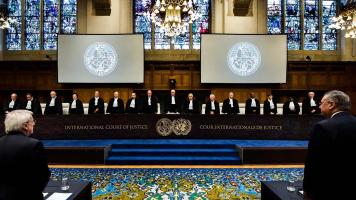 37 years after a 1986 International Court of Justice ruling, the United States still refuses to pay Nicaragua the reparations it legally owes. Today, the Nicaraguan government is demanding that the…
 Yevgeny Prigozhin, head of the Wagner Private Military Company, openly denounced the Russian Ministry of Defense and declared a march on Moscow.
 Canada Day celebrations in a settler colonial state and removing Cuba from the "State Sponsor of Terrorism" list.
 El Jones is a poet, journalist, professor and activist in Halifax, Nova Scotia, Canada.
 Shaquille Fontenot is a co-chair of the National Network on Cuba and a co-founder of the Low Country Action Committee in Charleston, South Carolina.


