by Dr. Wilmer J. Leon, III
The 1963 and 2013 marches on Washington shared many of the same issues, but took place in very different political contexts. Fifty years ago, a deep and broad movement pressured Congress and presidents to accede to Black demands. President Obama’s speech at last week’s gathering “did not propose any substantive legislative initiatives to address the suffering of today.”
The 2013 March, the “Tranquilizing Drug of Gradualism”
by Dr. Wilmer J. Leon, III
“We have also come to this hallowed spot to remind America of the fierce urgency of Now. This is no time to engage in the luxury of cooling off or to take the tranquilizing drug of gradualism. Now is the time to make real the promises of democracy.” – Rev. Dr. Martin Luther King, Jr. August 28, 1963
During the 50th anniversary of the March on Washington for Jobs and Freedom there was a lot of discussion about the “then” vs. “now”. Has the “Dream” been realized? Are we in a post-racial America? How did the 50th anniversary March compare to the first?
The answer to the first question is an emphatic “NO”. As I have written and lectured on a number of occasions, to refer to Dr. King’s message as a dream misses the point of the speech. Over the years Dr. King’s revolutionary message has been hijacked, compromised and relegated to being that of just a dreamer, not the lucid and radical ideas of a man seeking solutions to how a people can overcome oppression and racism. To cast King in the light of a dreamer allows people to be convinced that substantive change resulting from clear vision and direct action is not necessary.
Are we in a post-racial America? No, and that’s a ridiculous question. I have written to this point as well. America cannot be close to being post racial when a candidate for president has to run a deracialized campaign in order to make the masses comfortable with the obvious aesthetic. This is not a post-racial America when the unemployment rate in the African American community is more than double the national average and the wealth accumulation of the average European American family is 20 times that of the average African American family.
“Leading up to the 1963 March, civil rights organizations such as CORE, SNCC, SCLC and the NAACP were engaged in non-violent direct action.”
How did the 50th anniversary March compare to the first? Comparisons are natural due to the fact that the two marches were convened to address many of the same issues. The fact that 50 years later, speakers still addressed issues such as unemployment, jobs, civil liberties, education, health care, support for social programs and protection against police brutality made for easy yet unfortunate comparisons. It is understandable that people will try to make qualitative and quantitative assessments between similar events.
While there might be some obvious and natural similarities between the two marches they are also quite different. Their political contexts are very different.
Leading up to the 1963 March, civil rights organizations such as CORE, SNCC, SCLC and the NAACP were engaged in non-violent direct action. There was a three pronged strategy to bring pressure upon the executive branch and other branches of government to recognize and protect the civil rights of Negros of the day. This pressure was being applied in the streets (sit-ins, boycotts, and marches), the courts (Brown v. Board of Education, etc.) and the legislature (civil rights laws, voting, and public accommodations). It was the struggle of a people to be included into the social, economic and legal mainstream of America.
Due to the constant pressure that the Civil Rights Movement brought to bear upon the government which culminated with the ‘63 March, President Kennedy reluctantly came to support what would become the 1964 Civil Rights Act. Torn between the moral reality of the Movement and practical Southern electoral politics, Kennedy in June of ‘63 gave a nationally televised address where he stated, “A great change is at hand, and our task, our obligation, is to make that revolution, that change, peaceful and constructive for all." He then asked Congress to enact a civil rights bill that would remove race from consideration "in American life or law.”
After Kennedy’s assassination, President Johnson would support and sign the 1964 Civil Rights Act, along with the 1965 Voting Rights Act, and the Fair Housing Act. In seizing the initiative, Johnson stated, “…rarely in any time does an issue lay bare the secret heart of America itself. The issue of equal rights for American Negroes is such an issue. And should we defeat every enemy, should we double our wealth and conquer the stars, and still be unequal to this issue, then we will have failed as a people and as a nation… Wednesday I will send to Congress a law designed to eliminate illegal barriers to the right to vote.”
“It failed to articulate a legislative agenda and plan to pressure the Obama administration and Congress.”
It is important to understand what both Kennedy and Johnson said and did to bring about substantive change in American society. Today, due to complacency and the fallacy that those who dare criticize the president should turn in their “Black Card,” there has been virtually no pressure on the current administration to work with the Congressional Black Caucus to propose and fight for targeted legislation that addresses the interests of the African American community.
As a result of orchestrated efforts by of some in the extremist wing of the Republican Party and the complacency of the Black electorate after the election of President Obama, many of the civil rights gained from the movement and culminating in the 1963 March (affirmative action, voting rights, and protections against police brutality) have been eviscerated. The focus of the struggle has shifted away from inclusion into mainstream America to futile efforts to hang onto the gains that were hard fought and won in the 1960’s.
The 2013 March on Washington was a wonderful commemoration and tribute to the past, but it failed to articulate a legislative agenda and plan to pressure the Obama administration and Congress to address disparities in mass incarceration, home foreclosure, unemployment or education.
In 1963 President Kennedy stayed in the White House, choosing to watch the March on television. He was afraid that the March would turn into a riot. In 2013 President Obama was the keynote speaker. Many see this as progress.
During his speech President Obama applauded the struggles and successes of the past and with soaring rhetoric talked about the promise of tomorrow. He did not propose any substantive legislative initiatives to address the suffering of today and ask those in attendance to go back to their homes and hamlets and work with him to defeat legislative gridlock.
He offered the “tranquilizing drug of gradualism”.
Dr. Wilmer Leon is the Producer/ Host of the Sirisu/XM Satellite radio channel 110 call-in talk radio program “Inside the Issues with Wilmer Leon” Go to www.wilmerleon.com or email:wjl3us@yahoo.com. www.twitter.com/drwleon and Dr. Leon’s Prescription at Facebook.com
© 2013 InfoWave Communications, LLC

 The party that installed its presidential candidate without a primary vote now blames its 2024 loss on everything except its own contempt for its base and allegiance to neo-liberal policies.
 "SONNY" is the latest from BAR's Poet-in-Residence.
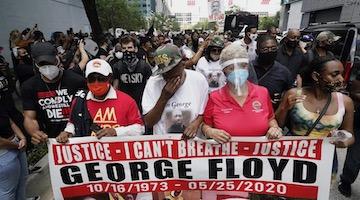 Six years ago, George Floyd was murdered by police. The reaction was swift - the streets erupted and demands to defund the police spread across the country. Yet, the response from Democrats was…
 Compliant Arab regimes spent decades spreading anti-Iran propaganda, but the current assault on Iran is shattering those lies.
 The U.S. indicted 94-year-old Raúl Castro not out of concern for the people of Cuba or the U.S., but because six decades of sanctions have failed to destroy Cuba's revolutionary continuity.


