by BAR executive editor Glen Ford
“George Zimmerman is no more provably racist in a U.S. court than most white Americans” – which is why a Justice Department action will get nowhere. Whites consider it “reasonable” to believe in the inherent dangerousness of Black males. “’Not guilty’ is reasonable, when everyone that counts shares the same assumptions as the perpetrator.”
Trayvon and White Madness
by BAR executive editor Glen Ford
“The government would have to prove that Zimmerman was motivated by racial animus.”
When Trayvon Martin was murdered by a “creepy-ass cracker” in February, 2012, an outraged Black America mobilized to force the State of Florida to put the perpetrator on trial. Seventeen months later, in the words of President Obama, “a jury has spoken,” affirming Florida’s original contention that Trayvon’s death was not a criminal act.
The White House also wanted Trayvon to be forgotten. Three weeks after the shooting, speaking through his press secretary, the president declared, “obviously we're not going to wade into a local law-enforcement matter." A few days later, Obama sought to placate Black public opinion with a statement of physical fact: “If I had a son, he’d look like Trayvon.”
In the wake of the acquittal, Obama’s press people have announced he’ll stay out of the case while Attorney General Eric Holder pretends to explore the possibility of pursuing civil rights charges against George Zimmerman. Holder told the sorority sisters of Delta Sigma Theta that Martin’s death was “tragic” and “unnecessary,” but a federal prosecution of Zimmerman is highly unlikely. The government would have to prove that Zimmerman was motivated by racial animus – a fact that is as obvious to Black America as a mob lynching at high noon at Times Square. However, except for the fact that he murdered a teenager, George Zimmerman is no more provably racist in a U.S. court than most white Americans – which is why the Florida cops and prosecutors initially refused to arrest him, why the jury acquitted him, and why the bulk of the corporate media empathized with the defense.
“Zimmerman was acting on the same racist assumption that motivates police across the country.”
The white public at-large shares with Zimmerman the belief – a received wisdom, embedded in their worldview – that young Black males are inherently dangerous. From this “fact” flows a reflex of behaviors that, to most whites, are simply commonsensical. If young Black males are inherently dangerous, they must be watched, relentlessly. Black hyper-surveillance is the great intake mechanism for mass Black incarceration. Zimmerman, the self-appointed neighborhood watchman, was acting on the same racist assumption that motivates police across the country, which is why the cops in Zimmerman’s trial were more valuable to the defense than to the prosecution. The same goes for the prosecutors and judge, much of whose daily lives are organized around the inherent dangerousness of young Black men.
Naturally, the cops testified that they saw no racial animus in Zimmerman’s actions – just as they would deny that their own hyper-surveillance of Black communities is motivated by animus. The jury, like the vast majority of white Americans, approves of the Black surveillance regime, and of those civilians that also keep an eye out for “crime” – which is synonymous with “Black males.” As juror B37 put it, Zimmerman’s “heart was in the right place” – meaning, she saw Zimmerman’s profiling and pursuit of Trayvon as well-intentioned and civic-minded; clearly, not malicious. Something “just went terribly wrong" – an unfortunate turn of events, but not a crime. The unanimous verdict shows the other jurors also perceived no malice – no racial motivation – by Zimmerman.
In fact, white folks in general do not think it is racist or evidence of malice to believe that Black males are a prima facie threat; it’s just a fact. Therefore, it is “reasonable” that civilians, as well as cops, be prepared to use deadly force in confrontations with Black males.
“The white public at-large shares with Zimmerman the belief that young Black males are inherently dangerous.”
The answer to the question: What would a reasonable person do? is essential to American law. Police, prosecutors, judges and jurors base their decisions on their own subjective perception of the state of mind of people who harm or kill, and the reasonableness of their actions. To most white people, it is reasonable to reflexively suspect young Black males of having criminal intent, and reasonable to fear for one’s life in a confrontation with such a person. “Not guilty” is reasonable, when everyone that counts shares the same assumptions as the perpetrator.
Black people cannot fix that. We cannot change white people’s warped perceptions of the world, although, Lord knows, we’ve tried. It has been 45 years since passage of the last major civil rights bill, the Fair Housing Act, yet housing segregation remains general, overwhelmingly due to white people’s decisions in the housing market, based on their racial assumptions. So powerful is the general white racist belief in Black criminality and inferiority, the mere presence of African Americans on or near property devalues the land. This is racism with the practical force of economic law. The same “law” has locked Black unemployment at roughly twice that of whites for more than two generations – an outcome so consistent over time it must be a product of the political culture (racism) rather than the vicissitudes of the marketplace.
The Brown Supreme Court decision is nearly 60 years old, yet school segregation is, in some ways, more entrenched than ever – again, because of white peoples decisions. Not only is school segregation on the rise, but charterization is creating an alternative public-financed system designed primarily for Black and brown kids. In many cities, whites can only be retained in the public schools by offering them the best facilities and programs. School desegregation has largely been abandoned as a lost cause, because of the whites’ “intransigence” – a euphemism for enduring racism: a refusal to share space with Black people.
But, the criminal justice system is white supremacy’s playground, where racial hatreds, fears and suspicions are given free rein. One out of eight prison inmates on the planet are African American, proof of the general white urge to purge Blacks from the national landscape. Trayvon Martin fell victim to the extrajudicial component of the Black-erasure machine.
“Racism is a form of mental illness, in which the afflicted perceive things that are not there, and are blind to that which is right in front of their eyes.”
White people don’t think they are malicious and racist; rather, they are simply defending themselves (quite reasonably, they believe) from Black evildoing. That whites perceive themselves as under collective attack is evident in the results of a Harvard and Tufts University study, which shows majorities of whites are convinced they are the primary victims of racial discrimination in America. Such mass madness is incomprehensible to sane people, but racism is a form of mental illness, in which the afflicted perceive things that are not there, and are blind to that which is right in front of their eyes.
To live under the sway of such people is a nightmare. Most of African American history has been a struggle to mollify or tame the racist beast, to find a way to coexist with white insanity, possibly to cure it, or to make ourselves powerful and independent enough that the madness cannot harm us too badly. George Zimmerman’s acquittal is so painful to Black America because it signals that our ancient enemy – white supremacy – is alive and raging, virtually impervious to any legal levers we can pull. The feeling of impotence is heightened by the growing realization that the Black president – a man who, in his noxious “Philadelphia” speech, denied that racism had ever been endemic to America – cannot and will not make anyone atone for Trayvon.
We have been in this spot before – or, rather, we have always been in this spot, but have for the last 40 years been urged to imagine that something fundamental had changed among white Americans. Trayvon smacks us awake.
We must organize for self-defense, in every meaning of the term, and create a Black political dynamic – a Movement – that will make our enemies fear the consequences of their actions.
BAR executive editor Glen Ford can be contacted at Glen.Ford@BlackAgendaReport.com.

 Senior care puts care workers into racialized, gendered, and age hierarchies, making it difficult for them to achieve social and economic mobility.
 I am hoping my call will provoke/inspire us to practice forms of life and liveliness differently.
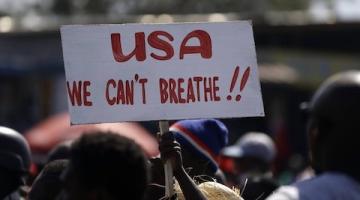 While Biden is telling Haitians “Don’t come over,” Haiti and its allies have been saying “U.S. Out of Haiti.”
 The author unpacks the tired trope of “poor rich Haiti,” highlighting the role of foreign capital and local elites in the destruction of life in the countryside.
 Guyana’s historically oppressed peoples direct their hostility at each other while neo-imperial powers hide in plain sight and reap the country’s wealth.


