by Mark P. Fancher
The U.S. military’s AFRICOM forces pretend their mission on the continent is humanitarian. In reality, AFRICOM is the sharp edge of U.S. imperialism, a killing force eager to impose American dominance. The military command “locks Africa into a state of dependency and maintains favorable political and social conditions for U.S.-based corporations that exploit Africa’s natural resources.” This is not a bug in the system. It's a defining feature of it.
AFRICOM AIN’T THE PEACE CORPS
by Mark P. Fancher
“AFRICOM downplays its military projects and instead presents itself as a Peace Corps type operation.”
Mention the words “Peace Corps” to folks who associate that agency with the idealism of the 1960s and in their minds’ eye they will probably see a dynamic young president who dispatched a virtual army of gentle, denim-clad, pony-tail wearing young Americans into the world’s most poverty-stricken villages to carry out a simple mission - to lend a neighborly hand.
Not to be found in this naive, rosy memory is a provision of the 1961 Peace Corps law that required volunteers to submit to: “... instruction in the philosophy, strategy, tactics, and menace of communism.” The plan to use the Peace Corps as a Cold War propaganda tool was explained by John F. Kennedy himself when he was still a presidential candidate. An advance text of one of his speeches said:
“...A friend of mine visiting the Soviet Union last year met a young Russian couple studying Swahili and African customs at the Moscow Institute of Languages. They were not language teachers - he was a sanitation engineer and she was a nurse. And they were being prepared to live among African nations as missionaries for communism.... Missiles and arms cannot stop them - neither can American dollars. They can only be countered by Americans equally skilled and equally dedicated....”
“The plan to use the Peace Corps as a Cold War propaganda tool was explained by John F. Kennedy himself.”
Regardless of whether Peace Corps volunteers were aware that their benevolent impulses were being politically exploited, some leaders of underdeveloped countries knew exactly what was going on, and they did not take kindly to U.S. attempts to gain a Cold War advantage at the expense of impoverished nations. Irritation escalated to rage when some leaders began to suspect that the Peace Corps was a cover for intelligence operations. In 1965, Ghana’s then-president Kwame Nkrumah wrote: “[Sargent] Shriver’s record makes a mockery of President Kennedy’s alleged instruction to Shriver to ‘keep the CIA out of the Peace Corps.’...Since its creation in 1961, members of the Peace Corps have been exposed and expelled from many African, Middle Eastern and Asian countries for acts of subversion or prejudice.”
Numerous well-meaning Peace Corps volunteers never became entangled in political intrigue and with the purest of motives they provided assistance and friendship that was much appreciated by the villages they served. But the program’s early propaganda agenda as spelled out in legislation and regulations was completely disrespectful of the rights to sovereignty, non-intervention and self-determination of the countries where volunteers were assigned. The Peace Corps’ Cold War agenda was later to be officially jettisoned, and in the 21st Century, it is disturbing to look back on that chapter in U.S. history. At least we can now take comfort in knowing that the U.S. no longer uses deception to advance a propaganda agenda. Or can we?
“Irritation escalated to rage when some leaders began to suspect that the Peace Corps was a cover for intelligence operations.”
The U.S. Africa Command (AFRICOM) deploys U.S. military personnel to advise and support African soldiers in missions designed to advance U.S. strategic and economic interests in Africa. But it also implements a not-so-subtle propaganda campaign to win the hearts and minds of Africans and the grudging support of a broader public that correctly suspects that AFRICOM is a Trojan horse for imperialism.
If one takes AFRICOM’s reports about its own activities at face value, it is easy to conclude that it exists solely for humanitarian purposes. For instance, the AFRICOM website has published warm and fuzzy accounts

of: a military chaplain’s assistance to a homeless double amputee in Uganda; an Army Reserve nurse’s delivery of a baby in a rural village; the delivery of emergency supplies for Chad refugees; and the exchange of medical information with the Djibouti military. It almost appears from these reports that AFRICOM personnel are really Peace Corps-type volunteers who happen to dress in military combat gear.
Not emphasized is AFRICOM’s primary mission, which is to use the armies of African governments to make Africa “a stable and secure African environment in support of U.S. foreign policy.” Interviews given by AFRICOM’s leaders make it pretty clear that they pay special attention to armed African militants, even if these rebels claim they are preserving and protecting their environment and natural resources from exploitative western corporations and individuals.
“It almost appears from these reports that AFRICOM personnel are really Peace Corps-type volunteers who happen to dress in military combat gear.”
For example, insurgent forces in the Niger Delta that have battled oil companies have been specifically identified by AFRICOM’s leadership as a problem. Last year, AFRICOM sent a military ship from port to port in the oil-rich Gulf of Guinea training African civilians and soldiers to combat “security threats” in the region. Likewise, so-called “pirates” in Somalia who in some cases have contested foreigners’ illegal dumping and fishing are among those that have been the focus of AFRICOM’s not-so-charitable concern.
By design AFRICOM downplays its military projects and instead presents itself as a Peace Corps type operation. However, missing from that version of its public face is the practice that makes it most like the 1961 version of the Peace Corps. That is, that AFRICOM is committed to the indoctrination of Africa’s people. It implements its program in a way that is far more sophisticated than any method contemplated when politicians hoped to use the Peace Corps to fight the “communist menace.”
Specifically, AFRICOM’s International Military Education and Training program is a vehicle not only for selling African leaders on the value of cooperating with the U.S. militarily, but also for exposing them to “the U.S. way of life.” An AFRICOM fact sheet on the program states that graduates “fill key leadership positions in militaries of many African nations.”
“AFRICOM is committed to the indoctrination of Africa’s people.”
Even the smallest, poorest African countries have a right to self-determination that is firmly grounded in international law. However, when AFRICOM drags future African leaders into a room to brainwash them into believing that U.S. strategic and economic interests are helpful to Africa’s development needs, it does not promote African independence, self-sufficiency and self-determination. Rather, it locks Africa into a state of dependency and maintains favorable political and social conditions for U.S.-based corporations that exploit Africa’s natural resources.
Although it is shameful that some Peace Corps volunteers were instructed to politically indoctrinate struggling, poverty-stricken villagers, it was probably a whole lot easier for a villager to tell a sandal-wearing Peace Corps volunteer to “go to Hell” than it is to give that same advice these days to a steely-eyed, square-jawed, gun-toting, U.S. military commander. AFRICOM ain’t the Peace Corps.
Mark P. Fancher coordinates the National Conference of Black Lawyers’ Africom TaskForce, and he is a member of the All-African People’s Revolutionary Party. He can be contacted at mfancher(at)Comcast.net.

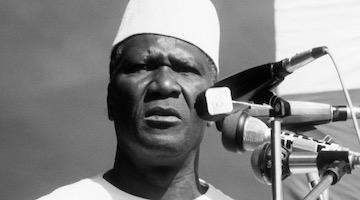 The ideology of Touréism combines aspects of Marxist – Leninist methodology with traditional African values.
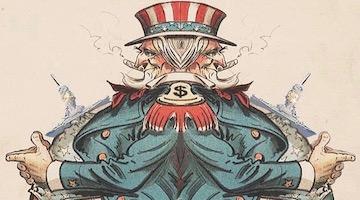 The US is currently attacking one-third of the planet’s population with 8,000 economic sanctions, ongoing acts of war against 39 nations.
 W.E.B. Du Bois’ classes at the radical school fixed Black Americans firmly within diasporic history and his vision for a socialist future.
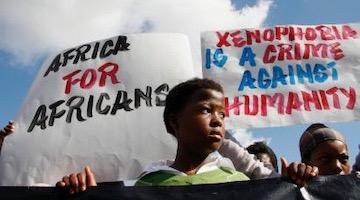 Sorrowing over the treatment of migrants, Achille Mbembe calls for Africa to adopt a pro-migration stance, phase out colonial borders and become “a vast space of circulation.”
 The ruling class has the capacity to manufacture and implement a coup or a domestic wave of political repression almost off-the-shelf.



