by BAR executive editor Glen Ford
The Pine Ridge, South Dakota, Oglala Sioux have convinced the U.S. Justice Department to re-examine 50 possible political killings, from the mid-Seventies, some of which are surely linked to the FBI’s infamous COINTELPRO. The program registered its biggest body count among African Americans, but Black Misleaders have made “no serious effort to exhume the full body of the program’s crimes, much less prosecute the guilty, or free the framed, or compensate the victims, or rewrite the lies of national history.”
Re-Open COINTELPRO Investigation: If the Sioux Can Seek Justice, Why Can’t Blacks?
A Black Agenda Radio commentary by Glen Ford
“Who among the Black Misleadership Class is demanding a reopening of COINTELPRO’s reign of terror in Black America?”
A U.S. Justice Department team will review the deaths of 50 Native Americans over the past 40 years, in what could amount to a re-examination of at least one theater of the FBI’s infamous secret war against U.S. radicals, including members of the American Indian Movement (AIM). The FBI’s counter-intelligence program, or COINTELPRO, has not been officially scrutinized since the Church Committee investigations of 1975-76. The impending Justice Department probe is the result of years of requests from members of the Oglala Sioux tribe to take a new look at scores of deaths that previous investigators had claimed were accidents or suicides, but which American Indian Movement members believe were related to political violence on the Pine Ridge reservation, including the 1973 federal siege of Wounded Knee in which two FBI agents also died. AIM member Leonard Peltier is serving a life sentence in those shootings. In the aftermath of its agents’ deaths, the FBI is reported to have “caused 542 separate charges to be filed against those it identified as key AIM leaders.”
AIM members have long maintained that many deaths that authorities attributed to accidents or suicides were actually murders committed by a tribal paramilitary force, abetted or covered up by the FBI and other federal lawmen. The FBI’s COINTELPRO specialized in instigating violence against – or fomenting deadly discord within – targeted organizations, scoring its highest body counts among AIM and the Black Panther Party, which FBI chief J. Edgar Hoover described as the number one threat to national security.
“COINTELPRO, has not been officially scrutinized since the Church Committee investigations of 1975-76.”
Had it not been for the perseverance of Oglala Sioux tribal leaders, there would be little hope of discovering the truth about political violence at Pine Ridge, and COINTELPRO’s role in the killings. But who among the Black Misleadership Class is demanding a reopening of COINTELPRO’s reign of terror in Black America? As the Jericho Movement has stated, “dozens of women and men are still incarcerated upwards of 40 years as a direct result of this heinous program.” Scores of Panthers were murdered directly by police, like Chicago Panther leader Fred Hampton; or in disputes instigated by the FBI, like the Los Angeles shootings of Bunchy Carter and John Huggins by the “US Organization.” The Party itself ultimately fell victim to internal discord – a methodical COINTELPRO campaign of destabilization that produced an unknown number casualties. The Church Committee told the world that COINTELPRO was real, not a figment of paranoid radical imaginations – but there has been no serious effort to exhume the full body of the program’s crimes, much less prosecute the guilty, or free the framed, or compensate the victims, or rewrite the lies of national history.
The Congressional Black Caucus, as a body, has repeatedly ignored appeals that they demand a real investigation of COINTELPRO’s massive official criminality. Most of these requests have been directed at Rep. John Conyers (D-MI) who, as chair or ranking member on the House Judiciary Committee, was the logical convener. But the closest the Caucus came to acknowledging the crimes of COINTELPRO was in Durban, South Africa, at the 2001 World Conference Against Racism, when Conyers and his Black Democratic colleagues Donna Christianson (VI), Eddie Bernice Johnson (TX), Barbara Lee (CA), Sheila Jackson Lee (TX), Diane Watson (CA), and Cynthia McKinney (GA) presented the study “COINTELPRO: The Untold American Story” to the UN High Commissioner for Human Rights. But Durban is far from Capitol Hill.
“The Caucus was more interested in creating an environment more conducive to Democratic electoral victories, than in justice.”
On her own, Congresswoman McKinney unsuccessfully introduced legislation, in 2006, to begin where the Church Committee left off and re-open the COINTELPRO investigation. (Rep. McKinney had held a forum on COINTELPRO at the CBC’s Legislative Weekend, in 2005.) Had the CBC deployed its collective prestige to hold a full-blown, official Caucus review of what was already known about COINTELPRO, even without subpoena power, it would have done its Black constituents, and the cause of truth, a real service. But the Caucus was more interested in creating an environment more conducive to Democratic electoral victories, than in justice.
As a result of the silence of the Black Misleadership Class, COINTELPRO still lives. From 2007 to 2009, the FBI coordinated a renewed persecution of aging Panthers in a case that became known as the San Francisco Eight, reviving charges that were nearly 36 years old.
The Oglala Sioux community was wracked by violence in the mid-Seventies, a period of terror and death fomented, in large part, by the FBI’s COINTELPRO. Yet, nearly 40 years later, Sioux leaders have compelled federal authorities to take a new look at the era’s ghastly events. The Pine Ridge Sioux have no congresspersons of their own, they number only about 20,000, and they cannot claim a U.S. president and attorney general among their ethnicity. But they have the courage to demand Truth of Power.
What’s wrong with Black America?
BAR executive editor Glen Ford can be contacted at Glen.Ford@BlackAgendaReport.com.

 In 1990, Lawrence Bell was 14, orphaned and living in an abandoned house when three Camden cops pressured him to sign a confession of murder.
 The US university is marked by the dominance of intellectual white liberalism in tension and complicity with conservative nationalism and neoliberalism.
 Alabama Communists helped lay the foundation for the organized civil rights movement that emerged in the late 1940s and early ’50s.
 Prison and police abolition were key to the thinking of many midcentury civil rights activists.
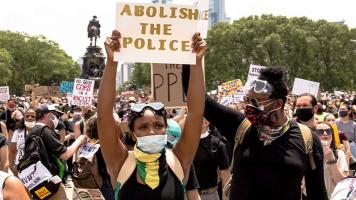 If there’s ever a time when a Reconstruction might actually lead to democratization and the end of American imperialism, this is the opportunity, says Robin D.G. Kelley.



