Ghettonation: A Journey Into
the Land of Bling and the Home of the Shameless
by Leah Samuel
"Daniels admits to identifying with and embracing Bill
Cosby's well-publicized rant about the black poor."
 This article originally appeared in The Progressive.
"Girl," Tarshel or I would begin, once the phone was
picked up, "I just saw the Ghetto Moment of the Day!" And the tale
would invariably be about a black, often young, person engaged in some socially
or professionally inappropriate or embarrassing act.
A woman at a shoe store yells into her cell phone, "She
pregnant again? By who?" Tarshel witnessed that one.
I overhear a young man standing in line at a store yelling
into his cell phone, "That nigger in jail again? I just bailed his ass
out!"
A man at a gas station tells another after a date,
"Man, I'm about to take this bitch home." Tarshel hears that one.
Tarshel is a librarian and a journalism instructor at a
two-year college with a mostly black student population. I am a reporter who
has covered poor neighborhoods and communities of color for 18 years. And to
arrive at these careers, we both had emerged from black childhoods in which
limited educational, social and economic opportunities were the norm.
"Daniels looks at the everyday, practical matter of
living in a racist culture."
Now comes Cora Daniels's Ghettonation: A Journey Into the
Land of Bling and the Home of the Shameless (Doubleday, 2007), which grew
out of her own experiences, observations, and analyses. Like Tarshel and me,
Daniels was born in the waning years of the civil rights movement after Martin
Luther King Jr.'s assassination. Daniels looks at the everyday, practical
matter of living in a racist culture and how difficult it is to resist internalizing
that racism.
Ghettonation is as plainspoken as its title,
identifying and addressing the practices and practitioners of
"ghetto," defined by Daniels as "actions that seem to go against
basic home training and common sense." She points out such actions in the
streets and in office suites, from New York to Hollywood and everywhere in
between.
She even starts us off with a history lesson on the word
"ghetto," from Italy to Jewish neighborhoods in Europe to the
blighted inner cities of the United States. From there, Daniels then brings us
to the current understanding of ghetto, as a noun and primarily, for the
purposes of the book, an adjective.
Daniels includes in her definition of ghetto the
"common misusage" of the term to mean: "authentic, black,
keepin' it real." She suggests that this way of thinking, by those inside
and outside America's ghettos, assumes that to be black means to live and think
in only one way - driven by poverty and the unwillingness to speak proper
English, among other things. Daniels points out that these are not, nor have
they ever been, the experiences of all black people.
Daniels notes that pop culture expects black performers,
writers and others to possess a stereotypical identity. She points to the case
of the late hip-hop artist Ol' Dirty Bastard, née Russell "Rusty"
Jones, who built his career on a biography that included welfare dependence and
an absent father, neither of which was true. "So in the name of selling
records," Daniels writes, "ODB takes on the character of a black man
who grew up on welfare with no daddy because the stereotype is easier for
buyers to digest than the reality. In reality, Rusty was the product of a
loving mom and pop in a close-knit traditional working-class household in
Brooklyn."
"Pop culture expects black performers, writers and others
to possess a stereotypical identity."
She then describes the mainstreaming of ghetto thinking and
behavior. As an illustration, she retells the tale of white author James Frey. A
Million Little Pieces, Frey's personal story of drug abuse, incarceration
and other markers of desperate street life turned out to be largely fictive. In
her view, Frey is just one of many celebrities ghettoizing themselves for
money. "Remember when folks used to lie their way up?" Daniels asks
incredulously. "Now folks are lying their way downward."
In one respect, the criticism of "ghetto" is
tricky in that it risks echoing conservative attitudes. Daniels tries to avoid
this, but it's an uneven effort.
For example, she indicts a tendency among the urban poor
toward parenthood before, or instead of, marriage. "I could have a
baby," she quotes one young man as saying, "but I don't think I could
ever get married." She is quick to note that efforts to promote marriage
among poor people, efforts that mostly scapegoat women, will not resolve issues
such as poverty and abuse, and that such "solutions" may indeed make
things worse. But sometimes Daniels' frustrations come with the taint of
classism, as when she lambastes a common "ghetto" attitude:
"Taking pride in being broke." But what, then, is the counter to
that? Shame in being poor? Somehow keeping one's poverty a secret?
"Sometimes Daniels' frustrations come with the taint of
classism."
Despite our being on welfare, going without food at times
and being evicted at least once, my single mother taught me and my four
siblings not to say we were poor. It was among many conditions we were
admonished not to "claim." This comes from a notion, found in many
religions, including my mother's fundamentalist Christianity, that to
"claim" something risked making it so. But it was also her response
to the shame of poverty.

I would argue that what Daniels derides as misplaced pride
is a deliberate, if overly defensive, act of resistance to the judgmental
shaming to which poor people are often subjected.
Daniels' book does little to address the underlying social
and political landscape on which ghetto takes root. And it clearly isn't meant
to. With little more than a nod to the broader, deeper issues ravaging poor
communities of color, she admits to identifying with and embracing Bill Cosby's
well-publicized rant about the black poor. In a couple of places, she seems to
be joking that the comedian had "lost his mind," but we can't be sure
if she is laughing at him or with him.
Daniels, educated in the Ivy League, knows what
it means to be granted access to the middle-class, mainstream world. And like
many of us, she straddles the line between that world and the dysfunctional one
in which she grew up. She laments that it can be a schizophrenic existence
("I am ghetto, and I am not ghetto"). Like Tarshel and me, she
understands the culture of the privileged and that of the not-so-lucky, and
she, like us, gets weary running back and forth over the line.

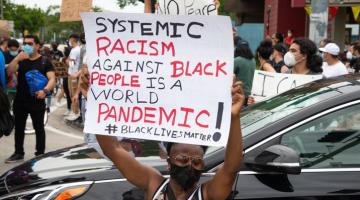 Systemic racism and reactionary violence are embedded into the foundation of the US political and social system, despite false claims of any sort of progress. Denying this reality is an act of mere…
 Western imperialist-backed paramilitary violence in Port-au-Prince, Haiti has escalated in the last year. As the conditions on the ground worsen, MOLEGHAF puts out this call to allies around the…
 The old world is dying once again, but the US-Israel axis is wrong to suggest it is slaying monsters. It is the monster.
 In St. James Parish, a zoning ordinance divides industrial development along racial lines.
 Yahya Sinwar was a man who became a larger-than-life symbol of Palestinian resistance and struggle. Myths and rumors surrounded him in life and now in death but he did not need anyone, friend or foe…


