Saint Bhutto, Devilish Musharraf and American Gangster
Politics
A Black Agenda Radio commentary by Glen Ford
"The former prime minister was a top-of-the-line
international crook - and so were her enemies in the Pakistan military."

The American corporate media have declared Benazir Bhutto an
instant saint - part of their daily revision of history. In fact, the former
prime minister was a top-of-the-line international crook right up to the moment
of her assassination, with corruption
and money-laundering cases pending against her in Spain, Britain, and
Switzerland. Copious documentation has been compiled of huge kickbacks from
selling Pakistani government contracts and monopoly trading rights to companies
in Poland, France and western Asia. Bhutto and her husband were world-class
kleptocrats - not democrats.
But then, her enemies in Pakistan's military are also crooks
- a thoroughly corrupted culture of millionaire majors, colonels and generals
who control whole sectors of the nation's horribly distorted economy. Like
Bhutto, the military treat government service as a license to steal. Unlike
civilians, however, the military have the muscle to maintain and expand their monopolies.
Much of that muscle has been provided by the United States.
Pakistan's birth in the partition of British India in 1947 coincides with the
start of the Cold War. The much larger, newly independent Indian government was
vaguely socialist and non-aligned in foreign policy - a cardinal sin in the
eyes of the United States. The U.S. saw Pakistan's military as an important
asset in keeping India off balance and to combat Soviet influence in south
Asia.
No sooner was Pakistan founded than a British Major General,
who was then Deputy Chief of Staff in the Pakistani Army, set up the Inter-Service-Intelligence
agency, the ISI, a huge network that combined the functions of the U.S.
CIA, military intelligence, and domestic security. The ISI is a military
state-within-a-state - a very convenient partner for American military and
intelligence objectives in the region. During those periods when Pakistan was
nominally ruled by civilians, the U.S. continued to rely directly on the ISI as
its geopolitical ally. When the military ruled directly, the state and the ISI
were one. This uniformed, criminal class methodically bullied itself deep into
the economy and infrastructure of the nation - rule by gangsters who were, in
turn, championed by the Americans as bastions of "stability" in Pakistan.
"As life-long gangsters, the Pakistani military
recognized that following Don Giorgio Bush's orders threatened their ‘family.'"
The American gangsters made great use of the Pakistani
gangsters. Pakistan was the rear base in the U.S. and Saudi
Arabian-financed jihad against the
Soviets in Afghanistan. Pakistan virtually invented the Taliban which, with no
discernable U.S. objection, took over Afghanistan in 1996. Benazir Bhutto was
then prime minister, and supported the Taliban's ascension to power. The Big
Gangster - Little Gangsters relationship between the U.S. and Pakistan's
military changed - like everything else - after the events of 9/11, which the
Bush regime perceived as an opportunity to become Supreme Gangster of the
Planet. The Pakistan military mafia, in the person of dictator Pervez
Musharraf, was threatened with being bombed "into the stone age" if it did not
turn on its Taliban children and, in effect, purge those sections of the
military that had given birth to the Taliban. Musharraf knew he could not do
this without destroying his own military mafia, but for six years he pretended
to try. As Bush's global offensive collapsed in Iraq and the Taliban rebounded
in Afghanistan, the Americans made Musharraf an offer that he - and/or his
military sub-gangsters - could not accept: share power with Benazir Bhutto, the
queen of civilian corruption and suddenly the darling of Washington. As
life-long gangsters, the Pakistani military recognized that following Don
Giorgio Bush's orders threatened their "family." So Bhutto had to go.
America rules like a gangster, favoring gangster clients
everywhere it goes. But gangsters all over the world know when they are being
set up, and they fight back. That's what happens when Washington becomes the
headquarters of a global Sopranoland.
For Black Agenda Radio, I'm Glen Ford.
BAR executive editor Glen Ford can be contacted
at Glen.Ford@BlackAgendaReport.com.

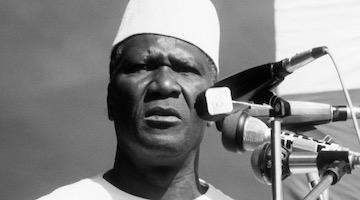 The ideology of Touréism combines aspects of Marxist – Leninist methodology with traditional African values.
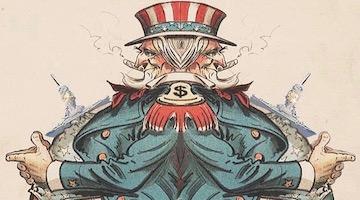 The US is currently attacking one-third of the planet’s population with 8,000 economic sanctions, ongoing acts of war against 39 nations.
 W.E.B. Du Bois’ classes at the radical school fixed Black Americans firmly within diasporic history and his vision for a socialist future.
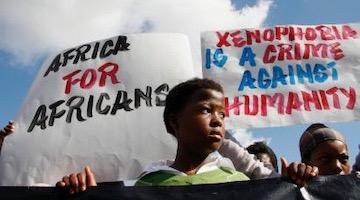 Sorrowing over the treatment of migrants, Achille Mbembe calls for Africa to adopt a pro-migration stance, phase out colonial borders and become “a vast space of circulation.”
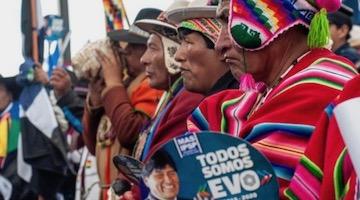 The ruling class has the capacity to manufacture and implement a coup or a domestic wave of political repression almost off-the-shelf.



