Some of white America's political elite are finally ready to speak openly of the failed and malevolent policies of Black mass incarceration. That's good news. But who speaks for the young, the black and the poor in this discussion? Presidential candidates? Democratic or Republican politicians? The Congressional Black Caucus and our Black leadership class? And without relentless pressure from a Black mass movement, can any of these actors be trusted to lead us anyplace different, to change much of anything?
Black Mass Incarceration is Now a Political Issue
by BAR managing editor Bruce Dixon
"The increase in the U.S. prison population wasn't really about crime. It was about how we chose to respond to crime."
On the issue of America's universal but seldom acknowledged policies of racially selective policing, racially selective prosecution and racially selective mass imprisonment, there's good news and there's bad news.
The good news is that members of America's political elite from both parties are finally admitting that mass imprisonment of the Black poor is bad public policy, is inherently unjust, and ought to be some kind of political issue. Many also concede that the remarkable expansion of and the alarming racial imbalance within America's prison population have nothing at all to do with rates of drug use or violent crime.
In a one-of-a-kind October 4 House and Senate Joint Committee hearing on the subject of mass incarceration, Virginia Senator Jim Webb (D) observed that the sevenfold growth of America's prison population over the last generation was, “only nominally related” to crime rates. It was a point so important he repeated it in his very next sentence, quoting a high Justice Department official as saying that the increase in US prison population since 1975 “...wasn't really about crime. It was about how we chose to respond to crime.”
It's good news that politicians are willing at last to discuss the costs to Black families and communities of mass imprisonment of the Black poor.
"For every 1,000 crimes America now locks up five times as many people as it did in 1975."
The bad news is that many are inclined to blame the black poor themselves, directing attention away from the corporations who profit from the growth of the prison state, the politicians who built careers selling it to us, and the edifice of white American culture which fundamentally defines itself as the opposite in every way of its poor, unworthy, and now dangerous Black citizens.
As Berkeley's Loïc Wacquant observed at Stanford University’s Tanner Lectures earlier this year, (Audio available free at itunes.stanford.edu) it's not unequal educational opportunities in Black communities that are feeding the prisons, joblessness, or the absence of two parent or the lack of suitable peer networks. Most of those indicators have been relatively stable for generations. In the mid 1960s, white men were the majority of American prisoners, and crime has remained relatively stable since then. But for every 1,000 crimes America now locks up five times as many people as it did in 1975. Most of that increase, as we all know, has been Black and poor.
In every era, Blacks have been viewed as apart, inferior and unworthy, as fringe players in the American narrative. But in the last 35 years the Black communities have been stripped of jobs, seen their poor isolated, resegregated, and redefined as unworthy and inherently dangerous. Government, the state itself has been refashioned into a punitive and carceral machine whose main function is to contain and control this unworthy, dishonored and dangerous poor and black population.
Physical isolation of the Black poor enables racially selective policing, prosecution and imprisonment without the need of special laws explicitly targeting blacks. And white America’s sense of itself as profoundly unlike and distinct from the Black and unworthy poor, along with the silence of our Black leadership class, make it politically possible.
It’s high time mass incarceration of the young Black poor is put on the political front burner and kept there till something changes. That's what Jena was about. It’s time for a new mass movement in our Black communities that will expose the complicit silence of Black leadership on mass Black imprisonment, one that will begin to make continuation of these unjust public policies impossible.
For Black Agenda Radio, I'm Bruce Dixon.
Bruce Dixon can be contacted at Bruce.Dixon@BlackAgendaReport.com.
To listen to or download this Black Agenda Radio commentary, click on the mic at right.

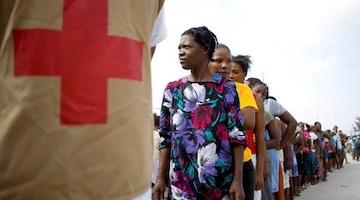 Much of the money sent to help Haiti ended up being spent on western citizens at the expense of Haitian suffering.
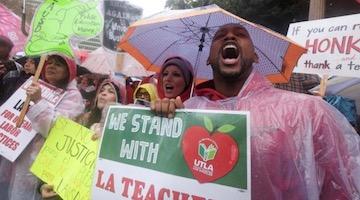 The LA teachers strike was a tale of two competing antiracist visions — one upheld by privatizing billionaires and another pushed by working people.
 Brown body writhing in orange flames; scents of burning hair and flesh—so, how do you say Lynching in Spanish? Torched clinics were hollowed out shells without medicines and
 MLK Fought for Workers’ Rights
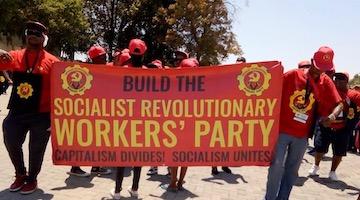 Irvin Jim, leader of South Africa’s largest union, told a People’s Forum audience in New York City that the newly formed Socialist Revolutionary Workers Party is not “another refor



