by Dr. Jared A. Ball, Ph.D. & Communications Fellow
Given the societal need and function of mass media and popular culture, all that is popular is fraudulent. Popularity is in almost every case an intentionally constructed fabrication of what it claims to represent. Too few who comment on the lamentable condition of today’s popular hip-hop seem to grasp this, the political nature of the nation’s media system, nor the political function that system serves. Hip-hop is often taken out of the existing context of political struggle, repression, or the primacy of a domestic/neo-colonialism in the service of which mass media play a (the?) leading role. Media, often incorrectly defined by their technologies, are the primary conduits of ideology or worldview and must be seen as such. Therefore, their highly consolidated ownership and content management structure (corporate interlocking boards of directors, advertisers, stockholders, etc.) cannot be understood absent their ability to disseminate a consciousness they themselves sanction and mass produce. Nowhere is this more clearly demonstrable than in hip-hop.Like mass media and popular culture, hip-hop too is often removed from its proper context as the cultural expression of a domestically-held internal colony otherwise known as Black America. The colonialism that prefigures its creation and subsequent popularity is too often absent from popular discussion of hip-hop and as such leads to confused analyses and a tremendous amount of inaction surrounding the issues involved. I use the term colonialism simply to draw attention to the systemic (i.e. intentional) maltreatment of a majority of those considered “citizens,” and to the particular form that this maltreatment takes regarding North America’s Black/African internal colony. By this I mean that the basic tenets of a colonial relationship remain intact for Black people in the United States. That is:
1) Black people remain held in spatially distinct communities, neighborhoods, projects, etc. where they,
2) form the basis of this country’s source of cheap labor and,
3) raw materials – which include cultural expression and, specifically, hip-hop.
That is, held intentionally in poverty so as to create conditions of desperation, Black people must then sell their labor cheaply and/or be willing to conform themselves to the needs and will of an elite in order to “succeed.” Hip-hop, like every other cultural expression generated from this community, has over the last twenty years been grafted to this structural need to systematically produce what is conducive to this system’s survival. This is quite natural and understandable and would only be confusing were this not the case.
The pervasiveness of self/community-directed violence, misogyny, conspicuous consumption, product placement promotion, and general lack of ingenuity in popular hip-hop is the aforementioned specific systemic need produced systematically via its media representative, in this case, the music industry. Understood properly we would note that corporations are themselves legal entities that give sanction and anonymity to those involved in the process of protecting the ruling elite. Therefore, their ability to sign (via contract), promote, disseminate, etc. the cultural expression of the colonized allows them to determine the direction or content in most popular hip-hop.
The tremendous amount of hip-hop created that does not suit this political need, which again is primary, is simply omitted. And without this current analysis, even our brightest thinkers ignorantly suggest, as did Michael Eric Dyson recently on Paula Zahn’s CNN special on the subject, that to be successful (i.e. “popular”) politically conscious artists need “better beats.” This precludes the continuing power struggle which necessitates both the maintenance of the Black colony, but also a specific image of that colony to be imposed on the country and world. In other words, there can be no popular representation of the colonized that does not reflect a justification or omission of their colonized status. It is the status of a neo-colony that needs changing, not the beats used by those expressing a desire for something different.
Zbigniew Brzezinski, in defense of this system, explained this reality quite clearly when writing in The Grand Chessboard (1997) that what will separate the United States as an empire from those of the past is this nation’s control over “international communication and popular entertainment.” Media today are more pervasive, powerful, and capable of the maintenance of colonialism than at any other time in world history. This is the result of the intentional and concomitant rise of both mass media technology and their consolidated ownership in the hands of the world’s only true “minority” elite: white men. Fewer people, almost all exclusively within the same self-identified racial, class, and gendered interest group, have a greater ability today than at any other time to produce a global consciousness conducive to their interests. Hence my earlier statement about the inherent fraudulence of popular culture. In a society where culture is used as a primary component or mechanism of social control, that which becomes “pop culture” is fraudulent in that it is forced, as Fanon has explained, to “testify against” its creators and to serve those able to determine its reach or societal penetration. Rarely is what we know of as “popular” the initial intention of the culture or individual from which that expression comes. Most often what is the final product is what is decidedly different than what its creator initially set out to make and is more than likely no longer in their own best interest.
While much of what is made popular in hip-hop glorifies the impoverished conditions out of which the cultural expression emerges, little has changed regarding those fundamental colonial conditions. In the thirty years of hip-hop’s ascendance and its annual generation of billions of dollars, the fundamental relationship between that population and the greater society remains intact. Hip-hop’s popularity has done nothing to improve Black America’s overall wealth, education, health-care, or certainly rates of imprisonment. In fact, the popularity of hip-hop is used to deny these conditions or explain them as natural to the conditions of African America. It is not to the people that these conditions are natural but, instead, to the condition of being colonized. Popular media and, therefore, hip-hop cannot be changed prior to a societal shift (revolution) in who holds power and how that power is to be wielded.
In future columns I will detail the historical shift in hip-hop, the corporate/industrial mechanism, detailing how the final product is shaped to these political needs and offer detailed strategies and current movements/artists whose work is in assertive resistance to this neocolonial condition.
Also posted at the Green Institute.
Dr. Jared A. Ball is an assistant professor of communication studies at Morgan State University. He is editor-at- large of the Journal of Hip-Hop and Global Culture from Words, Beats and Life and hosts Jazz & Justice Mondays 1-3p EST on DC’s WPFW 89.3 FM Pacifica Radio. Ball is also the founder and creator of FreeMix Radio: The Original Mixtape Radio Show, a hip-hop mixtape committed to the practice of underground emancipatory journalism. He is currently working on his first book Hip-Hop as Mass Media: The Mixtape and Emancipatory Journalism and can be found online at voxunion.com.

 The perfect storm of austerity policies and US imperialism sends billions of dollars to Ukraine but ends pandemic era emergency Supplemental Nutrition Assistance Program (SNAP) benefits.
 The practice of accepting observers to oversee elections is quite problematic. This practice leads to interference from entities with ulterior motives and legacies of colonial control.
 This week we hear about the absence of home rule in Washington DC and the congressional and white house decision to overturn its city council’s criminal statutes, and the Chicago community’s…
 The Black Agenda Report team are deeply saddened to learn of the passing of Kevin Alexander Gray, who was a Black Agenda Report contributor, an author, and a longtime activist from South Carolina.
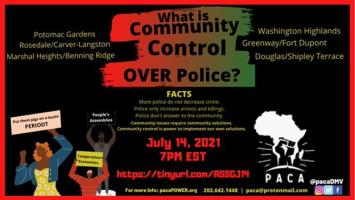 Netfa Freeman is an organizer with Pan African Community Action based in Washington DC, which is working on a campaign for community control over the police.


