by Anthony Monteiro
At last, a song for an unsung heroine of the Freedom Movement. Pam Africa is the irresistible force and immovable object of the movement to free Mumia Abu Jamal. “She fought several of Mumia's lawyers whose liberalism and belief in the system inhibited their capacity to fight for his freedom and to see the possibilities of connecting what goes on in the courts to what goes on in the streets.” Mumia’s live exit from death row “would have been impossible without the movement and without Pam Africa herself.”
All Praise and Revolutionary Homage to Pam Africa: Our Daughter of the Dust
by Anthony Monteiro
“Her accomplishments in fierce battles against police repression, mass incarceration and the death penalty are unsurpassed and in the heroic tradition of the Black Panther Party.”
It's about time AfroAmerica recognized Pam Africa as the great freedom fighter, organizer and Civil Rights heroine that she is. No one has contributed more to the struggle to free Mumia Abu Jamal than she, or worked more consistently and tirelessly than she. No one has more consistently rallied Mumia's supporters worldwide to his defense. Pam Africa by all accounts is a force to be dealt with, a person the ruling class and white supremacists cannot underestimate. As a strategist and tactician of struggle she cannot be taken lightly. She is a modern day Civil Rights icon on par with the likes of Fred Shuttlesworth and Ralph Abernathy, both of whom were leaders of the Montgomery, Birmingham and other civil rights campaigns in the South. As a fearless organizer she is the equal of Diane Nash and Ella Baker of the Student Nonviolent Coordinating Committee and Fannie Lou Hamer of the Mississippi Freedom Democratic Party. Her accomplishments in fierce battles against police repression, mass incarceration and the death penalty are unsurpassed and in the heroic tradition of the Black Panther Party.
“She preceded by at least two decades Michelle Alexander's recognition of the racist prison industrial complex and the centrality of the death penalty to it.”
Pam believed when others doubted that Mumia was innocent and that we could win his release from death row. She is convinced we will win his complete freedom. She stood up to Philadelphia's dreaded and fascist Fraternal Order of Police. She fought several Philadelphia Mayors, District Attorneys, especially the lethal and racist Lynn Abraham (called by the New York Times in 1995 the nation's "most deadly DA" because of the numbers of Blacks and Latinos she put on death row) and at least four Pennsylvania Governors. She fought, cajoled and ultimately won over a good part of the Philadelphia Black establishment. Pam brought moral critique upon Black preachers because of their refusal to condemn the unjust imprisonment of Mumia, as they preached what passed for the Christian doctrine of justice and the sanctity of life. In the course of fighting civil rights leaders and politicians she redefined the civil rights struggle in the so-called post civil rights era. She preceded by at least two decades Michelle Alexander's recognition of the racist prison industrial complex and the centrality of the death penalty to it. She faced off against that part of the white anti-death penalty movement who wanted to exclude Mumia from their campaigns and not acknowledge the death penalty's racist essence and its roots in slavery and lynchings of Black folk.
“In the course of fighting civil rights leaders and politicians she redefined the civil rights struggle in the so-called post civil rights era.”
Pam is a self identified revolutionary holding no regard, respect or trust in the existing legal and governmental systems or bourgeois institutions – period. She is a humble woman who seldom when talking about the movement uses the "I", but always refers to the "we". It's always what "we" have done, or what Mumia said. Never what "I" did or what "I" said. She fought several of Mumia's lawyers whose liberalism and belief in the system inhibited their capacity to fight for his freedom and to see the possibilities of connecting what goes on in the courts to what goes on in the streets.
Most Black preachers, intellectuals, politicians and civil rights leaders are invested in keeping leaders and fighters like Pam Africa unknown to the people and their contributions unrecognized. It seems that to recognize Pam is to draw attention to what they have not done and in fact their ties to the establishments they claim to be fighting. The other thing is, Pam Africa doesn't fit the image they have of African American leaders. She's not a Christian; she follows the teachings of her murdered and prophetic leader John Africa. She believes in life, all life, and not God. The other thing, she's a freedom fighter in a time when too many of us think we're free. Pam Africa is a mother, grandmother and great grandmother. While white media-recognized and -appointed Black leaders' world views and strategies of struggle are based on the lesser of evils among white folk and the mantras of gradual reform and "git in where you fit in," Pam's world view begins with the belief that evil is evil is evil and that evil in all its forms has to be fought.
“Pam is a self identified revolutionary holding no regard, respect or trust in the existing legal and governmental systems or bourgeois institutions – period.”
They say she's not ready to come into the circles of leadership. She's just too radical, too outside the mainstream, too loud, she curses too much, she doesn't straighten her hair, she doesn't dress right, eat right or live in the right neighborhood. She's not part of petty bourgeois and professional networks, clubs and associations. However, the breadth and significance of her life and work is a judgment upon their narrowness and hypocrisy. She has led a movement that has won a victory few thought possible, getting Mumia off death row and having his death penalty overturned. This legal victory would have been impossible without the movement and without Pam Africa herself. Consider the tragic fate of Troy Anthony Davis and Shaka Sankofa to name just two who were executed although they were innocent.
Overturning Mumia's death penalty might be the signature civil rights victory in several decades. However, the epic struggle to win his complete victory and overturn the system of mass incarceration continues and Pam continues in the vanguard of this struggle. She is a tribute to the Black proletariat of North Philadelphia where she and Mumia's roots are (Mumia grew up and was socialized and experienced his rites of passage in that part of Philly called the "Original Tenderlines") and where her hatred of injustice was nourished. She is a tribute to the revolutionary leaders and movements that emerged from the Civil Rights and Black Power Movements. Pam Africa is a figure that history must and will recognize; increasingly the world acknowledges this daughter of the Black working masses. Pam has never betrayed her roots in Black Philadelphia as she has become an international leader in the fight for human rights. Hopefully, in the not too distant future, her own people and the city and nation where she was born will also acknowledge her as a great human rights and civil rights leader.
ALL PRAISE AND GRATITUDE TO PAM AFRICA, OUR REVOLUTIONARY DAUGHTER OF THE DUST.
Pam Africa is leader of International Concerned Family and Friends of Mumia Abu-Jamal (ICFFMAJ), where she can be contacted at ICFFMAJ@aol.com.
Tony Monteiro is a veteran political activist and a professor of African American Studies at Temple University, in Philadelphia. He can be contacted at tmon(at)Comcast.net.

 A pamphlet written 70 years ago by an exiled Black American communist reveals an African continent seething to break free from European colonization.
 The real story of the Rwandan genocide begins in 1990, when exiled Tutsis from Uganda invaded northern Rwanda, unleashing a deadly campaign that uprooted a million Hutu peasants and set ethnic tens
 Northeast, midwest, southwest, south, down south, up south, out south—south of the Canadian border—Slouched down in his cruiser, slow-rollin’ the ‘hood; Or a-
 The new Democratic administration seems determined to sabotage an agreement to end the “longest war.”
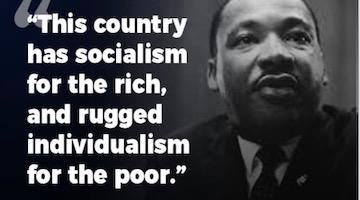 King explicitly linked the value of human dignity to the material conditions necessary to enable people to live a decent life.



