by BAR executive editor Glen Ford
The Occupy Wall Street movement faces challenges of relevance, and permanence, that must be addressed this winter. Most importantly, and like all American social movements, it must come to grips with the overarching issue of race. “Black people require that white-dominated movements offer the hope of specific impacts on the African American condition.” Opportunities abound, especially in the nation’s Harlems. “As economic and racial targets of Wall Street’s predations, Black city-dwellers are the natural allies of Occupy Wall Street. They need to be convinced, through substantive and ongoing collaboration, that OWS is an ally of theirs.”
The Occupy Movement, Gentrification and Black America’s Ancient Struggle
by BAR executive editor Glen Ford
“If there is any piece of ground where an anti-Wall Street movement should stand and fight, it’s Harlem.”
The “Occupy” brand is a hit, having embedded its “99%” emblem in the popular consciousness like no other political slogan of the past two generations. And, no wonder. Among the movement’s core non-leaders are the skilled counter-corporate-culturalists of Adbusters magazine, the Canada-based outfit that turns the instruments of mass commercial marketing against their capitalist inventors. Occupy Wall Street flipped the script on the historical subordination of the Many by the Few by symbolically purging the 1% from the righteous community of the rest of us. In hardly the time it takes to “Flick my BIC” – the phenomenally catchy slogan of a classic 1970s ad campaign – Occupy Wall Street has become what some are calling the most significant social movement since the Sixties.
Only time can validate that assessment, and we shall see if there is still magic in the invocation of the “99%” in the spring and summer. One thing is certain: Occupy can only fulfill its promise to build on the contributions of previous movements if it decisively confronts the overarching issue of race, the Great Contradiction at the heart of American life and history that has always thwarted the development of an enduring Left movement.
“Occupy can only fulfill its promise to build on the contributions of previous movements if it decisively confronts the overarching issue of race.”
The ultimate measure of Occupy’s capacity to combat white supremacy and privilege, is the degree to which the movement is seen as relevant to people of color – especially Black America, historically the nation’s most dependably progressive constituency and the group situated at the bottom of the economic heap in the current crisis. Black activists and the general African American public are keenly aware that OWS’s essential whiteness was key to its success in establishing encampments of borderline legality, and to the relatively favorable press coverage the movement has garnered. It is axiomatic that immediate and massive police repression would have been deployed to crush any such initiative by Blacks and browns.
White privilege is, of course, a fundamental fact of life in the United States, and understood as such by virtually every inner city Black child above a certain age, although the beneficiaries of privilege are most often blissfully unaware that they belong to a protected class. In the main, Blacks do not hold the existence of white privilege against Euro-Americans that engage in social struggle – indeed, white activists are often admired for risking their privileges. However, Black people do require that white-dominated movements offer the hope of specific impacts on the African American condition. We have learned through bitter and repetitive experience that campaigns advertised as serving the “common good” are no more to be trusted than the racially flawed slogan, “A rising tide lifts all boats.”
The Occupy movement’s “99%” mantra seems inclusive on its face, but can also subsume the aspirations and grievances of the darker constituencies within the super-majority. Therefore, Blacks are compelled to interrogate the movement’s relevance to their own conditions, including gross racial imbalances in relationships of power. At every juncture of the movement’s development, African Americans must be substantively assured of OWS’s relevance to them.
“The Occupy movement’s '99%' mantra seems inclusive on its face, but can also subsume the aspirations and grievances of the darker constituencies within the super-majority.”
The vocabulary of Occupy, with its constant references to building “new communities” based on new “values,” can be unsettling to a people whose own, older communities are under siege by gentrification, Wall Street’s quintessential crime against Black population centers. Those of us involved with Occupy Harlem (on Twitter @occupyharlemnow) place the highest priority on ensuring that our people can continue to occupy these historic spaces in northern Manhattan, in numbers sufficient to allow them to shape their own political destinies. The battle against Wall Street is most vicious, and for the highest stakes, in the Harlems of the nation, where finance capital attempts to disperse whole populations to artificially inflate the value of corporate assets in housing and land. If there is any piece of ground where an anti-Wall Street movement should stand and fight, it’s Harlem.
Resistance to inner city gentrification is primarily a battle for renter’s rights. Harlem is overwhelmingly renter-occupied, as are most central city Black communities in the U.S. – virtually all of whom are under gentrifying pressures, or soon will be. As economic and racial targets of Wall Street’s predations, Black city-dwellers are the natural allies of Occupy Wall Street. They need to be convinced, through substantive and ongoing collaboration, that OWS is an ally of theirs.
At three months of age, it is essential that the Occupy movement demonstrate that it is a permanent feature on the political landscape, not a flash in the pan. African Americans are acutely aware that they can never “retire” from the struggle, as relatively privileged social justice activists might have the option of doing. The most rewarding relationship that OWS could forge with Black Harlem and all the Harlems of the United States, is by committing its human and material resources to the struggle to ensure that besieged African American communities are made permanent, viable, self-determining centers in the battle against the rule of money.
BAR executive editor Glen Ford can be contacted at Glen.Ford@BlackAgendaReport.com.

 The Yemeni attack involved dozens of ballistic missiles and drones, targeting sites from which Saudi warplanes took off to strike Yemen.
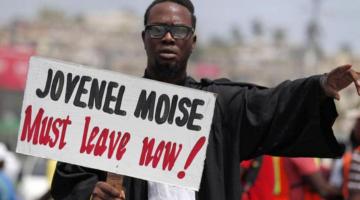 Responsibility for Haiti's deteriorating conditions does not rest on the Haitian masses. A population does not rise up spontaneously but depends on political movements and organizations to build it.
 The AfD's landslide in Saxony-Anhalt reflects real working-class anger at the war and the arms buildup, but the party redirects that anger toward migrants and leaves the capitalist system that caused…
 “DHS needs to be dismantled and held accountable for this complete inhumanity,” said Rep. Pramila Jayapal.
 In this week’s segment, we discuss the 55th anniversary and legacy of the 1971 Attica prison revolt. But we begin with the history of W.E.B. Du Bois and his struggle against the domestic repression…


