by Sikivu Hutchinson
To hear white institutions tell it, Black non-theists have nothing important to say about the human condition. But, in fact, “Black secular humanist critical inquiry stretches back to Frederick Douglass's era to the Harlem Renaissance and into the 1960s Black Power movement.” Such thinkers have been central to “a tradition of Black liberation struggle against white supremacy.”
Black Scholarship, Non-Theism and Radical Politics: Where are the Writers?
by Sikivu Hutchinson
“The dominant culture and mainstream media often act as though Black intellectual traditions don’t exist.”
When I began researching my book Moral Combat: Black Atheists, Gender Politics and the Values Wars in 2009 I was interested in discovering what other Black writers had published on the intersection of non-theism, feminism, and Black liberation. Historically, Black writers and scholars have been marginalized by what might be dubbed the To Kill a Mockingbird or The Help effect, i.e., that all-American phenomenon wherein a white writer playing cultural anthropologist on domestic safari travels to the ‘‘hood” to capture some aspect of Black lived experience and garners international acclaim and legitimacy denied Black writers publishing on similar topics. Commenting on this theme in her book Talking Back, bell hooks’ contends that, “Until the work of Black writers and scholars is given respect and serious consideration, this overvaluation of work done by whites, which usually exists in a context wherein work done by Blacks is devalued, helps maintain racism and white-supremacist attitudes.”
While scholarship on Black non-theist traditions is not as extensive as it is in other areas of Black cultural production, a robust, if still emergent, body of work does exist. Early on in my research I read and was enlightened by the work of Anthony Pinn, Norm Allen, and Donald Barbera. Pinn and Allen framed their scholarship within the context of early-to-late twentieth century African American humanist social thought; Barbera assailed the hypocrisy of the Black Church vis-à-vis contemporary mores. Pinn and Allen delineated the rich heritage of Black humanist literature and criticism espoused by thinkers like James Baldwin, Langston Hughes, Frederick Douglass, Nella Larsen, Hubert Harrison, James Forman, and Zora Neale Hurston. These writers challenged the racist, sexist, classist foundations of American democracy, citizenship, and human rights. A majority adopted radical postures on Black humanist thought, connecting it to a tradition of Black liberation struggle against white supremacy. Critical inquiry into non-belief and humanist intellectual discourse was positioned as a vital part of Black identity, culture, and political resistance.
“These writers challenged the racist, sexist, classist foundations of American democracy, citizenship, and human rights.”
So, honoring radical Black scholarship in marginalized areas of Black cultural production is important because the dominant culture and mainstream media often act as though Black intellectual traditions don’t exist. Emily Brennan’s recent New York Times article on Black atheists is a prime example. The article highlighted the challenges of coming out as an atheist articulated by Black non-believers like Mark Hatcher, founder of Howard University’s Secular Students Alliance, and Ronelle Adams, author of the children’s book Aching and Praying . Although it was heartening to see mainstream coverage of Black atheists, the article situates Black non-belief in a historical vacuum whilst egregiously ignoring contemporary Black non-theist discourse and scholarship. Evoking the now familiar theme of Black atheist alienation from hyper-religious Black culture, there is no reference to research or scholarship that might situate this dynamic within a broader sociological or political context. Rather, Brennan makes the totalizing claim that Blacks are “seeking a public intellectual of their own,” ala rock star white male authors Richard Dawkins, Sam Harris, and Christopher Hitchens. To underscore this “deficit,” the article trots out physicist Neil De Grasse Tyson, an agnostic who has made it crystal clear that he doesn’t want to be known as “the Black” anything.
“It is crucial that black secular scholarship goes beyond the current fixation with online groups, You Tube videos, and conferences.”
It is inconceivable that analysis of the global influence of atheism would omit the work of Dawkins, et al. and their reverence for scientism. By kicking Black scholarship to the curb the Times managed to give the false impression that Black non-theism isn’t grounded in a legacy of intellectual tradition or public discourse with a distinctly political lineage. In point of fact, Black secular humanist critical inquiry stretches back to Frederick Douglass's era to the Harlem Renaissance and into the 1960s Black Power movement. It is critical to an understanding of how race is made in the white supremacist United States, as well as to the relationship between capitalist exploitation and faith-based heterosexism. And what is perhaps most pronounced about the growing visibility of Black atheists is how it has coincided with the re-emergence of a virulent white nationalism steeped in theocratic control and hyper-religiosity. There is a dearth of scholarship on this phenomenon. So as black economic disenfranchisement in the so-called Occupy era deepens, it is crucial that black secular scholarship goes beyond the current fixation with online groups, You Tube videos, and conferences to document on-the-ground social justice organizing exemplified by multi-talented activists, organizers and intellectuals like Mandisa L. Thomas and Kimberly Veal of the Black Non-Believers of Atlanta and Chicago, Naima Washington of Washington Secular Humanists, author Donald Wright of the Houston Humanists and Alix Jules of the Dallas Coalition of Reason.
In the wake of continued attacks on “secular progressives” by Uncle Tom Christian fascists like lay minister Herman Cain and charlatans like Bill O’Reilly and Newt Gingrich, African American radical secular discourse and activism are all the more urgent. If Black non-theism is to have any teeth or traction beyond the white-dominated secular movement it must return to its radical roots and ethos of struggle.
Sikivu Hutchinson is the author of Moral Combat: Black Atheists, Gender Politics, and the Values Wars and founder of Black Skeptics Los Angeles.

 “...the science for revolutionary change…is forged by human persuasion and building social consciousness based on the class analysis which sees the struggle against racism as central.”
 Symone Sanders interview with Hasan Piker exposed her as a bad-faith interlocutor who uses identity as a cudgel while remaining silent on the poverty, pollution, and police violence that plague the…
 The U.S. extradition request for Fergie Chambers is an attempt to use Spanish courts to extend a domestic repression campaign against political opposition.
 The demand to call out alleged crimes in Iran or Cuba while those countries face annihilation from the U.S. and Israel is a refusal to see those people as human beings worthy of protection.
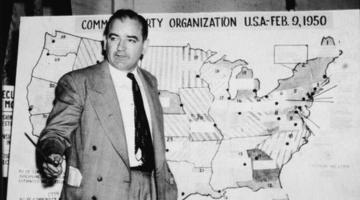 Red Scares are a recurring feature of the U.S. political tradition aimed at criminalizing anticapitalist politics through accusations of foreign infiltration and conspiracy. The NSPM-7 and the report…


