by BAR editor and senior columnist Margaret Kimberley
Do Black women and Black men have problems forging stable marriages in American society? Solution: Black women should seek partners outside the race, says the author of a new, “useless and perhaps dangerous” book. Author Ralph Richard Banks is also sexist and classist, focusing primarily on the marriage prospects of upwardly mobile Black women, to the exclusion of Black men and less affluent African American females. One thing Banks can’t come to grips with: “Black Americans have lower rates of marriage and higher rates of family breakups because of racism.”
Freedom Rider: Is Marriage for White People?
by BAR editor and senior columnist Margaret Kimberley
“All of the indices of terrible impacts on the health of black families are boiled down to hand wringing about a large number of doomed spinsters.”
Is marriage for white people? That is the title of a recently published book, which analyzes the human and economic consequences of persistently low marriage rates in the black community.
Black family life has been under siege from the moment the first enslaved Africans arrived on these shores. Two centuries of slavery, Jim Crow segregation, mass incarceration and now a hyper capitalist economy which makes workers irrelevant, have all conspired to make black people less able to form stable family units. The issue is a serious one that deserves discussion, but the way that author Ralph Richard Banks and others frame it is fairly useless and perhaps dangerous as well.
Banks and other observers focus on statistics that indicate most black women may never marry, marrying at less than half the rate of their white counterparts. He focuses on the relative success of black women in comparison with their male counterparts, which prevents them from marrying men of similar backgrounds. Banks concludes that the solution to black female singleness is for more women to marry outside of their racial group, thereby easing the pressure to seek a smaller number of eligible men.
“The way that author Ralph Richard Banks and others frame the issue is fairly useless and perhaps dangerous as well.”
Banks’ analysis and solution are disappointing to say the least. All of the indices of terrible impacts on the health of black families are boiled down to hand wringing about a large number of doomed spinsters. Simply put, black Americans have lower rates of marriage and higher rates of family break ups because of racism. Workplace discrimination and an ever expanding system of mass incarceration have made it difficult if not impossible for women and men who want marriage and children to have them both.
Is Marriage for White People? makes important points, but then devolves into concern for the plight of unmarried women only, and in particular, those who are college educated.
It is not just educated black women who suffer from a lack of marriageable men. Black women of all educational and economic levels do as well. Surely blue collar women deserve as much as attention as their better educated and higher income peers, but they get little of it in the latest conversations about black family life.
Not only does Banks’ argument show a class bias, but it is sexist as well. By focusing primarily on women, Banks ignores the problems faced by black men that result in low rates of marriage. They are likewise disappointed in their abilities to form stable families. He doesn’t acknowledge the pain and frustration they experience when they miss out on the traditional family life which many of them would like to experience.
“Surely blue collar women deserve as much as attention as their better educated and higher income peers.”
Marriage rates are no different from all of the other negative indices for black people in this country today. They are symptoms of a system which constantly perfects the ways in which black people are excluded from being citizens in the truest sense of that word. Banks admits as much and concedes his omission in a Time magazine interview. “I certainly may not have given enough weight in the book to issues of racism and the criminal justice system or educational policies or employer discrimination, but these topics are for my next book.”
While we should eagerly await that book, Banks reveals an important reason for his reluctance to get to the heart of the matter in his current work. “I consciously chose to sidestep issues of racism because they tend to be conversation-stoppers.” True enough. The R word can stop some in their tracks, but that is hardly a reason to leave it out of the conversation.
America has always been in deep denial about racism, even as it finds new and more efficient ways to practice it. There is little doubt that Banks would be given less credence and consideration if he were to discuss how racism continues to destroy black lives, but that has always been the burden of the truth teller.
“Banks ignores the problems faced by black men that result in low rates of marriage.”
If we are going to be outraged because educated women are going without husbands, we should certainly find it within ourselves to be angry about workplace discrimination and the destruction of the public education system. It is far easier to be outraged about the symptom of our society’s injustices than it is to be outraged about the injustices themselves. Expressing that anger means confronting the powerful and as Banks concedes, risking derision and exclusion.
Black people are in very deep trouble in this country, and the difficulty of forming healthy families is but one indicator of the crisis. There is a great deal to be angry about, and we should leave no stones unturned if that crisis is ever to find a resolution.
Margaret Kimberley's Freedom Rider column appears weekly in BAR, and is widely reprinted elsewhere. She maintains a frequently updated blog as well as at http://freedomrider.blogspot.com. Ms. Kimberley lives in New York City, and can be reached via e-Mail at Margaret.Kimberley(at)BlackAgandaReport.com.

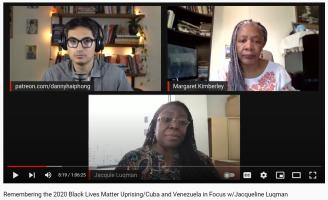 Journalist and activist Jacqueline Luqman joins the Left Lens to discuss the two year anniversary of the BLM uprisings and her recent trips to Cuba and Venezuela.
 The UK sends asylum seekers to Rwanda, the number of police killings in the U.S. continue unabated, and the Democratic Republic of Congo is threatened by U.S. client states and comprador, neo-…
 The United Kingdom is paying the Rwandan government $150 million to accept asylum seekers. The UK is accelerating deportations and denial of legal rights to Global South immigrants. Fiona of the…
 Police killings continue at a rate of more than 1,000 per year in the U.S., with 2022 numbers outpacing those of 2021. Sam Simyangwe of Mapping Police Violence provides analysis of the death toll and…
 The Democratic Republic of Congo lives under threat of attack from neighboring U.S. client states Rwanda and Uganda. Its neo-colonial leadership acts on the direction of Washington and Europe.…


