How We Fuel Africa's Bloodiest War
by Johann Hari
This article originally appeared in Independent UK.
"Rwandan business interests make a fortune from the mines they illegally seized during the war."
The deadliest war since Adolf Hitler marched across Europe is starting again -- and you are almost certainly carrying a blood-soaked chunk of the slaughter in your pocket. When we glance at the holocaust in Congo, with 5.4 million dead, the clichés of Africa reporting tumble out: this is a "tribal conflict" in "the Heart of Darkness." It isn't. The United Nations investigation found it was a war led by "armies of business" to seize the metals that make our 21st-century society zing and bling. The war in Congo is a war about you.
Every day I think about the people I met in the war zones of eastern Congo when I reported from there. The wards were filled with women who had been gang-raped by the militias and shot in the vagina. The battalions of child soldiers -- drugged, dazed 13-year-olds who had been made to kill members of their own families so they couldn't try to escape and go home. But oddly, as I watch the war starting again on CNN, I find myself thinking about a woman I met who had, by Congolese standards, not suffered in extremis.
I was driving back to Goma from a diamond mine one day when my car got a puncture. As I waited for it to be fixed, I stood by the roadside and watched the great trails of women who stagger along every road in eastern Congo, carrying all their belongings on their backs in mighty crippling heaps. I stopped a 27-year-old woman called Marie-Jean Bisimwa, who had four little children toddling along beside her. She told me she was lucky. Yes, her village had been burned out. Yes, she had lost her husband somewhere in the chaos. Yes, her sister had been raped and gone insane. But she and her kids were alive.
"It is a war led by ‘armies of business' to seize metals."
I gave her a lift, and it was only after a few hours of chat along on cratered roads that I noticed there was something strange about Marie-Jean's children. They were slumped forward, their gazes fixed in front of them. They didn't look around, or speak, or smile. "I haven't ever been able to feed them," she said. "Because of the war."
Their brains hadn't developed; they never would now. "Will they get better?" she asked. I left her in a village on the outskirts of Goma, and her kids stumbled after her, expressionless.
There are two stories about how this war began -- the official story, and the true story. The official story is that after the Rwandan genocide, the Hutu mass murderers fled across the border into Congo. The Rwandan government chased after them. But it's a lie. How do we know? The Rwandan government didn't go to where the Hutu genocidaires were, at least not at first. They went to where Congo's natural resources were -- and began to pillage them. They even told their troops to work with any Hutus they came across. Congo is the richest country in the world for gold, diamonds, coltan, cassiterite, and more. Everybody wanted a slice -- so six other countries invaded.
These resources were not being stolen to for use in Africa. They were seized so they could be sold on to us. The more we bought, the more the invaders stole -- and slaughtered. The rise of mobile phones caused a surge in deaths, because the coltan they contain is found primarily in Congo. The UN named the international corporations it believed were involved: Anglo-America, Standard Chartered Bank, De Beers and more than 100 others. (They all deny the charges.) But instead of stopping these corporations, our governments demanded that the UN stop criticizing them.
"They went to where Congo's natural resources were -- and began to pillage them."
There were times when the fighting flagged. In 2003, a peace deal was finally brokered by the UN and the international armies withdrew. Many continued to work via proxy militias -- but the carnage waned somewhat. Until now. As with the first war, there is a cover-story, and the truth. A Congolese militia leader called Laurent Nkunda -- backed by Rwanda -- claims he needs to protect the local Tutsi population from the same Hutu genocidaires who have been hiding out in the jungles of eastern Congo since 1994. That's why he is seizing Congolese military bases and is poised to march on Goma.
It is a lie. François Grignon, Africa Director of the International Crisis Group, tells me the truth: "Nkunda is being funded by Rwandan businessmen so they can retain control of the mines in North Kivu. This is the absolute core of the conflict. What we are seeing now is beneficiaries of the illegal war economy fighting to maintain their right to exploit."
At the moment, Rwandan business interests make a fortune from the mines they illegally seized during the war. The global coltan price has collapsed, so now they focus hungrily on cassiterite, which is used to make tin cans and other consumer disposables. As the war began to wane, they faced losing their control to the elected Congolese government -- so they have given it another bloody kick-start.
"We need to build an international system that values the lives of black people more than it values profit."
Yet the debate about Congo in the West -- when it exists at all -- focuses on our inability to provide a decent bandage, without mentioning that we are causing the wound. It's true the 17,000 UN forces in the country are abysmally failing to protect the civilian population, and urgently need to be super-charged. But it is even more important to stop fuelling the war in the first place by buying blood-soaked natural resources. Nkunda only has enough guns and grenades to take on the Congolese army and the UN because we buy his loot. We need to prosecute the corporations buying them for abetting crimes against humanity, and introduce a global coltan-tax to pay for a substantial peacekeeping force. To get there, we need to build an international system that values the lives of black people more than it values profit.
Somewhere out there -- lost in the great global heist of Congo's resources -- are Marie-Jean and her children, limping along the road once more, carrying everything they own on their backs. They will probably never use a coltan-filled mobile phone, a cassiterite-smelted can of beans, or a gold necklace -- but they may yet die for one.
To save the lives of the victims of Congo's sexual violence, you can donate money here.

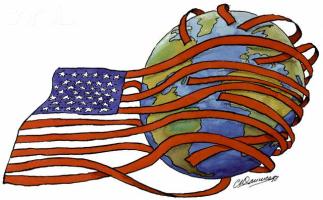 The U.S. reprises Iraq, inventing a WMD threat from Syria. The FBI concocts home-grown terror through stings, while the NSA claims it has secretly saved many lives. “Why this steady stream of…
 An essay by the late Glen Ford recounts the perverse origin story of the twisted life and lies of Clarence Thomas.
 As the late Glen Ford said, the Black misleadership class has no shame. Congresswoman Karen Bass's campaign for mayor of Los Angeles is full of empty promises. She proposes nothing that would…
 The Black misleaders have been busy selling out Black people for half a century, but are still only barely tolerated by the rich man’s Democratic Party and its racist figurehead, Joe Biden.