Odetta is a legendary figure who is almost unknown to the masses of the American people. However, her place in African American and American history is secure. Odetta and Mahalia Jackson were among the few women on stage at the 1963 March on Washington. Dr. Martin Luther King introduced her and she performed "We Shall Overcome." She was the first guest on David Letterman's show after September 11, 2001, the "The Day the World Changed."
Born on December 31, 1930, Odetta is a singer, actress, guitarist, songwriter, is often referred to as "The Voice of the Civil Rights Movement." She grew up in Los Angeles, California, and studied music at Los Angeles City College. Her musical repertoire consists largely of American folk music, blues, jazz, and spirituals. An important figure in the American folk music revival of the 1950s and '60s, she was a formative influence on dozens of artists, including Bob Dylan, Joan Baez, and Janis Joplin.
She performed October 24-25 at the Hugh's Room in Toronto for two sold out performances. . Accompanied only by Radoslav Lorkovic, a pianist who has played with her for the last two years, she performed 12 songs. She opened her set with the anti-apartheid anthem "(Something Inside) So Strong," written by Labi Siffre.
It was released as a single in 1987 and was the song that brought him back to mainstream popularity in his home country England. It was also used in the John Pilger documentary "The War on Democracy."
Her second song was "Sometimes I Feel Like a Motherless Child" (or simply "Motherless Child"), a traditional Negro spiritual. The song dates back to the era of slavery in the United States when it was common practice to sell children of slaves away from their parents. An early performance of the song dates back to the 1870s by the Fisk Jubilee Singers. The Fisk Jubilee Singers first took Black Music to Europe in 1883. Odetta brought the song to life and it was indeed a tear jerker.
She then turned to "This Little Light of Mine," a gospel children's song written in 1920. Often thought of as a Negro spiritual, it does not, however, appear in any collection of jubilee or plantation songs from the nineteenth century. The song takes its theme from Mathew 5:16, "Let your light shine before men, that they may see your fine works and give glory to your Father who is in the heaven:"
Under the influence of Zilphia Horton, Fannie Lou Hamer and others it eventually became a Civil Rights anthem in the 1950s and 1960s. The music of Odetta is and has been a weapon in the struggle for the liberation of Africans and all oppressed people.
A recording of the song by Paul Robeson can be heard in Sidney Lumet's 1983 film, "Daniel," Sam Cooke also recorded it on his "Sam Cooke Live at the Copa album."
Odetta also dealt with matters of the heart and performed "Careless Love/ St. Louis Blues " which was followed by "You Don't Know My Mind."
She paid tribute to the great Leadbelly (Huddie Ledbetter), by performing a number of songs written or made famous the legendary Louisiana born singer/songwriter. One of Leadbelly's most popular songs, "Bourgeois Blues," a song that has been covered by Pete Seeger, Ry Cooder, Taj Mahal,Toronto's own Faith Nolan and was reworked by Billy Braggs as "Bush War Blues." She performed "Alabama Bound," "Boll Weevil Blues," "Roberta" " Rock Island Line" and a song sung by Leadbelly" and others
"The House of the Rising Sun."
"Bourgeois Blues" was written after Leadbelly went to Washington, D.C. at the request of Alan Lomax, to record a number of songs for the Library of Congress. After they had finished, they decided to go out with their wives to celebrate, but were thrown out of numerous establishments for being an interracial party.
The song rails against racism, classism and discrimination in general, with such verses as "The home of the Brave /The land of the Free / I don't wanna be mistreated by no bourgeoisie."
Leadbelly recorded "Bourgeois Blues" numerous times, first on December 26, 1938, accompanied by himself on his 12-string guitar. It should be noted that in all but the earliest recording of the song, the original line "Some white folk in Washington, they know just how, call a colored man a nigger just to see him bow" was altered to "give a colored man a nickel just to see him bow," presumably to avoid causing offense.
Odetta also addressed the health issue and pointed out that health is a social /political matter. "The "T. B. Blues" is related to the Bessie Smith song "The Rich Man, Poor Man Blues" "In a capitalist environment money is necessary for your physical and mental health... ‘
She closed the show with the "The House of the Rising Sun", which tells of a life gone wrong in New Orleans. The most famous version was recorded by the English rock group, The Animals, in 1964, which was a number one hit in the United States, United Kingdom, Sweden and Canada.
As I stated in the beginning of this piece, Odetta's place in history is secure. Dr. King pointed out by in 1961by proclaiming her "The Queen of American folk music." And poet Maya Angelou once said, "If only one could be sure that every 50 years a voice and a soul like Odetta's would come along, the centuries would pass so quickly and painlessly we would hardly recognize time."
Norman Richmond is a Toronto-based writer/broadcaster/human rights
activist. Richmond can be heard on CKLN-FM 88.1 www.ckln.fm Thursday's on
Diasporic Music 8pm to 10pm and Saturday's on Saturday Morning Live 10am
to 1pm He can be reached norman@ckln.fm

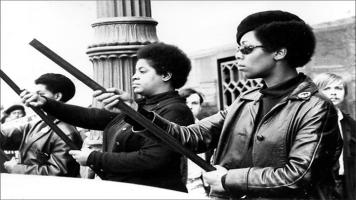 This week’s featured scholar is Adam Bledsoe. Bledsoe is Assistant Professor of Geography at the University of Minnesota. His article “Neither Ground on Which to Stand, nor Self to Defend: The…
 "Abolition" is the word of the moment. But what does it mean? How should it be taught? Robert Sirvent and Sarah Abdelaziz discuss.
 Roberto Clemente was one of the all-time great baseball players and one of the best in a long line of Afro-Latinos. He also acted in solidarity with people around the world, which ironically led to…
 The U.S. brokered Abraham Accords normalized relations between Israel and some Persian Gul Arab regimes. But Israel discovered at the recent World Cup that the Arab masses are still in solidarity…
 The Dominican Republic continues to abuse its Haitian descended population. The Haitian-Dominican Women's Movement (MUDHA) was recently raided by government agents.


