
by Marsha Coleman-Adebayo, Ph.D and Kevin Berends
Dr. Martin Luther King was a whistle-blower for justice. In contrast, Barack Obama has been more aggressive in punishing whistle-blowers than his predecessors. “Is it likely that the administration that recently announced psychologists, psychiatrists and sociologists will be deployed throughout the federal bureaucracy to ferret out potential whistleblowers would treat Dr. King any differently than it has treated Julian Assange?”
Obama and MLK: The Clear Contrast
by Marsha Coleman-Adebayo, Ph.D and Kevin Berends
“Dr. King was rooted in the deep traditions and followed the heroic trajectory of a whistleblower.”
Early on one could imagine the new president's embarrassment at receiving the Nobel Peace prize with so little to show in tangible accomplishment beyond his having spoken against the authorization of attacking Iraq and his later rhetorical flourishes while campaigning for the presidency. His pledge of withdrawing U.S. forces from Iraq was thus consistent with his early position and could be seen as reason to consider Barack Obama a peace candidate. His other rhetorical accomplishment—advocating fighting the good fight in Afghanistan and effectively countering the appearance of being soft on terror—was canonized in his acceptance speech for the Nobel. In it, the argument for a just war, a reasoned approach to armed conflict served as a euphemism for the slaughter of innocents. Even granting that this unpalatable certainty may not have been known at the time of Mr. Obama's acceptance speech there is no hiding now from the grim tallies in both Iraq and Afghanistan after nearly a decade of the good war. During WWI 75% of the casualties were military personnel but the trend toward civilian casualties has steadily increased so that now the numbers are inverse. The vast majority of casualties are civilians with women and children bearing the brunt of modern warfare.
As the nation honors another Nobel Peace laureate—Dr. Martin Luther King, Jr., and celebrates his birthday—it would be prudent and wise for us to compare and contrast the fruits these two trees will be known by.
“Obama’s argument for a just war served as a euphemism for the slaughter of innocents.
To start we would do well to remember that Dr. King had a dream and a nightmare. We are all familiar with the dream, its aspirations, the lofty biblical phrasings. But the nightmare, as King expressed it in his 'Beyond Vietnam” speech, bears the signature earmarks all whistleblowers come to know. Isolation, discrimination and retaliation were tactics well known to Dr. King, having spend many nights alone in jail, having faced the onslaught of dogs and clubs and having received the harshest in retaliation on a fateful balcony in Memphis.
Beyond his spiritual and moral guidance Dr. King was rooted in the deep traditions and followed the heroic trajectory of a whistleblower, sounding his clarion not from under a bucket but from the rooftops. He linked the killing of brown people abroad in Vietnam to the persecution of black people at home. Still he found his own beloved community reluctant to follow his call for peace born of justice.
Without laying blame as to their origins let's denote some of Mr. Obama's fruits by inference of what Dr. King's response likely would have been to them. What do we think Martin Luther King would have thought of drone strikes killing innocents? What may we reasonably assume his response to extra-judicial, executive branch ordered executions of American citizens abroad? Is it likely that Dr. King would have looked the other way over verified instances of U.S. government-sanctioned torture?
“What do we think Martin Luther King would have thought of drone strikes killing innocents?”
Conversely, what could we expect of the Obama administration in reaction to a challenge to its policies from a hypothetical Dr. Martin Luther King? Is it likely that the administration that recently announced psychologists, psychiatrists and sociologists will be deployed throughout the federal bureaucracy to ferret out potential whistleblowers would treat Dr. King any differently than it has treated Julian Assange? Is it even plausible that the administration that has taken a conscientious whistleblower who allegedly leaked classified evidence of American atrocities in Iraq and subjected him to likely personality-destroying solitary confinement for seven months would have treated a Southern Christian Leadership Conference founder any less tyrannically? Can any of those memorializing Dr. King today seriously believe that Martin would have said of the blatant criminality of the preceding government that it was time to move forward without bringing the guilty to justice? Or what would Dr. King say about a government that delays justice for decades for Black farmers and then refuses to fire a single discriminator under the pretext that it is time to move on. And finally what would King say about a president that received 99.9% of the black vote but has now invited into his inner chambers two former heads of agencies that were notorious for their mistreatment treatment of African-Americans, the EPA under Carol Browner and the Department of Commerce under William Daley. In fact, before Daley, a J. P. Morgan executive could accept this new appointment he had the unenviable task of shedding $7.6 million worth of stock in the bank, according to a regulatory filing.
“This President prefers to mimic the style of the great peacemaker while ignoring the demands of King's principles.”
Rather it is far more likely that an 82 year old Martin Luther King would have approached the Nobel committee with much sadness and little fanfare when he returned his Peace Prize because he could no longer in good conscience subscribe to the broadening definitions of peace and peacemakers that the current President's acceptance speech endorsed. This President prefers instead to mimic the style of the great peacemaker while ignoring the demands of King's principles. In the process of remembering our peacemakers, particularly today, the President needs to make a choice between style and substance.
Marsha Coleman-Adebayo, Ph.D, is Chairwoman of the No FEAR Coalition and author of the up-coming book, No FEAR: A Whistleblowers Story of Corruption, Betrayal and Retaliation at the EPA. Kevin Berends is Director of Communication, No FEAR Institute, co-founder of Lake Affect Magazine and producer of the independent television program streetlevel.

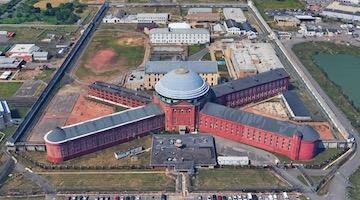 In 1990, Lawrence Bell was 14, orphaned and living in an abandoned house when three Camden cops pressured him to sign a confession of murder.
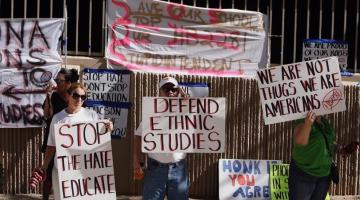 The US university is marked by the dominance of intellectual white liberalism in tension and complicity with conservative nationalism and neoliberalism.
 Alabama Communists helped lay the foundation for the organized civil rights movement that emerged in the late 1940s and early ’50s.
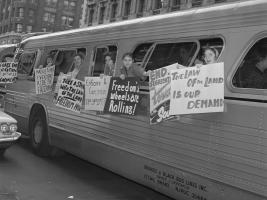 Prison and police abolition were key to the thinking of many midcentury civil rights activists.
 If there’s ever a time when a Reconstruction might actually lead to democratization and the end of American imperialism, this is the opportunity, says Robin D.G. Kelley.



